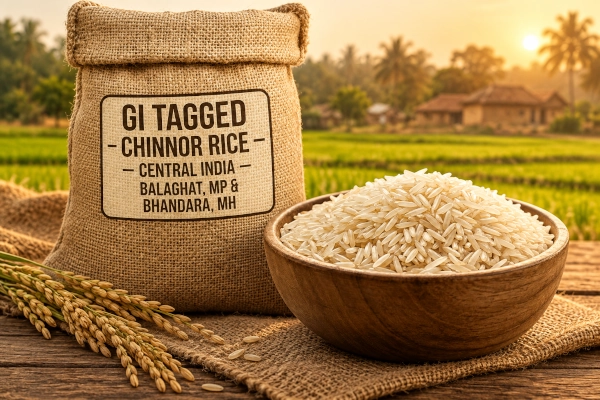
Among Maharashtra’s traditional aromatic rice varieties, Bhandara Chinoor Rice occupies a distinctive place. Cultivated in the eastern Vidarbha region, particularly across Bhandara district, this indigenous rice is valued for its characteristic fragrance, pleasant taste and cooking quality. Its association with the region is sufficiently strong that the Geographical Indications Registry has recognised Bhandara Chinoor Rice as a protected agricultural product of Maharashtra.
Bhandara is often described as the “Rice Bowl of Maharashtra” because of the importance of paddy cultivation to its agricultural economy. The district administration lists Chinnor, Dubhraj and Kalikammod among the aromatic rice cultivars traditionally grown in the region, while the Maharashtra Groundwater Surveys and Development Agency similarly identifies Chinnor among Bhandara’s established rice varieties.
The Rice Country of Bhandara
Bhandara district lies in eastern Maharashtra, adjoining Madhya Pradesh and forming part of the fertile agricultural landscape associated with the Wainganga River basin. Paddy fields are a defining feature of the district, supported by its rainfall pattern, extensive water resources and numerous lakes and irrigation systems.
The district contains seven talukas — Bhandara, Pauni, Tumsar, Mohadi, Sakoli, Lakhani and Lakhandur — and rice cultivation extends across much of this landscape. Chinoor has traditionally been grown within this wider paddy belt and is particularly associated with farming communities that preserved aromatic local varieties even as higher-yielding modern cultivars became increasingly common.
The region’s close relationship with rice extends beyond cultivation. Bhandara has a substantial network of small rice mills and processing enterprises, allowing paddy grown in the district to move through local milling, grading and marketing systems. Under the One District One Product initiative, rice has consequently been identified as one of Bhandara’s principal products.
A Traditional Aromatic Rice
Bhandara Chinoor belongs to the broad family of non-Basmati aromatic rice varieties preserved in central and eastern India. Its appeal comes primarily from its aroma, cooking quality and the sensory character of the cooked grain rather than from exceptionally long grain size.
The rice is generally described as having a pleasant fragrance that becomes particularly noticeable during cooking. Its grains cook into a tender rice while retaining sufficient firmness, helping it avoid becoming excessively sticky when properly prepared. The combination of aroma, texture and flavour has traditionally made Chinoor suitable for meals in which the natural character of the rice itself is intended to remain noticeable.
Like several traditional aromatic varieties, Chinoor illustrates that India’s premium rice heritage extends far beyond Basmati. Different ecological regions evolved their own locally preferred fragrant cultivars, many of which were maintained by farmers because of their eating quality even when their agricultural yields were lower than those of modern varieties.
What Makes Bhandara Chinoor Distinctive
The fragrance of aromatic rice is associated with a complex mixture of volatile compounds, with 2-acetyl-1-pyrroline, commonly abbreviated as 2AP, being especially important in the characteristic aroma of many fragrant rice varieties.
Bhandara Chinoor is valued for a combination of aroma, white grains, pleasant taste and favourable cooked texture. Available descriptions of the GI product characterise it as a medium-grain aromatic rice that remains relatively firm after cooking and exhibits useful grain elongation.
Its distinctive identity, however, does not depend on a single physical characteristic. The GI recognition reflects the relationship between the variety and its traditional production environment in Bhandara. Seed selection, local cultivation practices, soil and climatic conditions, water availability and generations of farmer experience together contribute to the reputation associated with the rice.
Generations of Cultivation
Chinoor is not a recently introduced speciality crop. Historical accounts cited in documentation surrounding the variety indicate that rice known as Chinoor or Chinnor has been associated with Bhandara for well over a century. References to the variety have been traced to nineteenth-century descriptions of Indian rice races, indicating that the name had already acquired a regional identity during the colonial period.
Its survival into the modern era reflects the role played by farming families in conserving traditional seed. Such varieties frequently face competition from newer cultivars offering greater yield, shorter duration or easier mechanised production. Farmers nevertheless continue to grow them where consumer demand for aroma and taste provides sufficient economic incentive.
The GI recognition therefore protects more than a commercial name. It formally acknowledges an agricultural tradition maintained through generations of cultivation and seed preservation.
From Paddy Field to Plate
Chinoor is appreciated primarily as a table rice. Its fragrance allows comparatively simple preparations to showcase the grain without requiring heavy seasoning. It can accompany lentils, vegetable preparations, curries and traditional Maharashtrian meals, while its aromatic character also lends itself to festive rice dishes.
Good aromatic rice is often judged as much by what happens in the cooking vessel as by the appearance of the uncooked grain. As the rice heats, its fragrance becomes more pronounced, while careful cooking allows the grains to retain their structure.
This sensory quality historically gave aromatic varieties a special place in household consumption. They were often reserved for guests, celebrations or meals where flavour and aroma were considered more important than obtaining the maximum possible yield from a field.
Bhandara Chinoor and Balaghat Chinnor
An important distinction must be made between Bhandara Chinoor Rice of Maharashtra and Balaghat Chinnor Rice of Madhya Pradesh. The two regions lie close to one another geographically, and related Chinnor rice traditions occur on both sides of the Maharashtra–Madhya Pradesh boundary.
They nevertheless hold separate geographical identities. The GI registered for Maharashtra is specifically Bhandara Chinoor Rice, tied to the production area and producer organisation identified in its own GI registration. The existence of closely related rice across a modern state boundary demonstrates how older agricultural landscapes frequently predate contemporary administrative borders.
GI protection in such cases is especially useful because it identifies the geographical origin attached to a particular registered name rather than implying that every similarly named grain belongs to the same protected product.
Preserving an Indigenous Rice Heritage
Traditional rice diversity across India was created through centuries of farmer selection. Different communities maintained varieties suited to local rainfall, soils, water conditions, culinary habits and cultural preferences.
The expansion of modern high-yielding varieties greatly increased rice production but also reduced the area devoted to many regional landraces. Aromatic cultivars such as Chinoor therefore represent an important component of agricultural biodiversity.
Their continued cultivation preserves genetic resources as well as culinary heritage. Regional aromatic rice can also provide farmers with an opportunity to compete on quality and identity rather than volume alone, particularly when GI recognition, traceability, appropriate packaging and direct marketing allow consumers to distinguish genuine regional produce from generic rice.
A Product of Maharashtra’s Rice Bowl
Bhandara’s agricultural identity is unusually closely tied to paddy. The district government describes the region as Maharashtra’s Rice Bowl and has identified rice as a major focus of its One District One Product programme. Efforts under the initiative have included support for organic production clusters, processing facilities, packaging, marketing and export promotion.
A network of roughly 243 rice mills, mostly micro-scale units, has also been associated with the district’s rice-processing cluster. Such infrastructure is important for traditional speciality varieties because their value can be lost if harvesting, milling, storage or packaging does not preserve grain quality and aroma.
For Bhandara Chinoor, therefore, GI protection forms only one part of a wider opportunity. The long-term value of the product will depend on maintaining genuine seed, ensuring quality, developing reliable traceability and creating markets willing to pay for its regional identity.
The GI Journey
The official Geographical Indications Registry records the product under the name Bhandara Chinoor Rice. The application was submitted by the Bhandara Chinoor Dhan Utpadak Sangh, based at Asgaon in Pauni taluka of Bhandara district.
Geographical Indication: Bhandara Chinoor Rice
GI Application Number: 688
Category: Agricultural
Class: 31
State: Maharashtra
Applicant / Registered Proprietor: Bhandara Chinoor Dhan Utpadak Sangh
Applicant Location: Asgaon, Pauni Taluka, Bhandara District
Date of Filing: 1 May 2020
GI Journal: No. 158
Journal Availability Date: 15 July 2022
Certificate Number: 485
Certificate Date: 1 July 2023
Registration Valid Until: 30 April 2030
The GI registration gives the name a legally recognised geographical identity and provides a framework through which authorised producers can distinguish genuine Bhandara Chinoor from rice originating elsewhere.
Why the GI Recognition Matters
For a traditional crop such as Chinoor, GI recognition can help convert regional reputation into economic value. Consumers increasingly seek food products whose origin, cultivation history and distinctive qualities can be traced to a particular landscape.
The GI gives Bhandara’s farmers a collective identity around which branding, premium marketing and specialised distribution can develop. It also creates an incentive to preserve the traditional variety rather than replacing it entirely with generic high-yielding rice.
The National Portal’s One District One Product platform now identifies Bhandara Chinoor Rice as a GI-tagged product of Bhandara, reflecting its emergence as one of the district’s recognised agricultural identities.
A Fragrant Grain Carrying Bhandara’s Identity
Bhandara Chinoor Rice represents the intimate relationship between a crop and the landscape that sustained it. Its aroma and cooking qualities made it valuable to generations of consumers, while farmers across Bhandara kept the variety alive through repeated cultivation and seed selection.
Its GI recognition in 2023 gave that inherited reputation formal legal protection. Today, the grain stands alongside India’s growing collection of geographically protected traditional rice varieties, demonstrating the extraordinary diversity hidden within what may otherwise appear to be a single staple crop.
For Bhandara, Chinoor is more than another variety of rice. It is a fragrant expression of the Wainganga plains, Maharashtra’s rice-growing traditions and the agricultural knowledge preserved by generations of local farmers.
You may also like
-
India Approves Accession to Southern Indian Ocean Fisheries Agreement, Expanding High-Seas Fishing Opportunities
-
India’s Trout Production Grows Sixfold as Himalayan Coldwater Aquaculture Expands
-
Indian Health-Tech Startup Kubo Care Develops Radar-Based Technology for Elderly Care
-
Indian Startup Pramatra Space Develops Chip-Based Quantum Security for Space and Ground Networks
-
India Develops First Riverine Lighthouses on Brahmaputra to Strengthen Inland Waterway Navigation
