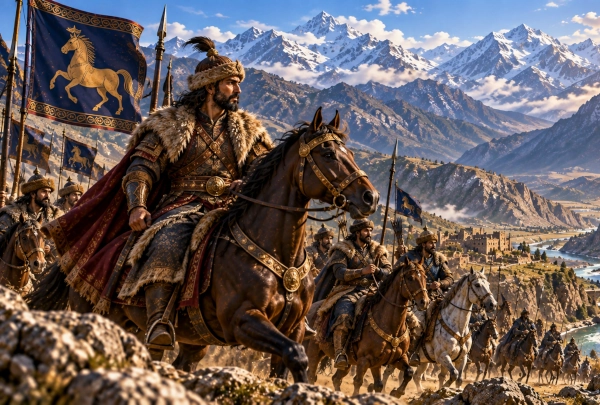
Among the great northwestern peoples of the Mahabharata, Kamboja occupied one of the most distant and strategically important regions known to the epic tradition. Its people lived along the frontier where the northwestern approaches of ancient Bharat met the Iranian and Central Asian worlds, in a mountainous country associated broadly with eastern and northeastern Afghanistan, the Hindu Kush approaches and adjoining parts of northwestern Pakistan. Some reconstructions extend the wider Kamboja sphere northwards towards Badakhshan and the Pamirs, potentially reaching areas now within southern Tajikistan, although this northern extension is considerably less certain than the Afghan identification.
Kamboja was particularly renowned for its horses and cavalry traditions. The Mahabharata repeatedly refers to Kamboja horses as prized animals, while Kamboja rulers and warriors appear during Arjuna’s northern conquest, Yudhishthira’s Rajasuya and the Kurukshetra War. Their most prominent warrior in the conflict was King Sudakshina, who joined Duryodhana with a powerful army and eventually fell in single combat against Arjuna.
Modern scholarship also gives Kamboja unusual importance because its population appears to have belonged to the ancient Indo-Iranian frontier world. Encyclopaedia Iranica describes the Kambojas as a southeastern Iranian people living at the extreme northeastern edge of the Iranian-speaking world, along the northern Indo-Iranian frontier.
The Mountain Country of Kamboja
The precise boundaries of ancient Kamboja remain debated, but the geographical evidence consistently points towards the northwestern frontier beyond Gandhara, particularly the regions associated with eastern Afghanistan and the mountain approaches around Kabul, Kapisa and the Hindu Kush.
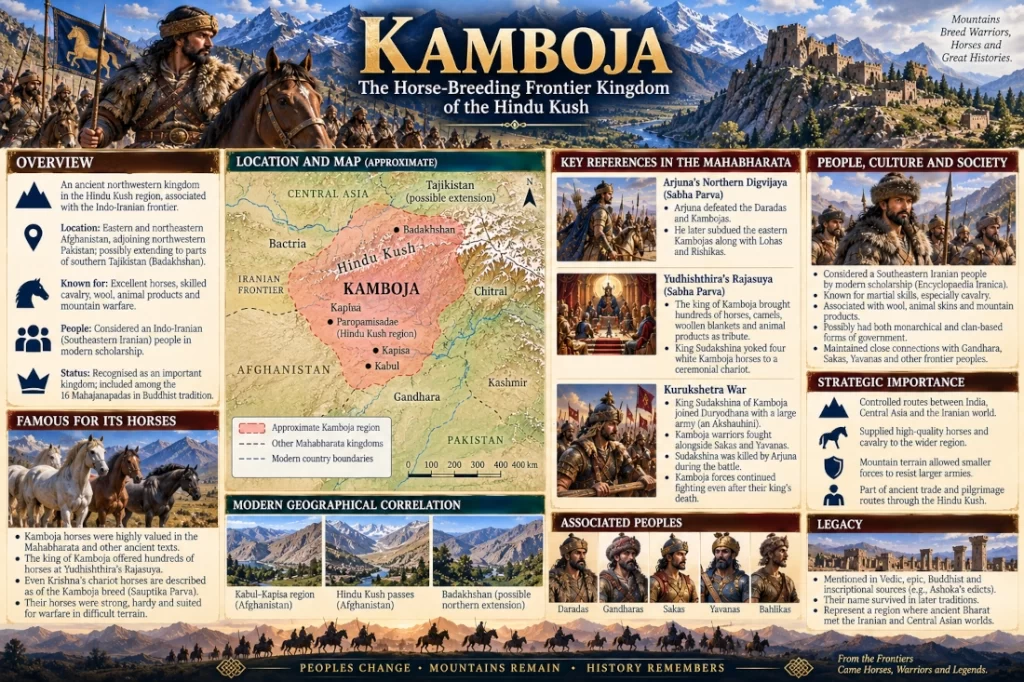
It is important to note that “Hindu Kush” is a modern geographical shorthand when discussing the epic period. The mountain range itself is ancient, but Encyclopaedia Iranica notes that the name Hindu Kush appears much later in historical sources. The ancient Kambojas would therefore not have described their homeland using that medieval geographical name.
The physical landscape consists of enormous mountain ridges separated by narrow valleys, river corridors and cultivable basins. South of the main range lie the valleys leading towards Kabul, Kapisa, Kunar and Gandhara. Northwards lie Badakhshan and the approaches towards the Pamirs and Bactria.
These valleys formed some of the principal routes connecting the Indian subcontinent with Bactria and Central Asia. Mountain passes were difficult, but they were not barriers in the absolute sense. For centuries merchants, armies, herders and migrants moved through them. Iranica notes that important long-distance routes crossed the Hindu Kush between the Kabul region and the territories farther north.
Kamboja’s geographical position therefore helps explain almost every characteristic attributed to it in ancient literature: skilled horsemen, valuable horses, woollen products, connections with Iranian peoples and frequent association with Gandharas, Yavanas, Sakas and Bahlikas.
An Indo-Iranian Frontier People
Kamboja is particularly interesting because ancient Indian sources appear to preserve evidence that its people spoke a language different from the Indo-Aryan languages of the Gangetic heartland.
The name appears in late Vedic linguistic tradition. Yaska’s Nirukta records that a particular verb was used specifically among the Kambojas, suggesting that their speech was already recognised as distinctive. Encyclopaedia Iranica interprets the available linguistic and historical evidence as indicating that the Kambojas belonged to the southeastern Iranian branch of the wider Iranian world.
That does not make Kamboja culturally separate from the world represented in Indian literature. On the contrary, the region occupied precisely the kind of frontier where Iranian and Indo-Aryan societies interacted continuously.
The Kambojas appear in Indian epics, Buddhist literature, grammatical traditions and inscriptions. They were therefore simultaneously a frontier people and an established part of the geographical consciousness of ancient India.
Kamboja Among the Great Janapadas
Kamboja was not remembered as an insignificant hill tribe.
Buddhist tradition includes Kamboja among the sixteen major peoples or Mahajanapadas, alongside Gandhara and the great kingdoms farther east. Its inclusion is particularly striking because only Gandhara and Kamboja represent the extreme northwest in this famous political list. Encyclopaedia Iranica notes the same tradition and describes Kamboja as an established kingdom ruled by a king.
The political structure of Kamboja may have changed over time. Other ancient traditions suggest that Kamboja communities could also possess forms of collective or clan-based government. This would not be unusual in the northwest, where monarchies, tribal confederations and oligarchic republics existed alongside one another.
The Mahabharata, however, clearly knows individual Kamboja kings, most notably Sudakshina.
Arjuna Encounters the Kambojas
Kamboja enters directly into the political story of the Pandavas during Arjuna’s northern Digvijaya before Yudhishthira’s Rajasuya sacrifice.
Arjuna had been assigned the northern direction and advanced progressively through Punjab, the Himalayan foothills and the increasingly distant regions beyond them.
After bringing the Bahlikas under his authority, the Sabha Parva states that Arjuna took a selected force and defeated the Daradas together with the Kambojas. He then advanced farther and subdued a coalition consisting of the Lohas, the eastern Kambojas and the northern Rishikas.
This passage is geographically important because it suggests that the epic knew more than one Kamboja grouping or at least recognised subdivisions within a wider Kamboja world.
The Daradas belonged to the Upper Indus mountain region. Beyond them lay territories increasingly connected with the Hindu Kush, Badakhshan and Central Asian approaches. The sequence therefore supports a far northwestern location for at least substantial sections of the Kamboja population.
Eastern Kambojas and the Wider Kamboja World
The reference to “eastern Kambojas” has generated considerable discussion.
It could indicate that the Kamboja country itself contained eastern and western divisions. Alternatively, different Kamboja communities may have occupied territories on both sides of major mountain ranges.
Later geographical scholarship sometimes distinguishes ordinary Kambojas south of or around the Hindu Kush from Parama-Kambojas farther north towards Badakhshan and the Pamir region. This broader reconstruction has occasionally been extended into areas now within northern Afghanistan and southern Tajikistan.
The evidence is not strong enough to draw precise boundaries. One scholarly discussion of ancient trade routes notes that Kamboja may have been connected with routes running through Badakhshan, Wakhan and the Pamirs towards Kashgar, demonstrating that this northern geographical interpretation has a long history in scholarship.
For a cautious modern identification, eastern Afghanistan should remain central, while Badakhshan and the southern Pamirs are better regarded as possible parts of the broader Kamboja sphere rather than unquestionably belonging to the core kingdom.
Rajapura — The Elusive Kamboja Centre
The Mahabharata associates the Kambojas with a place called Rajapura.
During a later description of Karna’s military achievements, Bhishma recalls how Karna had gone to Rajapura and defeated the Kambojas there.
The location of this Rajapura remains controversial.
Older scholars identified it with Rajauri, south of Poonch, largely because the name resembles Rajapura and because the Chinese pilgrim Xuanzang later described a similarly named region in that direction. H. C. Raychaudhuri consequently placed Kamboja somewhere close to Gandhara and the northwestern hill country.
Other scholars have questioned this identification and argued for locations farther northwest, including regions around Afghanistan, Chitral or the Hindu Kush. Encyclopaedia Iranica takes the cautious position that the Kamboja capital called Rajapura is mentioned in the Mahabharata but cannot presently be securely located.
That is the safest conclusion.
Rajapura should therefore not be presented on a historical map as a firmly identified archaeological site.
Kamboja at Yudhishthira’s Rajasuya
After Arjuna’s campaigns, the wealth of the conquered and allied kingdoms flowed towards Indraprastha for Yudhishthira’s Rajasuya sacrifice.
Kamboja made an especially impressive contribution.
The Sabha Parva describes the king of Kamboja presenting valuable animal skins, woollen blankets and hundreds of horses, together with camels and other animals. The horses included distinctive breeds highly valued in the northwestern world.
Another passage states that King Sudakshina himself yoked four white Kamboja horses to a ceremonial chariot during Yudhishthira’s sacrifice.
These descriptions are particularly revealing because the tribute reflects the natural economy of a mountain and steppe frontier.
Instead of primarily supplying agricultural grain or tropical products, Kamboja was associated with horses, wool, animal products and pack animals.
Its geography and economy were closely intertwined.
The Famous Horses of Kamboja
Few regions in the Mahabharata are as strongly associated with horses as Kamboja.
Encyclopaedia Iranica notes that the Kambojas had a widespread reputation as horse breeders and suppliers of animals particularly suited for warfare. Kamboja horses were imported into India and repeatedly appear in literary descriptions of royal tribute, cavalry and prestigious chariots.
Even Krishna’s celebrated chariot horses are described in the Sauptika Parva as being of the Kamboja breed.
The reputation makes geographical sense.
Mountain valleys and upland pastures across Afghanistan and the neighbouring Central Asian frontier produced strong horse-breeding cultures throughout history. Access to Iranian and Central Asian equestrian traditions would also have given Kamboja an important position in the military economy of northern India.
A kingdom able to supply high-quality cavalry horses possessed a strategic commodity.
Kamboja Between Gandhara and the Iranian World
Ancient sources frequently associate Kamboja with Gandhara, but the two were distinct geographical identities.
Gandhara was centred principally around Peshawar, Pushkalavati and Taxila. Kamboja lay farther towards the northwestern and Iranian frontier.
This relationship appears particularly clearly in the inscriptions of Emperor Ashoka centuries after the chronological setting traditionally associated with the epic. Ashoka’s rock edicts mention the Yonas, Kambojas and Gandharas together among frontier peoples influenced by the Mauryan state.
The edicts are important historical evidence because they establish that Kamboja remained a recognised ethnogeographical name in the third century BCE.
They do not prove the historical date of the Mahabharata events. Rather, they demonstrate the persistence of the Kamboja identity within the northwestern frontier world.
Kamboja and the Kaurava Alliance
Despite having submitted to Arjuna during the Rajasuya campaign, Kamboja later became one of the strongest northwestern allies of Duryodhana.
The kingdom entered the Kurukshetra War under King Sudakshina.
The Udyoga Parva records that Sudakshina arrived to support Duryodhana accompanied by an Akshauhini of troops, including Kambojas together with Yavanas and Sakas. The approaching force is poetically compared with a flight of locusts because of its enormous size.
Bhishma later evaluated Sudakshina as an accomplished chariot warrior and specifically praised the fighting power of the Kamboja forces under his command.
This made Kamboja one of the substantial military contributors to the Kaurava coalition.
Why Kamboja Fought for Duryodhana
The epic does not provide a single detailed political explanation for Kamboja’s choice.
Its earlier submission during Arjuna’s campaign did not necessarily imply permanent loyalty to Yudhishthira. Digvijaya campaigns established tribute and recognition for a specific royal ceremony, whereas alliances during a later dynastic conflict could be shaped by entirely different political calculations.
Duryodhana assembled many of the great states and warrior peoples of the northwest, including Gandharas, Sindhus, Sauviras, Madras, Sakas and Yavanas.
Kamboja belonged naturally within that geopolitical network.
Its alliance illustrates an important feature of the Mahabharata: political relationships were fluid. A kingdom defeated by one ruler could subsequently ally with his enemies.
Sudakshina — King of the Kambojas
Sudakshina is the most prominent named Kamboja ruler in the Kurukshetra narrative.
Bhishma describes him as a capable warrior fighting wholeheartedly for Duryodhana. His forces included large numbers of Kamboja soldiers and were particularly associated with mobile warfare.
Sudakshina eventually confronted Arjuna during the desperate fourteenth day of the war, when Arjuna was attempting to reach Jayadratha before sunset.
The encounter was fierce.
Sudakshina struck Arjuna and Krishna with arrows and then hurled a powerful iron dart at Arjuna. The weapon struck the Pandava warrior with such force that he briefly lost consciousness.
Arjuna recovered quickly.
He destroyed Sudakshina’s bow, standard, horses, chariot and supporting equipment with a devastating series of arrows before finally striking the Kamboja king in the chest. Sudakshina fell dead from his chariot.
The death removed Kamboja’s principal royal commander from the battlefield.
The Kamboja Army Continued Fighting
Sudakshina’s death did not end Kamboja participation in the war.
The Karna Parva continues to describe Kamboja troops holding major positions within the Kaurava formations. In one battle array, the Kambojas, Sakas and Yavanas were stationed together on the left wing under Karna’s overall command.
Arjuna later attacked a wing defended by the Kambojas and inflicted severe losses. The text also records him killing the younger brother of Sudakshina, who had continued fighting after the king’s death.
Even on the eighteenth day, after most of Duryodhana’s great commanders had fallen, Kamboja forces remained in the Kaurava army, operating with Ashvatthama and other surviving warriors.
The Kamboja military contribution therefore lasted almost until the destruction of the Kaurava host itself.
Kambojas, Sakas and Yavanas
The Mahabharata frequently groups Kambojas with Sakas and Yavanas.
This does not necessarily mean that these peoples were ethnically identical. Rather, it reflects the broad northwestern military and geographical world from which they came.
Kamboja stood near territories inhabited by Iranian peoples and close to routes linking Gandhara with Bactria and Central Asia. Saka groups originated in the wider Central Asian steppe world, while Yavana became an Indian term especially associated with Greeks and other western populations.
Their repeated association in epic military formations therefore has a strong geographical logic.
It portrays the Kaurava coalition drawing significant manpower from the far northwestern frontier beyond the Indus.
Horses, Cavalry and the Mountain Economy
Kamboja’s military reputation cannot be separated from its environment.
The great plains of northern India supported huge infantry formations, elephants and chariot armies. Mountain-frontier regions operated differently. Long distances, steep terrain and extensive grazing zones favoured horses and highly mobile warriors.
A horse-breeding society could also participate in long-distance trade without producing the agricultural surpluses of the Gangetic plains.
The tribute offered at Yudhishthira’s Rajasuya—horses, camels, wool and animal products—provides a remarkably coherent picture of this frontier economy.
Kamboja thus occupied an economic niche linking the pastoral and equestrian cultures of the Iranian-Central Asian frontier with the great kingdoms farther east.
Beyond the Hindu Kush
How far Kamboja extended north of the main mountain barrier remains uncertain.
Some historical geographers have placed sections of the Kambojas in Badakhshan and the Pamir region, while others locate their principal territory south of the Hindu Kush around eastern Afghanistan. The Mahabharata’s references to eastern Kambojas alongside Daradas, Lohas and Rishikas have encouraged the idea that Kamboja communities existed across a fairly extensive northern zone.
This broader reconstruction is the main reason that southern Tajikistan sometimes appears in modern descriptions of ancient Kamboja.
It should, however, be presented cautiously.
The strongest evidence connects Kamboja with the Indo-Iranian frontier in or near Afghanistan, while a direct identification of large parts of modern Tajikistan with Kamboja remains a scholarly hypothesis rather than a settled conclusion.
Kamboja in Modern Geography
There is no single modern province that can be declared the precise successor of ancient Kamboja.
The most cautious reconstruction places its principal geographical sphere across parts of eastern and northeastern Afghanistan, probably connected with the Kabul-Kapisa and adjoining mountain regions, while extending towards the frontier areas of what is now northwestern Pakistan.
The wider Kamboja world may have reached northwards into Badakhshan, Wakhan and the Pamir approaches, which creates a possible connection with present-day southern Tajikistan.
The identification can therefore be stated most carefully as:
Kamboja — the ancient Indo-Iranian frontier country associated with the Hindu Kush and eastern/northeastern Afghanistan, extending towards adjoining northwestern Pakistan, with a possible broader northern sphere reaching Badakhshan and the Pamir regions of Afghanistan and southern Tajikistan.
Exact borders remain uncertain, and any historical map should show the region as approximate rather than fixed.
The Northwestern Horse Kingdom of the Mahabharata
Kamboja is one of the most revealing kingdoms in the geographical world of the Mahabharata because it demonstrates how far the epic’s political horizon extended beyond the familiar plains of the Ganga and Yamuna.
Arjuna reached the Kambojas during his northern Digvijaya, defeating them alongside the Daradas before advancing towards still more distant northern peoples. Their king later brought horses, woollen products, camels and other valuable goods to Yudhishthira’s Rajasuya.
When the great war came, however, Sudakshina of Kamboja joined Duryodhana with an Akshauhini of troops. His soldiers fought alongside Sakas and Yavanas, and Sudakshina himself confronted Arjuna before being killed during the struggle to reach Jayadratha. Kamboja warriors continued fighting even after their king had fallen.
Beyond the epic, Kamboja remained an important geographical name. Late Vedic linguistic tradition knew the Kambojas, Buddhist literature counted them among the major peoples of northern India, and Ashoka’s inscriptions placed them beside the Yonas and Gandharans along the Mauryan frontier. Modern linguistic scholarship in Encyclopaedia Iranica identifies them with the southeastern Iranian world of the ancient Indo-Iranian borderlands.
Kamboja can therefore be identified broadly with the ancient mountain and frontier country around the Hindu Kush and eastern Afghanistan, extending towards northwestern Pakistan and possibly into the Badakhshan-Pamir world farther north. It was a kingdom of mountain routes, formidable warriors and celebrated horses—a region where ancient Bharat met the Iranian and Central Asian worlds.
You may also like
-
Darada: The Upper Indus Mountain Realm of the Mahabharata
-
Abhisara: The Himalayan Frontier Kingdom Between Kashmir and Punjab in the Mahabharata
-
India to Build National Digital Repository for Tribal Languages with IITs and Universities
-
Gandhara: The Northwestern Kingdom of Gandhari and Shakuni in the Mahabharata
-
Kekaya or Kaikeya: The Western Punjab Kingdom Divided by the Kurukshetra War
