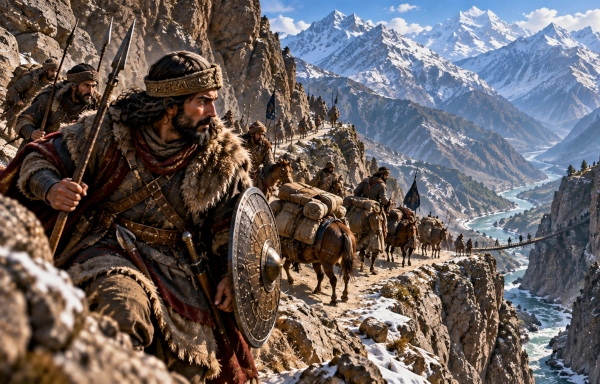
Among the northern mountain peoples described in the Mahabharata, the Daradas occupied one of the most remote and dramatic geographical regions of the epic world. Their country, Darada, lay beyond the Punjab plains in the high valleys surrounding the Upper Indus and its tributaries, where the Himalaya, Karakoram and Hindu Kush mountain systems approach one another.
Ancient Darada is generally associated with the Upper Indus country around Gilgit, Chilas and neighbouring valleys, while the wider geographical and cultural zone linked with the Daradas extended towards Chitral, Kashmir, the western Himalayan valleys and parts of the eastern Afghan highlands. Later scholars used the name Dardistan for an even broader mountain region extending between Kashmir and the Kabul area, although this nineteenth-century geographical term should not simply be equated with the political Darada country of the Mahabharata. Encyclopaedia Iranica notes that Dardistan came to designate the extreme northwestern mountain region of the subcontinent stretching broadly from Kashmir towards Kabul.
The most defensible identification therefore places the ancient Darada heartland in the Upper Indus and adjoining Gilgit-Chilas mountain country, with connections extending towards Chitral and neighbouring Himalayan and Hindu Kush valleys.
The Mountain Country of Darada
Darada belonged to a world radically different from the large agricultural kingdoms of the Gangetic plains. Its geography was dominated by towering mountains, narrow river valleys, rocky gorges and high passes. Communities survived wherever rivers created cultivable terraces and small pockets of fertile land between steep slopes.
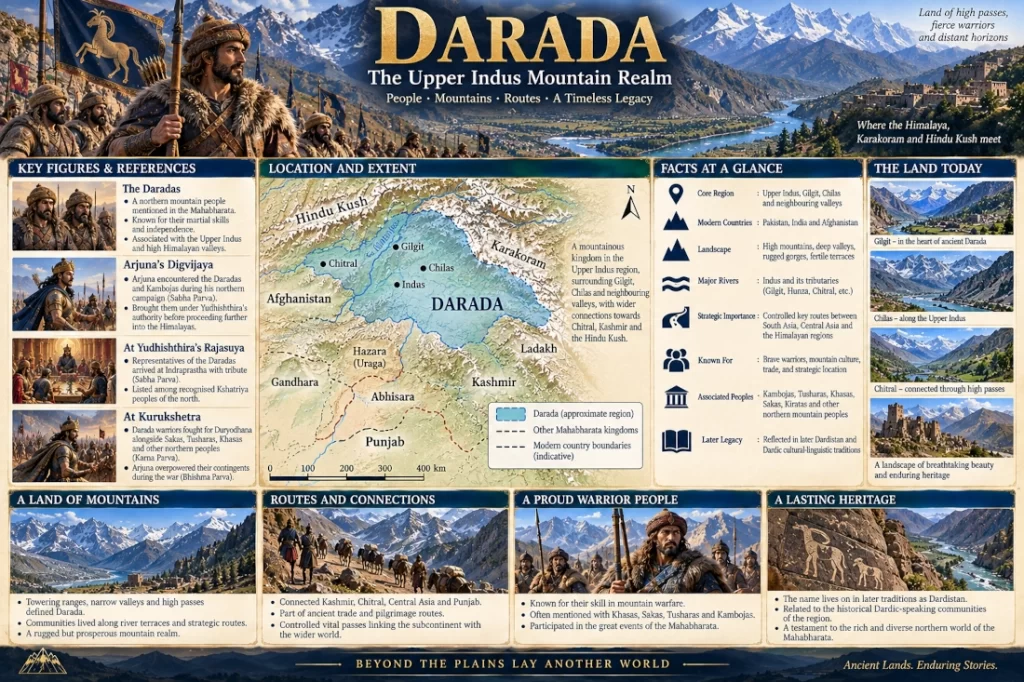
The Upper Indus formed the principal artery of this landscape. Rivers descending from Gilgit, Hunza and other mountain valleys eventually joined the Indus, creating natural corridors through otherwise formidable terrain. Settlements could develop along these waterways, while routes across the mountains connected the region with Kashmir, Chitral, Central Asia and the Punjab.
The wider geographical area historically associated with Dardic-speaking communities included Gilgit, Chilas, Indus Kohistan, parts of Chitral and neighbouring mountain regions. The Indira Gandhi National Centre for the Arts similarly notes the historical presence of Darad territories around Gilgit, Chilas and Chitral when discussing the spread of the Sharada script across the northwestern Himalayan world.
This mountainous setting helps explain why ancient literature regularly associates the Daradas with other northern peoples such as the Kambojas, Tusharas, Khasas, Sakas and Kiratas.
Arjuna Encounters the Daradas
One of the clearest references to Darada occurs during Arjuna’s northern Digvijaya before Yudhishthira’s Rajasuya sacrifice.
Arjuna advanced northwards through a succession of kingdoms and mountain territories. After passing through Abhisara and defeating Rochamana of Uraga, he encountered the Daradas together with the Kambojas and brought them under his authority. The narrative then takes him farther towards the Rishikas and increasingly remote Himalayan regions.
The geographical sequence is important. Abhisara is generally associated with the western Himalayan country around Rajouri and Poonch, while Uraga or Urasa is connected with the Hazara region. Darada appears beyond this northwestern mountain zone as Arjuna continues deeper into the highlands.
The passage therefore fits remarkably well with a location around the Upper Indus and Gilgit region.
Arjuna’s campaign also demonstrates the fragmented political landscape of the mountains. Instead of confronting one large Himalayan empire, he encountered numerous kingdoms and peoples occupying individual valleys, river corridors and strategic routes.
Darada was one of these recognised northern political regions.
The Daradas at Yudhishthira’s Rajasuya
The Daradas appear again when Yudhishthira performed the Rajasuya sacrifice at Indraprastha.
The Sabha Parva describes representatives of numerous distant peoples arriving with tribute. Among them were the Daradas, listed alongside peoples such as the Kairatas, Darvas, Paradas, Bahlikas, Kashmiris, Sivis, Trigartas, Madras and Kaikeyas. They are described collectively as established Kshatriya communities organised into clans and trained in warfare.
Their participation is significant because Darada lay far from Indraprastha.
The presence of Darada representatives at the Rajasuya suggests that the political world recognised by the epic extended far beyond the plains of northern India. Mountain communities of the Upper Indus were connected through tribute, warfare and long-distance routes with kingdoms hundreds of kilometres away.
Arjuna’s earlier campaign provides the political explanation: the Daradas had already been compelled to recognise Yudhishthira’s supremacy.
The Pandavas Travel Through Darada
Darada also appears during the Pandavas’ Himalayan journeys in the Vana Parva.
After spending time in the high mountains, the Pandavas retraced their route towards the kingdom of Suvahu. The text describes them crossing difficult Himalayan terrain and travelling through the countries of China, Tukhara, Darada and Kulinda before reaching Suvahu’s capital.
This passage is among the most valuable geographical references concerning Darada because it places the region within a sequence of northern mountain countries.
Tukhara was associated with territories farther towards Central Asia, while Kulinda belonged to the Himalayan region farther southeast. Darada occupied an intermediate position within this immense trans-Himalayan landscape.
The passage also shows that the Mahabharata did not imagine the Himalayas as an empty wilderness. They contained inhabited valleys, organised kingdoms and recognised geographical regions linked by difficult but functioning routes.
Darada at Kurukshetra
When the Kurukshetra War began, warriors from Darada were drawn into the conflict.
The Bhishma Parva records Darada warriors among the forces confronting Arjuna, alongside Sauviras, Bahlikas, Sakas, Trigartas and several other western and northern peoples. Arjuna overwhelmed these contingents with his weapons during the fighting.
A later passage in the Karna Parva is even more explicit. It remembers the Daradas, Darvabhisaras, Tusharas, Yavanas, Khasas, Sakas, Ramathas, Tanganas and other mountain peoples as fighting for Duryodhana and the Kurus.
The Daradas therefore appear to have been represented principally within the Kaurava coalition at Kurukshetra.
This is another example of how the political alliances of the war could override earlier relationships. Although Arjuna had previously conquered Darada for Yudhishthira’s Rajasuya, at least significant Darada contingents later fought against the Pandavas.
Ancient kingdoms did not necessarily maintain permanent alliances across generations or political crises.
Warriors of the High Mountains
The Mahabharata’s grouping of the Daradas with Khasas, Sakas, Tusharas and other northern peoples reflects the environment from which these warriors came.
Mountain warfare demanded different skills from combat in the great plains. Soldiers needed to move through narrow valleys, steep slopes and difficult passes. Horses and pack animals capable of surviving in mountainous terrain were particularly valuable, while communities controlling strategic routes could resist much larger armies.
The epic often portrays northern contingents as fierce and difficult opponents. The Karna Parva describes the Daradas and other mountain warriors fighting with great intensity for Duryodhana before being overcome by the Pandavas.
Their presence at Kurukshetra also demonstrates the extraordinary geographical scale claimed by the narrative. Armies were remembered as coming not only from Punjab, Rajasthan and the Gangetic kingdoms but from remote valleys deep within the northwestern mountain world.
Darada and the Upper Indus
The identification of Darada with the Upper Indus is supported by the persistence of related names in later geographical traditions.
Classical Greek and Roman writers knew peoples rendered as Dardae or Daradae, contributing to later scholarly attempts to connect ancient Darada with the peoples of the Upper Indus. Encyclopaedia Iranica notes this Classical connection when discussing the origin of the name Dardistan.
The geographical association remained particularly strong around Gilgit, Chilas and the upper Indus valleys.
These valleys occupy one of the most dramatic junctions in Asia. To the south lies Kashmir and the western Himalayas. To the east rise the great Karakoram ranges. To the north lie routes towards the Pamirs and Central Asia, while to the west the mountains connect towards Chitral and the Hindu Kush.
Darada therefore stood at a natural crossroads between South Asia and the Inner Asian mountain world.
Gilgit and the Darada Heartland
Modern Gilgit lies near the confluence of several routes that historically connected the Upper Indus with Hunza, Chitral, Kashmir and the high passes towards Central Asia.
The region’s geography explains its enduring strategic importance. Narrow valleys provide the principal corridors of movement, and control of junctions could give local rulers considerable influence over trade and military movement.
Although it would be misleading to identify modern Gilgit itself as a securely established capital of the Mahabharata’s Darada kingdom, the Gilgit-Chilas-Upper Indus zone provides the strongest broad geographical setting for ancient Darada.
The landscape remains characterised by immense mountains rising directly from the river valleys, irrigated settlements clustered on terraces and routes squeezed between cliffs and waterways.
Chilas and the Indus Corridor
Chilas, farther downstream along the Indus, also lies within the historical Darad geographical world.
The Indus here passes through extremely rugged mountain country. For travellers moving between the upper valleys and the lower Indus, this corridor formed one of the few natural routes through the mountains.
Centuries later, the surrounding area became famous for thousands of rock carvings and inscriptions left by travellers, merchants and pilgrims, demonstrating the long history of movement along the Upper Indus corridor.
These remains belong mainly to historical periods later than the epic tradition and should not be treated as archaeological evidence for the events of the Mahabharata. They nevertheless demonstrate how the physical geography of the region repeatedly channelled movement through the same valleys.
Darada and Chitral
The wider Darada geographical sphere is frequently connected with Chitral, although Chitral should not necessarily be considered part of one fixed Darada kingdom throughout antiquity.
Chitral occupies the deeply enclosed valley of the Chitral River, which becomes the Kunar before joining the Kabul River system. The valley is surrounded by the Hindu Kush and Hindu Raj and historically connected with Gilgit through high routes such as the Shandur Pass. Encyclopaedia Iranica describes Chitral as one of the mountain regions where South Asia, Central Asia and Inner Asia meet.
The cultural and linguistic connections between Chitral, Gilgit and neighbouring valleys help explain why later scholarship grouped much of this territory within a wider Dardistan.
For the Mahabharata period, however, it is safer to speak of Darada’s connections with the Chitral region rather than impose a precise territorial border.
Darada and Kashmir
Darada also had a particularly close relationship with Kashmir.
The two regions were neighbouring but distinct. Kashmir occupied the great enclosed valley south of the main northwestern mountain systems, while Darada lay beyond its northern and northwestern approaches in the Upper Indus country.
Later Kashmiri historical traditions frequently refer to the Daradas or Dards, indicating continued political interaction between Kashmir and the mountain communities beyond its frontiers.
This relationship was geographically inevitable. Routes from Kashmir towards Gilgit and the Upper Indus crossed difficult mountain passes, while the control of these approaches was important for commerce and defence.
Darada consequently formed part of the mountainous frontier separating the Kashmir Valley from the high Indus world farther north.
Darada and the Wider Dardistan
The terms Darada, Dard and Dardistan require careful distinction.
Darada is an ancient Sanskrit ethnonym and geographical name found in Indian literary sources. “Dard” later became a broader label applied by outsiders to several communities of the northwestern mountains. “Dardistan” was popularised primarily by nineteenth-century European scholars, especially G. W. Leitner, for a much larger region extending across the northwestern Himalayan and Hindu Kush valleys.
Modern linguistics similarly uses Dardic for a branch or grouping of Indo-Aryan languages spoken across parts of Kashmir, Gilgit-Baltistan, northern Pakistan and eastern Afghanistan. The modern linguistic category does not mean that every Dardic-speaking community descends directly from one ancient political people called the Daradas.
Ancient ethnicity, language and political geography rarely correspond so neatly.
The safest conclusion is that the Mahabharata’s Daradas represent an ancient population of the Upper Indus mountain world, whose name later became associated with a considerably broader group of northwestern peoples.
Mountain Routes and Long-Distance Trade
Darada’s apparent remoteness should not be mistaken for isolation.
The high valleys north of Kashmir formed part of routes connecting the subcontinent with Central Asia, the Pamirs, the Hindu Kush and the Tarim Basin. Travel was difficult and highly seasonal, but valuable commodities could move through these corridors.
Mountain communities could trade livestock, wool, animal skins, minerals and other products unavailable in the plains. The Mahabharata’s description of northern peoples bringing valuable mountain products and tribute to Yudhishthira fits this wider economic environment. The Daradas themselves are specifically listed among the peoples bringing tribute to the Rajasuya.
Control over valleys and passes therefore provided mountain rulers with influence disproportionate to the size of their cultivable territory.
Darada was geographically remote from Hastinapura but connected to a much larger network.
Darada in Modern Geography
Ancient Darada cannot be assigned a precise modern boundary because the geographical name appears to have been used with varying scope.
Its strongest core identification is with the Upper Indus region around Gilgit and Chilas, together with neighbouring mountain valleys. Its wider cultural sphere can reasonably be connected with parts of Chitral, the northern Kashmir-Himalayan region and adjoining Hindu Kush valleys extending towards eastern Afghanistan.
In present-day political geography, these areas lie across territories administered by Pakistan and India, with the broader historical mountain sphere also reaching into Afghanistan.
The most useful broad identification is therefore:
Darada — the Upper Indus and adjoining northwestern Himalayan and Hindu Kush mountain country, centred particularly around Gilgit and Chilas and connected with Chitral and neighbouring valleys — today spanning parts of Pakistan, India and Afghanistan.
This description should be understood as a geographical approximation rather than a reconstruction of exact ancient frontiers.
The Northern Mountain Realm of the Mahabharata
Darada provides some of the clearest evidence that the geographical imagination of the Mahabharata extended deep into the mountains beyond Kashmir and Punjab.
Arjuna encountered the Daradas and Kambojas during his northern conquest, placing their country along his progression towards increasingly remote Himalayan territories. Darada representatives later arrived at Yudhishthira’s Rajasuya, demonstrating their participation in the political network centred on Indraprastha. The Pandavas themselves travelled through Darada during their Himalayan wanderings, and Darada warriors eventually appeared at Kurukshetra fighting alongside Duryodhana’s northern contingents.
The consistency of these references paints a recognisable geographical picture: a northern country beyond the ordinary plains, associated with high mountains, formidable routes and the peoples of the Upper Indus.
Darada can therefore be identified most convincingly with the Upper Indus mountain world centred around Gilgit, Chilas and adjoining valleys, with wider links towards Chitral, Kashmir and the Hindu Kush. Positioned where the Himalaya, Karakoram and Hindu Kush worlds converge, it represented one of the most distant yet strategically connected northern regions remembered in the Mahabharata.
You may also like
-
Abhisara: The Himalayan Frontier Kingdom Between Kashmir and Punjab in the Mahabharata
-
India to Build National Digital Repository for Tribal Languages with IITs and Universities
-
Gandhara: The Northwestern Kingdom of Gandhari and Shakuni in the Mahabharata
-
Kekaya or Kaikeya: The Western Punjab Kingdom Divided by the Kurukshetra War
-
Madra: The Ancient Punjab Kingdom of Shalya and Madri in the Mahabharata
