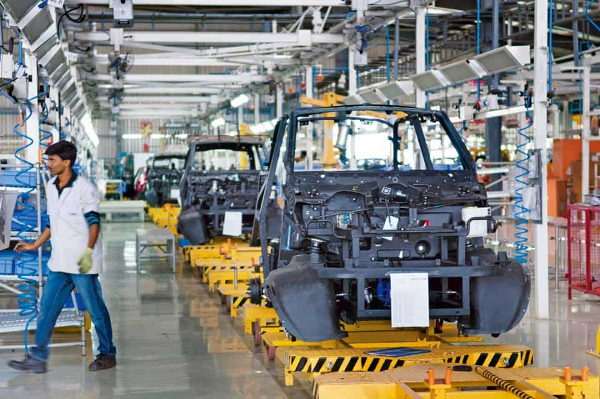
India’s automobile retail market recorded its strongest-ever August in 2026, with vehicle registrations climbing to more than 24.23 lakh units as demand strengthened across most major segments and alternative-fuel passenger vehicles crossed an important milestone.
Data released by the Federation of Automobile Dealers Associations (FADA) showed that total vehicle retail registrations reached 24,23,201 units during August 2026, an increase of 17.51% from 20,62,038 units in August 2025.
The performance represented the highest automobile retail volume ever recorded in India for the month of August.
The most significant structural change, however, emerged in the passenger vehicle market.
For the first time, the combined share of CNG, hybrid and electric passenger vehicles surpassed that of petrol-powered vehicles.
Alternative-fuel vehicles accounted for 41.95% of passenger vehicle retail sales, while conventional petrol vehicles held a 40.85% share.
The change provides a notable indication of how India’s passenger vehicle market is gradually diversifying away from its historic dependence on petrol-powered cars.
Electric vehicles remain only one part of this transition. CNG vehicles have expanded rapidly in cities with established gas-distribution networks, while hybrid vehicles are increasingly attracting buyers seeking improved fuel efficiency without depending entirely on charging infrastructure.
Together, these technologies have now reached sufficient scale to exceed petrol’s market share during a complete month for the first time.
Passenger vehicle registrations themselves rose strongly during August, crossing the four-lakh-unit mark for the first time in an August, while two-wheelers remained the largest component of India’s automobile market.★★★★ India’s August Auto Retail Sales Reach Record 24.23 Lakh Units. FADA reported vehicle retail sales of 24,23,201 units, up 17.51%, with alternative-fuel passenger vehicles also making significant gains.
Two-wheeler registrations reached approximately 17.15 lakh units, recording year-on-year growth of around 19.69%.
Commercial vehicles also recorded healthy growth, rising around 14.45%, while three-wheeler registrations increased by approximately 8.64%. Tractor registrations remained broadly stable, recording marginal year-on-year growth of around 0.84%.
Wheeled construction equipment recorded particularly strong percentage growth during the month.
The figures suggest that demand is not being driven by a single category.
Growth across passenger vehicles, two-wheelers and commercial vehicles points toward relatively broad momentum in mobility demand, consumer purchases and business-related vehicle requirements.
Rural demand also remained an important contributor, particularly in two-wheelers and other mobility categories.
However, FADA cautioned against interpreting the headline annual growth figure without considering the unusual market conditions of the previous year.
August 2025 had experienced some purchase deferment as buyers anticipated changes associated with GST 2.0, creating a comparatively favourable base for year-on-year growth in August 2026.
Month-on-month figures therefore provide a more measured picture.
Total retail registrations in August were 6.48% lower than July 2026, which had produced exceptionally high vehicle sales.
FADA attributed part of the sequential decline to the seasonal slowdown associated with the monsoon and differences in the festive calendar, with purchasing linked to Ganesh Chaturthi and the spillover from Onam shifting into September.
This makes the September-November period particularly important for determining whether the strong annual growth can be sustained through India’s main festive buying season.
The growing share of alternative-fuel vehicles may prove more significant over the longer term than the monthly sales record itself.
India’s automotive transition is increasingly developing through several technologies simultaneously rather than through electric vehicles alone.
Battery-electric cars are gaining ground as charging networks expand, while CNG remains attractive because of lower running costs in markets with sufficient fuel availability. Hybrids provide another route toward reduced fuel consumption, especially for consumers who remain concerned about charging access or driving range.
This multi-technology transition is beginning to reshape decisions by automobile manufacturers as well.
Companies are expanding portfolios across electric, CNG, hybrid and other lower-emission powertrains, while investments are increasing in battery manufacturing, charging networks, electric drivetrains and alternative-fuel technologies.
The shift could also have wider economic implications.
India remains heavily dependent on imported crude oil, and greater adoption of electric vehicles, CNG and more efficient hybrid systems could gradually reduce the growth of petrol and diesel demand from road transport.
Domestic manufacturing of batteries, electric motors, power electronics and other EV components could simultaneously create new industrial opportunities as India’s automobile sector transitions toward cleaner mobility.
The August numbers therefore represent more than another monthly sales record.
With 24.23 lakh vehicles retailed and alternative-fuel passenger vehicles overtaking petrol for the first time, India’s automobile market appears to be entering a period in which record overall demand is being accompanied by a gradual transformation in the technologies powering that growth.
The coming festive months will show whether the strong volume expansion continues, but the changing fuel mix already points toward a significant shift in the structure of India’s passenger vehicle market.
You may also like
-
NALCO Ties Up With Emirates Global Aluminium for Advanced 0.5-MTPA Angul Smelter Expansion
-
NITI Aayog Launches PACT to Accelerate Zero-Emission Truck Deployment Across India
-
India and Luxembourg Explore Deeper Cooperation in Space, AI, Quantum Technologies and Life Sciences
-
India Pushes Next-Generation Aquaculture With RAS and Biofloc Technologies to Strengthen Blue Economy
-
Bugworks Research: India’s Drug-Discovery Startup Developing a New Antibiotic Class Against Superbugs
