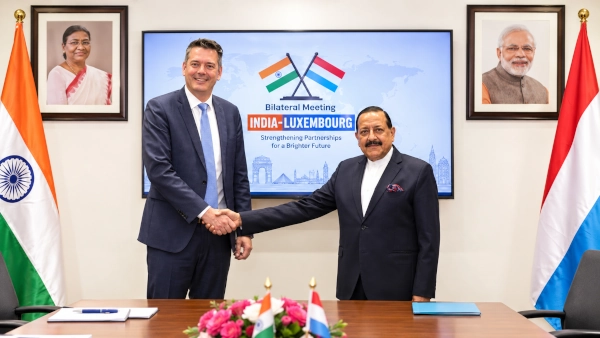
India and Luxembourg are looking to expand their bilateral technology partnership beyond an established relationship in space, with new opportunities being explored in artificial intelligence, quantum technologies, advanced materials, life sciences and commercial space activities.
Luxembourg’s Minister of the Economy, SME, Energy and Tourism, Lex Delles, met Union Minister Dr Jitendra Singh in New Delhi on September 7, 2026, during his visit to India. The discussions focused on identifying concrete areas where institutions, research organisations and companies from the two countries could work together.
Space emerged as the central pillar of the talks, but both sides also showed interest in building a wider technology partnership around emerging sectors.
The proposed cooperation is expected to help prepare specific bilateral initiatives ahead of a planned State Visit from Luxembourg to India in January 2027.
Dr Jitendra Singh said the broader India-Luxembourg relationship provides a strong foundation for moving into new areas of scientific and technological cooperation. He also recalled the virtual summit between Prime Minister Narendra Modi and his Luxembourg counterpart in 2020 as an important milestone in strengthening bilateral ties.
The two countries already have a formal framework for cooperation in space. India and Luxembourg signed an MoU on the exploration and peaceful use of outer space in February 2022, and commercial engagement has subsequently expanded.
Luxembourg satellites have been launched aboard India’s Polar Satellite Launch Vehicle, while satellite communication capacity and transponder services have also formed part of the commercial relationship.
India’s space regulator and promoter IN-SPACe has additionally been interacting with the Luxembourg Space Agency to encourage closer links between the two countries’ private and institutional space ecosystems.
During the meeting, Dr Jitendra Singh outlined India’s longer-term space ambitions, including growing requirements for navigation and communication satellites as well as future human-spaceflight programmes.
India is targeting the establishment of an Indian space station by 2035 and a crewed lunar landing by 2040. The rapid expansion of private-sector participation in the country’s space programme is also creating new opportunities for international partnerships, technology cooperation and commercial projects.
Both sides discussed ways in which Luxembourg’s space companies could engage more deeply with India’s growing private space industry.
Potential areas identified included Earth-observation imagery, communication transponders, satellite and subsystem manufacturing, commercial launch services, ground stations and mission-support services.
Luxembourg-based companies are already active in the Indian market. SES, one of the world’s major satellite communications groups, has been interacting with Indian companies and IN-SPACe on opportunities involving satellite capacity, user terminals and satellite and ground infrastructure.
The bilateral discussion also moved into artificial intelligence and high-performance computing.
Dr Jitendra Singh highlighted India’s efforts to expand national computing infrastructure, increase access to Graphics Processing Units, and develop indigenous large language models capable of addressing the country’s extensive linguistic diversity.
Luxembourg, meanwhile, outlined plans for a new AI-focused high-performance computing facility and expressed interest in linking its technology ecosystem more closely with Indian companies and research institutions.
The two countries are therefore examining possible connections between their respective AI, computing and private-sector ecosystems, particularly where research capabilities can be converted into commercial applications.
Quantum technology was identified as another promising field.
India is currently implementing the National Quantum Mission, which covers areas including quantum computing, communication, sensing and related technologies.
Dr Jitendra Singh said quantum systems have potential applications across healthcare, defence, security and space. The intersection between quantum communication and space-based optical communications could be particularly relevant for India-Luxembourg collaboration.
A future partnership could potentially bring together India’s growing quantum research ecosystem with Luxembourg’s expertise in space systems, communications infrastructure and advanced technology development.
Life sciences and biotechnology also featured prominently in the talks.
The Indian side outlined the country’s BioE3 policy, which seeks to promote biotechnology-based economic development while expanding research, manufacturing and innovation in emerging biological technologies.
Dr Jitendra Singh identified Luxembourg institutions such as the Luxembourg Institute of Health and the Luxembourg Centre for Systems Biomedicine as possible partners for Indian researchers.
Potential cooperation could include research into neurodegenerative disorders, including Alzheimer’s disease, as well as other areas of biomedical and systems research.
India’s growing public-private approach to vaccine development, medical research and biotechnology was also discussed.
Dr Jitendra Singh noted that the recent opening of parts of nuclear medicine research to greater private-sector participation could create additional opportunities for international research institutions and companies working in areas with broad healthcare applications.
Minister Lex Delles highlighted Luxembourg’s increasing interest in India across space, satellite communications, AI, cybersecurity and high-performance computing.
He said stronger engagement between government institutions as well as companies from both countries could help translate existing political and technological links into practical commercial and research partnerships.
The two sides also discussed the importance of structured engagement before the proposed Luxembourg State Visit in January 2027.
Dr Jitendra Singh suggested that Luxembourg’s diplomatic mission remain closely connected with Indian ministries, research institutions and industry so that concrete proposals can be prepared before the visit rather than limiting discussions to broad areas of interest.
Such an approach could enable the January visit to produce specific projects, partnerships or institutional arrangements.
India and Luxembourg bring different but potentially complementary strengths to the emerging technology landscape.
India offers a large technology workforce, an expanding digital and scientific infrastructure, a rapidly growing private space sector and significant domestic demand for advanced technologies.
Luxembourg, despite its smaller size, has developed considerable expertise in satellite communications, commercial space, advanced computing, financial technology and research-intensive industries.
The existing space relationship therefore provides a practical foundation for building a wider strategic technology partnership.
By connecting space cooperation with AI, quantum technologies, high-performance computing and life sciences, India and Luxembourg are seeking to move their relationship toward a more diversified model of joint research, commercial collaboration and technology development.
The planned January 2027 visit could become an important opportunity to convert these discussions into specific programmes linking government agencies, companies and research institutions from both countries.
Source: PIB: https://www.pib.gov.in/PressReleaseDetail.aspx?PRID=2307380®=48&lang=1
You may also like
-
EON Space Labs and Dhruva Space Advance Indian Space Hardware on Transporter-18 Mission
-
SatLeo Labs’ TAPAS-1 Reaches Orbit, Advancing India’s Private Thermal-Imaging Capability
-
TakeMe2Space’s MOI-1A Reaches Space on Falcon 9 Transporter-18 Mission
-
Bank of Baroda Enters Pension Fund Management After PFRDA Appointment
-
SCI and India’s Push for a Larger Indigenous Maritime Fleet
