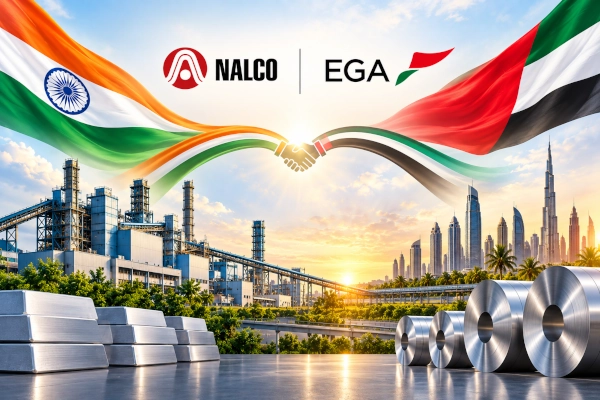
India’s state-owned National Aluminium Company Limited (NALCO) has entered into a major technology partnership with Emirates Global Aluminium (EGA) for the planned expansion of its aluminium smelter at Angul in Odisha, bringing advanced high-amperage smelting technology into one of India’s largest public-sector aluminium projects.
NALCO and EGA signed a Technology Licensing Agreement in Dubai on September 7, 2026, covering deployment of EGA’s UAE-developed DX+ Ultra aluminium smelting technology for NALCO’s proposed 0.5-million-tonne-per-annum brownfield expansion.
The project forms an important part of NALCO’s wider capacity-expansion strategy and could nearly double the company’s primary aluminium production capability at Angul.
NALCO’s existing aluminium smelter has an installed capacity of around 4.60 lakh tonnes per annum. The proposed addition of approximately 0.5 million tonnes annually would take the company’s overall aluminium capacity towards one million tonnes per year.
Under the agreement, EGA will provide NALCO with the licence for its DX+ Ultra technology, along with the engineering know-how, designs and technical information necessary to implement the system.
The UAE company will also provide technical assistance during different stages of project execution, giving NALCO access not simply to equipment specifications but to the expertise required to integrate and operate the new smelting technology.
DX+ Ultra is EGA’s latest fully industrialised aluminium reduction technology and has been designed around high-amperage operation, greater productivity and improved energy performance.
EGA says decades of development in its proprietary smelting technologies have substantially reduced the electricity required to produce each tonne of aluminium. The company currently uses its own technologies across all its reduction cells in the UAE and has also licensed them internationally.
Energy consumption is one of the most important factors determining the economics of aluminium production because primary aluminium smelting requires very large and continuous quantities of electricity.
Higher-efficiency reduction cells can therefore improve both operating costs and environmental performance while allowing more metal to be produced from a given smelting installation.
NALCO expects DX+ Ultra to support higher productivity, improved energy efficiency and optimisation of capital and operating expenditure at the expanded Angul complex.
NALCO Chairman and Managing Director Brijendra Pratap Singh said the company expects the expanded plant using EGA technology to emerge as one of India’s more efficient aluminium smelters.
He also linked the project to India’s broader effort to strengthen its domestic aluminium ecosystem while improving the efficiency and competitiveness of indigenous production.
The agreement was signed in the presence of Singh and EGA Chief Executive Officer Abdulnasser Bin Kalban. Senior project and finance officials from NALCO and representatives of EGA were also present.
The partnership has wider industrial significance because aluminium is increasingly important to sectors extending well beyond conventional construction and consumer applications.
Lightweight aluminium alloys are extensively used in aerospace, defence, railways, automobiles, electric vehicles, renewable-energy equipment, power transmission and advanced manufacturing. India’s demand for aluminium is consequently expected to rise alongside expansion in infrastructure and high-technology industries.
Increasing domestic primary aluminium capacity can therefore play a role in strengthening industrial supply chains as India expands manufacturing in strategic and emerging sectors.
NALCO already operates an integrated aluminium production chain in Odisha, with bauxite mining and alumina refining at Damanjodi and aluminium smelting and captive power facilities at Angul.
At the Angul plant, alumina is converted into primary aluminium through electrolytic reduction before the molten metal is processed into products including ingots, billets, wire rods, alloy ingots, strips and rolled products.
The latest technology agreement represents a significant modernisation step compared with NALCO’s existing smelting configuration, which uses 180-kiloampere cell technology.
Introducing a modern high-amperage platform through the new expansion could increase productivity while allowing the brownfield project to benefit from infrastructure and capabilities already available at the established Angul industrial complex.
For EGA, the agreement also extends the international reach of technology developed within the United Arab Emirates.
EGA began licensing its proprietary smelting technology internationally in 2016 and says it has since licensed technology covering more than half a million tonnes of installed aluminium-smelting capacity outside the UAE. The NALCO programme will add another major overseas application of the company’s technology.
The NALCO-EGA partnership also illustrates a broader trend in India’s industrial expansion in which international technology is being combined with domestic manufacturing capacity rather than relying principally on imports of finished products.
Once implemented, the Angul project will add approximately 500,000 tonnes of annual aluminium capacity within India, while the production itself will remain part of NALCO’s domestic industrial base.
The expansion could consequently strengthen India’s ability to supply aluminium to fast-growing downstream industries while improving NALCO’s scale and competitiveness.
For the Navratna PSU, moving towards one million tonnes of annual aluminium production would represent one of the most significant capacity expansions in its history.
With advanced smelting technology, higher energy efficiency and expanded domestic capacity forming the core of the project, the NALCO-EGA agreement could become an important element of India’s effort to build a larger and technologically stronger aluminium manufacturing ecosystem.
You may also like
-
EON Space Labs and Dhruva Space Advance Indian Space Hardware on Transporter-18 Mission
-
SatLeo Labs’ TAPAS-1 Reaches Orbit, Advancing India’s Private Thermal-Imaging Capability
-
TakeMe2Space’s MOI-1A Reaches Space on Falcon 9 Transporter-18 Mission
-
Bank of Baroda Enters Pension Fund Management After PFRDA Appointment
-
SCI and India’s Push for a Larger Indigenous Maritime Fleet
