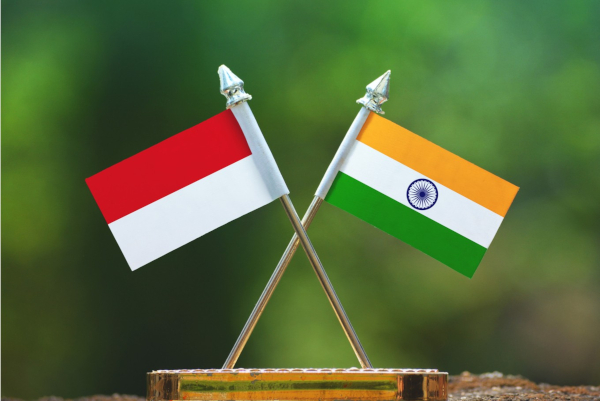
Indian military parachutists have carried out a major multinational airborne operation in Indonesia, jumping alongside troops from Indonesia, the United States, Japan and France during Exercise Super Garuda Shield 2026. The operation took place on September 4 at the Baturaja Combat Training Center in South Sumatra, demonstrating the ability of forces from several countries to plan, coordinate and execute an airborne insertion together.
According to information released by the Indonesian military, 40 Indian military parachutists participated in the operation. They were joined by 110 Indonesian personnel, 147 American paratroopers, 17 Japanese personnel and six French parachutists, bringing together airborne troops from five countries for the exercise.
The troops conducted static-line parachute jumps from an altitude of around 1,200 feet over the Baturaja training area. Two Indonesian C-130 Hercules aircraft were involved, while the United States deployed three Hercules aircraft and a KC-130 tanker in support of the exercise. U.S. Army documentation from the operation also shows Indian, Indonesian, American, Japanese and French personnel jumping from a C-130J Super Hercules.
The multinational airborne force departed from Gatot Subroto Airfield in Lampung before flying to the drop zone in South Sumatra. Conducting a combined airborne operation required the participating militaries to synchronise parachuting procedures, aircraft timings, communications and actions after landing. These details are important because airborne forces from different countries can use different equipment, terminology and operating practices.
For the Indian contingent, participation went beyond simply completing a parachute jump. U.S. Army reporting shows American personnel assisting members of the Indian Armed Forces with their parachute equipment ahead of the mission, while Indian troops subsequently operated alongside partner forces after reaching the ground. The exercise therefore provided practical experience in integrating Indian personnel into a multinational airborne formation rather than conducting parallel national drills.
Once on the ground, the paratroopers moved from the landing zone towards their assigned objective before transitioning into further training in the tropical environment around Baturaja. Indian personnel have also participated in jungle-survival training during Super Garuda Shield, working alongside Indonesian troops and soldiers from other participating countries.
The airborne phase fed into the activities of Combined Task Force 501, which brought together personnel from the United States, Indonesia, India, Japan, Australia, New Zealand and Canada. Instead of keeping every national contingent completely separate, troops from different countries were organised into formations that allowed them to work alongside one another and compare tactical procedures at comparatively low levels of command. French troops additionally participated in the airborne jump.
Such training is particularly valuable for airborne forces because parachute operations demand precise coordination between aircraft crews, jumpmasters, ground commanders and individual soldiers. A multinational operation adds another layer of complexity, requiring participating forces to establish common procedures before troops can safely leave aircraft, regroup after landing and continue a mission on the ground.
The Indonesian military described the airborne training as an opportunity to improve the ability of participating troops to carry out safe and accurate aerial insertion while also testing their capacity to conduct immediate combined operations during regional emergencies or contingencies. It forms part of Indonesia’s wider effort to use Super Garuda Shield as a platform for defence cooperation and military diplomacy.
Super Garuda Shield 2026 began on August 31 and will continue until September 11. The Indonesian Armed Forces say the wider exercise involves 4,743 personnel from 21 countries and includes 12 different training components. Participating nations include India, Indonesia, the United States, Australia, Japan, France, the United Kingdom, Germany, Canada, South Korea, New Zealand, Singapore and several other partners.
The exercise has expanded considerably from its origins as the bilateral Garuda Shield drill between Indonesia and the United States. It developed into the multinational Super Garuda Shield format in 2022 and has since grown into one of Indonesia’s largest recurring multinational military exercises.
This year’s programme extends well beyond airborne operations. Indonesian military sources say the exercise includes cyber training, command-post activities, live-fire components and humanitarian assistance and disaster-relief training, allowing participants to practise both Referencecombat and non-combat missions. Indonesia has described the exercise as a means of strengthening interoperability while also building defence relationships and exchanging operational experience among participating militaries.
India’s participation in the Baturaja airborne operation therefore represents more than ceremonial involvement in a large international exercise. Indian parachutists have trained directly with airborne forces from four other countries, used a common air-mobility framework and continued into multinational operations after landing. Such experience strengthens familiarity with foreign procedures and gives Indian personnel an opportunity to practise rapidly integrating with partner forces in an unfamiliar tropical operating environment.
The sight of Indian, Indonesian, American, Japanese and French parachutists leaving the same transport aircraft over South Sumatra is also a striking illustration of how Super Garuda Shield has evolved into a much broader multinational training platform. For India, participation adds another practical dimension to its expanding defence engagement with Indonesia and other Indo-Pacific partners while allowing its troops to test interoperability through demanding field training rather than classroom-level exchanges alone.
Reference:
U.S. Army/4th Infantry Division reporting on the September 4 airborne operation, official Indonesian Armed Forces information carried by ANTARA, and official TNI statements on Super Garuda Shield 2026.
You may also like
-
India’s Counter-Space Programme Expands Into Space-Based High-Power Lasers and Satellite Jamming
-
DRDO Launches SHIELD Programme to Develop Indigenous S-Band High-Power Microwave Technology
-
Adani Defence to Supply Indigenous Ammunition for AK-203 Rifles Under Five-Year Pact
-
Indian Air Force Indigenises Critical Hydraulic Booster Pump for Su-30MKI Fighter Fleet
-
Indian Air Force Showcases Do-228 Fleet Readiness in Elephant Walk at Yelahanka
