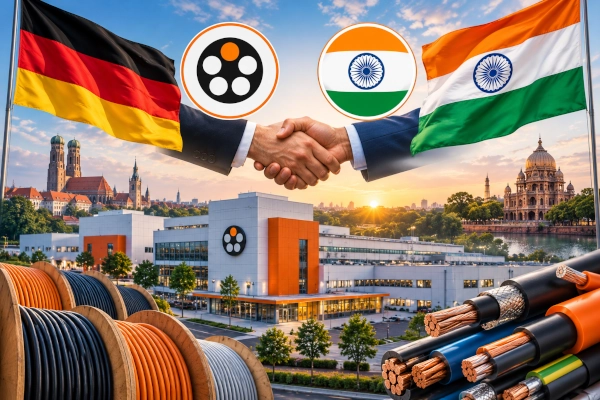
German connectivity specialist LAPP has made its manufacturing complex at Bhopal in Madhya Pradesh the largest production facility in the company’s global network, marking a significant expansion of India’s role in the group’s international manufacturing strategy.
LAPP confirmed the milestone in an official announcement issued on September 2, 2026, as the company celebrated 30 years of operations in India. What began as a local cable-production facility at Bhopal in 2012 has grown into the largest manufacturing site across the entire LAPP Group. The expanded complex now incorporates advanced cable-production technologies, polymer processing and a newly launched facility for low-voltage cables.
The development gives India a particularly prominent position within the Stuttgart-based family-owned company. India is now LAPP’s second-largest market globally, while the Bhopal operation has surpassed the group’s other manufacturing sites in scale.
Advanced Cable Manufacturing Expands in Madhya Pradesh
The latest expansion at Bhopal includes a state-of-the-art production facility for low-voltage cables. These products are used throughout modern electrical infrastructure, including factories, commercial buildings, transportation systems, renewable-energy installations, utility networks and industrial equipment.
The facility also carries out some of LAPP’s more technologically advanced production processes. The company manufactures specialised polymer compounds for cable sheathing at Bhopal using formulations developed within the group. Electron-beam technology is also used to modify cable materials at the molecular level, improving their performance characteristics.
This makes the site more than a conventional cable assembly operation. By integrating materials processing and advanced cable treatment with large-scale production, LAPP is building deeper manufacturing capability in India.
From a 2012 Plant to LAPP’s Largest Global Factory
LAPP began manufacturing at Bhopal in 2012 as part of its effort to expand production closer to Indian customers. The facility has since undergone successive expansions as demand for connectivity products has risen across infrastructure, industrial automation, rail transport and renewable energy.
The company has now formally described Bhopal as the largest manufacturing site in the entire LAPP Group. The expansion was inaugurated by senior company leadership, including LAPP Group CEO Matthias Lapp, Chief Technology Officer Hubertus Breier and Asia-Pacific CEO Richard Lee.
LAPP currently operates three major production locations in India and employs around 500 people in the country. Its Indian manufacturing and distribution network serves sectors including mechanical engineering, automation, infrastructure, railways and renewable energy.
India Becomes LAPP’s Second-Largest Market
LAPP’s decision to concentrate major manufacturing capacity in India follows three decades of expansion in the country. The company established its Indian headquarters in Bengaluru in 1996 and opened its first nearby cable-production plant in 1998.
India has since become LAPP’s second-largest market. The company says it sells most of the cables manufactured at its Indian facilities within India itself, reflecting the scale of domestic demand rather than treating the country simply as an export-production location.
Infrastructure development is a major driver. Rapid expansion in railways, renewable power, industrial automation, factories, data infrastructure and electricity networks is increasing demand for specialised cables and connectivity systems.
LAPP’s global financial results also illustrate India’s growing importance. The group reported sales of €1.93 billion in fiscal 2025, with India, China and South Korea identified as major contributors to growth in Asia. LAPP operates 27 international production facilities worldwide, making Bhopal’s emergence as its largest particularly significant.
Localisation at the Centre of LAPP’s India Strategy
The company has explicitly placed localisation at the centre of its Indian operations. Matthias Lapp said LAPP develops and manufactures products in India specifically for Indian requirements while drawing on expertise from the group’s international engineering network.
That model allows Indian engineers to work with product and materials specialists elsewhere in the LAPP Group while maintaining substantial production within the country.
The strategy fits LAPP’s wider global approach of producing closer to major markets. The company calls this its “local for local” model, intended to make supply chains more resilient while allowing manufacturing operations to respond more quickly to regional customer requirements.
For India, the approach means progressively deeper localisation rather than dependence on imported finished cables and components.
Supporting Railways, Renewables and Industrial Growth
The Bhopal expansion is particularly relevant to sectors undergoing rapid investment in India. Rail modernisation, metro construction, renewable-energy capacity, industrial automation and new manufacturing facilities all require increasingly sophisticated power, control, instrumentation and data connectivity.
LAPP already supplies solutions for railway technology, renewable energy, industrial communication, automation, mechanical engineering and infrastructure. The expanded Indian manufacturing base gives the company greater capacity to supply those markets domestically.
The newly commissioned low-voltage production capability is especially important because such cables form part of the basic electrical architecture of factories, buildings, transportation networks, utility systems and renewable-energy projects.
A Significant Make in India Manufacturing Milestone
The Bhopal development represents a notable Make in India milestone because an Indian manufacturing site has become the largest factory in the global network of an established German industrial company.
Rather than simply establishing a small regional production unit, LAPP has progressively transferred greater manufacturing depth to India, including proprietary polymer processing, electron-beam cable technology and expanded low-voltage cable production.
Three decades after establishing LAPP India, the company now considers the country one of its most important global growth markets. With its largest factory located in Madhya Pradesh and India ranking as its second-largest market, the group’s expansion illustrates how India is moving from being primarily a sales destination for international industrial companies toward becoming a major manufacturing and technology base within their global operations.
You may also like
-
India Launches Mission Rangeen Machhli 2031 to Build a Scientific and Export-Ready Ornamental Fisheries Sector
-
Tamil Nadu Expands UAV and Counter-UAV Ecosystem With New Defence Testing Infrastructure
-
India Demonstrates 60% Recycled Asphalt Technology on Chennai–Tirupati Highway
-
Syrma SGS and Italy’s Elemaster Open Advanced Electronics Manufacturing Hub in Bengaluru
-
Novonesis Bets €600 Million on India With Advanced Enzyme Manufacturing Hub in Maharashtra
