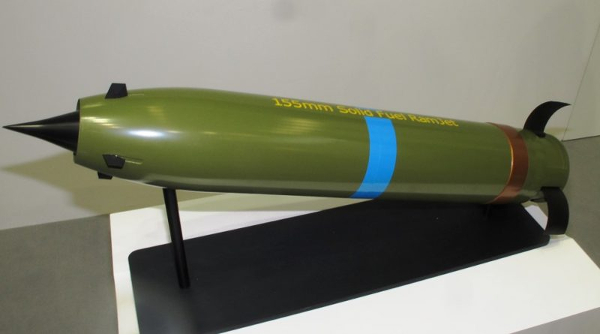
India’s Defence Research and Development Organisation is advancing an indigenous 155mm ramjet-powered artillery projectile intended to substantially increase the reach of the country’s next-generation artillery while adding precision-guidance capability.
The projectile is being developed by DRDO’s Armament Research and Development Establishment (ARDE), Pune. DRDO officially identified the 155mm Ramjet Projectile as one of ARDE’s ongoing programmes in May 2025, alongside ATAGS, Pinaka and advanced 155mm ammunition projects.
DRDO publicly displayed the new ammunition at Aero India 2025, where officials indicated that the technology was being developed to extend the reach of the 155mm/52-calibre Advanced Towed Artillery Gun System (ATAGS) to as much as 80 km. Conventional extended-range ammunition gives ATAGS a considerably shorter reach, meaning the ramjet round could provide Indian artillery with a much deeper engagement envelope without requiring an entirely new gun platform.
Unlike a conventional shell, which begins losing velocity after leaving the barrel, a ramjet projectile uses its high initial speed to compress incoming air. Fuel is then burned in the compressed airflow to produce sustained thrust during flight. This allows the projectile to retain energy over a much longer trajectory while avoiding the need to carry the oxidiser required by a conventional rocket motor.
The programme is also being associated with a Guidance, Navigation and Control system intended to transform the extended-range shell into a precision-strike weapon. The development objective being discussed for guided Indian 155mm ammunition is a Circular Error Probable of around 10 metres. India already has a parallel indigenous smart-ammunition programme led by IIT Madras and Munitions India specifically targeting a CEP of 10 metres using satellite navigation and aerodynamic control surfaces.
India has meanwhile achieved important experimental milestones in ramjet artillery propulsion. A separate IIT Madras programme undertaken with the Indian Army successfully demonstrated a ramjet-assisted 155mm shell during trials at the School of Artillery at Deolali in September 2025. Those tests established clean gun exit, stable flight and ramjet ignition. Further trials were conducted at Pokhran in December 2025 as work continued towards an operational configuration.
Ramjet ammunition could significantly alter the economics of long-range battlefield fires. Targets that currently require missiles or other comparatively expensive precision weapons could potentially be engaged using existing 155mm artillery systems firing specialised long-range rounds. The technology would also allow batteries to strike command posts, logistics nodes, air-defence positions and opposing artillery from farther behind friendly lines.
For India, the programme complements the induction of ATAGS and other 155mm artillery systems while building an indigenous family of advanced ammunition around them. If DRDO succeeds in combining an approximately 80-km reach with precision guidance approaching the 10-metre objective, the new projectile could give Indian tube artillery a strike capability significantly beyond that offered by conventional shells while retaining the flexibility and sustained firepower of standard 155mm guns.
You may also like
-
Dixon Technologies Plans Entry Into Aerospace and Defence Electronics as Next Growth Frontier
-
DRDO Secures Patent for Indigenous BAM-H24 High-Energy Fuel for Advanced Solid Rocket Propulsion
-
Indrajaal Expands Made-in-India AI-Powered Anti-Drone Defence for Critical Infrastructure
-
Japanese Contingent Arrives in Jodhpur Ahead of Veer Guardian 2026 Air Exercise
-
TriNano Technologies: India’s Nano-Coating Push to Make Solar Panels Cleaner, Cooler and More Productive
