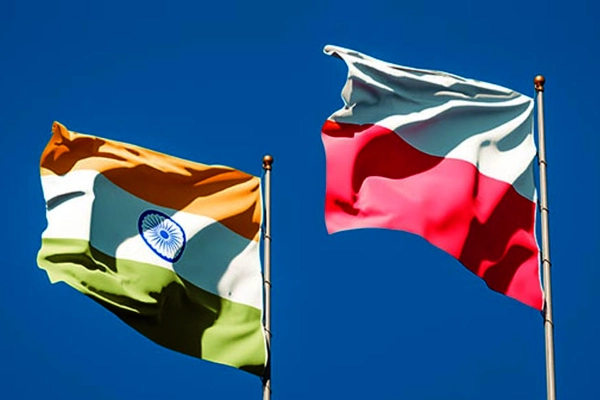
India’s cultural and academic links with Poland are gaining renewed attention as External Affairs Minister S. Jaishankar highlighted the continuing strength of Indology and Sanskrit studies at Polish universities during his visit to Warsaw.
Speaking after talks with Polish Deputy Prime Minister and Foreign Minister Radosław Sikorski on September 4, Jaishankar said that Indology and Sanskrit programmes were doing well in Polish universities. His remarks came as the two countries reviewed their expanding Strategic Partnership, which now stretches from defence and technology to education, culture and people-to-people exchanges.
Poland’s interest in Indian civilisation is not a recent development. The country has one of Europe’s longest academic traditions of studying India, with Polish scholars engaging with Sanskrit texts from the nineteenth century. According to the Embassy of India in Warsaw, Sanskrit was being studied at Jagiellonian University in Kraków in 1860–61, while a dedicated Chair of Sanskrit was established there in 1893.
The tradition subsequently expanded considerably. The University of Warsaw, whose Indology department traces its institutional history to 1932, has developed into what the Indian Embassy describes as the largest centre for Indian studies in Central Europe. Indian languages, literature and culture are also studied at Jagiellonian University in Kraków, Adam Mickiewicz University in Poznań and the University of Wrocław.
At the University of Warsaw, the present Oriental Studies–Indology programme combines language training with the study of Indian history, religion, philosophy, literature and society. The university says its South Asian teaching encompasses Sanskrit, Hindi, Bengali and Tamil, giving students exposure to both classical and contemporary India.
For the 2026–27 academic year, the University of Warsaw is recruiting undergraduate Indology students into a programme that includes the parallel study of Tamil and Sanskrit. At postgraduate level, students can continue with Indian languages including Tamil and Hindi. The programme draws on nearly nine decades of institutional experience in South Asian studies.
Jagiellonian University has an equally important place in this history. Besides its nineteenth-century Sanskrit tradition, the university today offers India and South Asia Studies, while its academic curriculum includes subjects dealing with classical Sanskrit literature and wider Indian civilisation.
Academic cooperation between India and Poland has also been supported institutionally by the Indian Council for Cultural Relations. An MoU establishing an ICCR Chair of Indian Studies at Jagiellonian University was signed in 2017, and Indian professors have subsequently served there under the programme.
Polish scholarship has produced several internationally recognised specialists in Indian languages and thought. During Prime Minister Narendra Modi’s visit to Poland in 2024, he met prominent Polish Indologists including Sanskrit scholar Prof. Maria Christopher Byrski, Hindi scholar Prof. Monika Browarczyk, Indian-philosophy specialist Prof. Halina Marlewicz, Indologist Prof. Danuta Stasik and Prof. Przemysław Szurek of the University of Wrocław.
Prof. Byrski, a former Polish ambassador to India and noted Sanskrit scholar, received India’s Padma Shri in 2022 for his contribution to literature and education. Another Polish Sanskrit scholar, Dr Joanna Jurewicz of the University of Warsaw, received the ICCR’s Distinguished Indologist honour for her work on ancient Indian texts and Vedic thought.
These academic links have increasingly been complemented by university-to-university partnerships. In June 2026, India’s Ambassador to Poland Neeta Bhushan met Jagiellonian University officials to discuss expanding collaboration with Indian institutions, while IIIT Dharwad and AGH University in Kraków signed an academic cooperation agreement during another engagement.
The significance of Indology and Sanskrit in India-Poland relations therefore extends well beyond language teaching. Generations of Polish scholars have translated, interpreted and taught Indian philosophical, literary and religious traditions, creating an intellectual connection between the two countries long before their present-day strategic relationship took shape.
As India and Poland now broaden cooperation in defence, space, cyber security, critical minerals and advanced technology, their longstanding academic relationship provides a deeper cultural foundation for those ties. Jaishankar’s remarks in Warsaw underline that Sanskrit and Indology remain active parts of that relationship rather than merely historical legacies, linking a nineteenth-century Polish scholarly tradition with a rapidly expanding twenty-first-century partnership.
You may also like
-
IAF and IIT Bombay Join Hands for Master’s-Level Education of India’s Flight Test Crew
-
Sanjaya’s Embassy to the Pandavas: The Messenger Who Had to Speak for a Policy He Did Not Fully Support
-
Krishna and the Hunter Jara: The Final Moment of Krishna’s Earthly Life
-
The Elephant Named Ashwatthama: The Half-Truth That Brought Down Dronacharya
-
Canada Raises Proof-of-Funds Requirement for International Students to C$23,448
