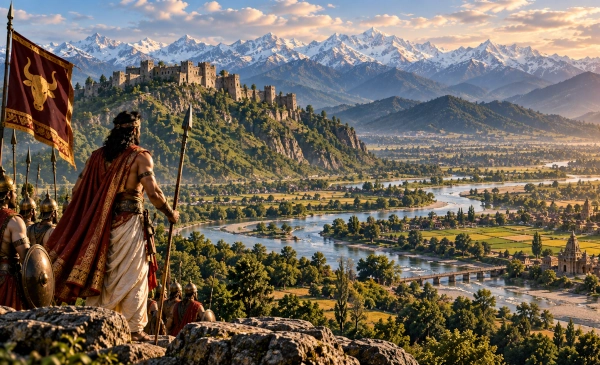
The ancient kingdom of Trigarta occupied one of the most strategically important regions of the northwestern world described in the Mahabharata. Its geographical heart lay across the Kangra Valley, the Jalandhar Doab and the adjoining western Himalayan foothills, corresponding principally to parts of present-day Himachal Pradesh and Punjab. The kingdom stood where the mountains descended towards the fertile Punjab plains, giving its rulers access to both Himalayan routes and the river-rich country between the Ravi, Beas and Sutlej.
Trigarta is unusually prominent in the Mahabharata. Its ruler Susharma was a determined ally of Duryodhana, an old enemy of the Matsya kingdom and one of the commanders who repeatedly confronted Arjuna. During the Kurukshetra War, Trigarta supplied many of the warriors who took the terrible Samsaptaka vow—to defeat Arjuna or die fighting him. The kingdom therefore appears not merely as a geographical name but as a substantial military power in the northwestern political landscape of the epic.
The Land Between the Mountains and the Punjab Plains
The most convincing reconstruction of ancient Trigarta places it across two connected geographical zones. One consisted of the Kangra hills and valleys, particularly the country around the Beas and the approaches to the Dhauladhar range. The other extended southwards into the Jalandhar region of Punjab, especially the plains between the Beas and Sutlej.
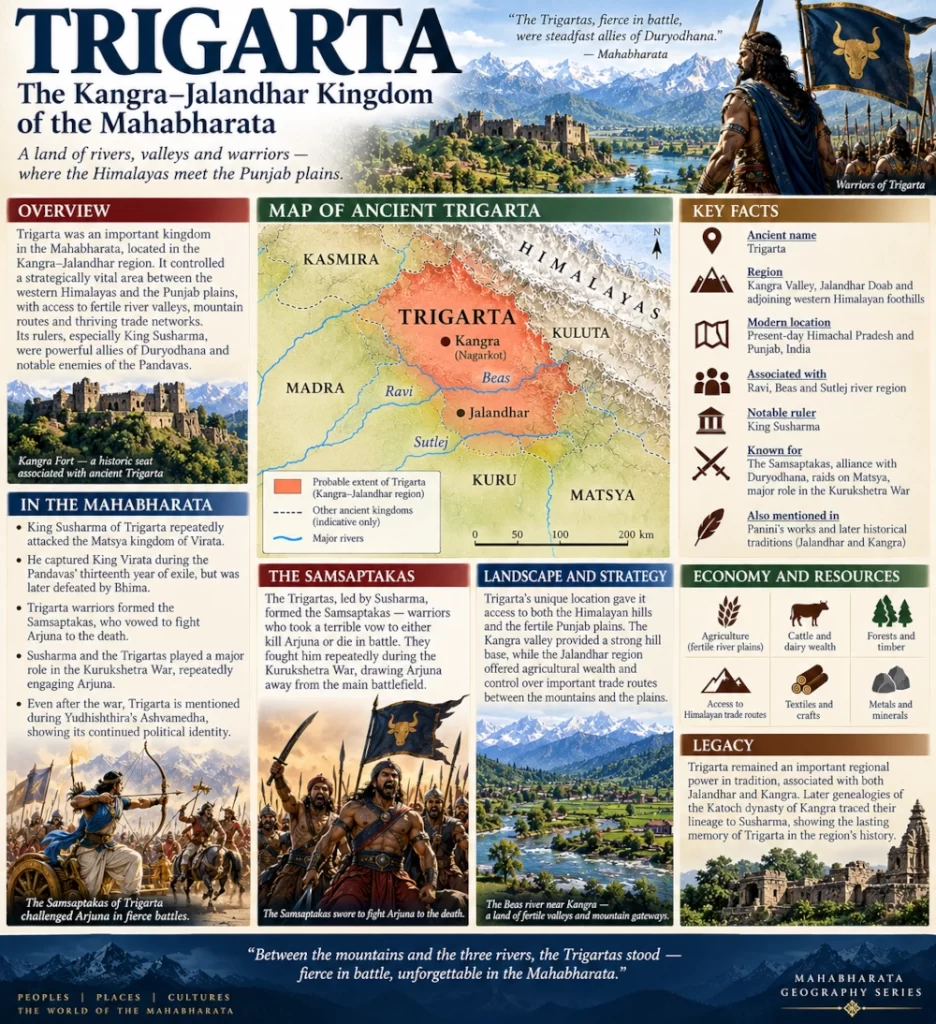
Government historical records for both Kangra and Jalandhar preserve this identification. The Kangra district history explicitly associates ancient Kangra with the Trigarta kingdom of the Mahabharata, while the Jalandhar district history records Trigarta as an earlier name for the wider Jalandhar country. The Archaeological Survey of India’s Ancient India similarly describes the Jalandhar Doab together with the Kangra hills as Trigarta in Sanskrit literature.
The traditional explanation of the name associates Trigarta with a land connected to three rivers, generally identified as the Ravi, Beas and Sutlej. This interpretation suits the broader geography of the region, although the exact ancient etymology should not be treated as certain. The more important point is that historical descriptions consistently place Trigarta between the western Himalayan hills and the upper Punjab river system.
This made Trigarta quite different from a purely Himalayan kingdom. Its rulers could draw upon both the protected valleys of the hills and the agricultural and commercial resources of the plains.
Kangra and Jalandhar: Two Faces of Trigarta
Later historical evidence helps explain the apparent breadth of Trigarta.
The region came to be associated closely with both Jalandhara and Nagarkot, the old name of Kangra. The plains portion was centred around Jalandhar, while Kangra became the great hill stronghold. The Census of India historical account of Kangra describes ancient Trigarta as comprising a plains province associated with Jalandhar and a hill province associated with Nagarkot.
This two-part geography is particularly useful when reading the Mahabharata. Trigarta could field large numbers of chariots and conduct major raids into neighbouring kingdoms, which would be easier to understand if its power extended beyond steep mountain valleys into substantial plains territory.
At the same time, its connection with Kangra explains why Trigarta remained associated with the western Himalayan political world long after the epic period.
The kingdom therefore belonged simultaneously to Punjab and the Himalayas.
Trigarta and the Matsya Kingdom
One of the clearest geographical relationships in the Mahabharata is the hostility between Trigarta and Matsya.
Matsya, ruled by King Virata, lay to the southeast of Trigarta. During the Pandavas’ thirteenth year of exile, when they were living anonymously at Virata’s court, Susharma saw an opportunity to attack his old rival.
The Virata Parva explains that Susharma had previously suffered defeats at the hands of Virata and his powerful commander Kichaka. When Kichaka was killed, Susharma argued that Matsya had been weakened and persuaded Duryodhana to launch a coordinated attack.
The plan was carefully organised. Trigarta would strike first, drawing Virata and the main Matsya army away, while the Kauravas would attack from another direction and seize Matsya’s cattle.
The episode gives important geographical information. The text says that the Trigarta army moved towards the southeastern direction on its expedition against Virata. This is consistent with locating Trigarta northwest of the Matsya country.
Rather than relying entirely on later identifications, the direction of movement recorded in the epic itself supports a northwestern location for Susharma’s kingdom.
Susharma’s Raid on Virata
Susharma’s attack becomes one of the central military episodes of the Virata Parva.
Trigarta forces seized thousands of Virata’s cattle and forced the Matsya army into battle. The fighting was severe. Susharma personally confronted Virata and eventually succeeded in destroying the king’s chariot support and capturing Virata alive.
The Pandavas could not reveal their identities, but they could not allow the king who had sheltered them to be carried away.
Yudhishthira therefore ordered Bhima to rescue Virata.
Bhima entered the fighting with his brothers and shattered the Trigarta forces. He eventually pursued Susharma, dragged him from the battlefield and captured him. Yudhishthira then ordered Susharma to be released rather than killed.
The episode shows Susharma as more than a minor border chief. He commanded a sizeable army, conducted coordinated military operations with the Kurus and was powerful enough temporarily to defeat and capture the king of Matsya.
Trigarta was evidently one of the significant military states of the northwestern region.
Susharma: The Trigarta Ally of Duryodhana
The alliance between Susharma and Duryodhana continued into the Kurukshetra War.
The Mahabharata repeatedly calls Susharma ruler of the Trigartas. In some passages he is also described as ruler of Prasthala, suggesting that Prasthala was either an important territory within the Trigarta realm or a closely associated political centre. It should not automatically be treated as the sole capital of the entire kingdom, since the geographical traditions surrounding Trigarta are more complex.
Susharma’s importance is clear from the responsibilities Duryodhana gave him. He was repeatedly ordered to engage Arjuna and other leading Pandava warriors, tasks that would not have been entrusted to an insignificant ally.
His hostility towards Arjuna became one of the defining military relationships of the war.
That hostility eventually produced the Samsaptakas.
The Samsaptakas: Trigarta’s Warriors Sworn to Die
Among the most memorable warriors of the Drona Parva are the Samsaptakas, men who solemnly vowed that they would either kill Arjuna or die in battle.
The word refers to warriors bound by such a terrible oath.
Before taking the field, these fighters performed formal rites around fire, made religious offerings and pledged themselves to battle without retreat. Susharma and his forces were central to this formation. The Mahabharata specifically describes Susharma, his brothers and numerous associated warriors participating in the oath.
Their purpose was strategic.
Drona needed Arjuna drawn away from the main Pandava army so that he could attempt to capture Yudhishthira. The Samsaptakas repeatedly challenged Arjuna, knowing that his warrior code would make it difficult for him to refuse a direct call to battle.
The plan succeeded in pulling Arjuna away from the principal battlefield for prolonged periods.
The Drona Parva describes the Samsaptakas arraying themselves for combat and identifies the Trigarta brothers among the warriors waiting for Arjuna. Even when Arjuna’s attacks broke their formation, Susharma urged them not to flee and reminded them of the vow they had taken.
These battles became some of Arjuna’s fiercest encounters of the war.
Arjuna and the Trigartas
The Trigartas developed an unusually personal military rivalry with Arjuna.
Again and again, Susharma and his warriors tried to surround him, overwhelm his chariot and keep him separated from the main Pandava army. On several occasions the volume of their arrows became so great that even Krishna and Arjuna disappeared from view beneath the attack.
Arjuna responded with devastating force, but the Samsaptakas repeatedly returned to the battle.
Their significance did not lie in defeating Arjuna—they could not—but in forcing one of the Pandavas’ greatest assets to spend enormous time and energy fighting away from the centre of the Kuru army.
The Trigartas therefore played an important strategic role in Duryodhana and Drona’s plans.
Their repeated challenges also demonstrate the military resources available to Susharma. Trigarta could contribute substantial chariot forces and sustain heavy losses while continuing to fight.
The conflict lasted almost until the end of the war. In the Shalya Parva, Arjuna finally struck Susharma with a powerful arrow that pierced his heart, bringing the long rivalry between the Pandava hero and the Trigarta ruler to its conclusion.
Trigarta After Kurukshetra
The political identity of Trigarta did not disappear with Susharma.
The Ashvamedha Parva, describing Yudhishthira’s horse sacrifice after the war, records Arjuna once again fighting Trigarta warriors during his campaign accompanying the sacrificial horse. The Trigartas were defeated and eventually submitted to him.
This is an important detail.
It indicates that the epic does not present Trigarta simply as the personal possession of Susharma. The country and its warrior aristocracy survived the death of their famous king and continued to function as a distinct political community.
Trigarta therefore possesses one of the stronger territorial identities among the regional kingdoms of the Mahabharata.
A Region Known Beyond the Mahabharata
Trigarta was not confined to epic tradition.
The name appears in the grammatical tradition associated with Panini, where the Trigartas are connected with organised warrior communities. Historical discussions of Panini’s material refer to a group known as the Trigarta-shashthas, interpreted as a confederation of six constituent groups.
This evidence is important because it independently establishes Trigarta as a recognised northwestern political name in ancient Sanskrit geographical tradition.
The precise relationship between Panini’s Trigarta communities and the monarchy portrayed in the Mahabharata cannot be reconstructed with certainty. Ancient political organisation could change considerably across centuries. What the sources demonstrate is the persistence of the name and its association with the northwestern Punjab-Himalayan region.
Centuries later, Trigarta continued to be linked with Jalandhar and Kangra.
The Kangra Connection
Kangra preserves perhaps the strongest later memory of Trigarta.
The district’s official historical account identifies Kangra with the ancient Trigarta kingdom and connects its traditional ruling house with the Trigarta rulers remembered in the Mahabharata.
Traditional genealogies of the Katoch dynasty trace the ruling house of Kangra back to Susharma. Such claims belong to dynastic tradition and cannot be independently demonstrated across the enormous chronological gap separating the epic from securely documented medieval rulers. They are nevertheless historically important because they show how strongly the political memory of Trigarta became embedded in Kangra’s identity.
Nagarkot—later Kangra—developed into one of the most formidable hill strongholds of the western Himalayas.
The continuity is therefore best understood geographically rather than as an unbroken proven genealogy: the region remembered as Trigarta continued to sustain important political centres at Jalandhar and Kangra long after the period represented in the epic.
Rivers, Valleys and Strategic Routes
Trigarta’s strength can be understood from its landscape.
The Ravi, Beas and Sutlej systems created fertile corridors through Punjab and the Himalayan foothills. The Jalandhar Doab between the Beas and Sutlej provided productive agricultural territory, while the Kangra Valley offered access into the western Himalayas.
The Beas—known in Sanskrit as the Vipasha—was particularly important to this geographical world.
Routes through Trigarta could connect the Punjab plains with the hill states and mountain valleys farther north and east. The kingdom thus stood near the meeting point of several ecological zones: fertile plains, foothill forests, river valleys and high mountains.
Agriculture and cattle would have been important in the plains, while the hill country provided timber, grazing grounds and access to mountain commodities.
The Virata Parva’s repeated emphasis on large armies and cattle raids is entirely at home in this landscape.
Trigarta, Kuluta and the Himalayan Neighbours
To the east and northeast of Trigarta lay other Himalayan regions, including Kuluta, associated with the Kullu Valley. Farther into the mountains were additional hill communities occupying the valleys of present-day Himachal Pradesh.
To the south and southeast lay the Punjab plains and routes towards the Kuru and Matsya regions.
This geographical position made Trigarta a frontier kingdom without making it remote.
Unlike some of the more isolated Himalayan peoples described in the epic, the Trigartas participated directly in the great wars and political alliances of the plains. Their rulers travelled, formed alliances and deployed large chariot armies.
Trigarta consequently belonged both to the Himalayan political world and the northwestern plains civilisation.
Trigarta in Mahabharata Geography
Trigarta was principally the ancient country of the Kangra–Jalandhar region, extending across the Kangra Valley, the Jalandhar Doab and adjoining western Himalayan foothills. In modern geography its core falls within Himachal Pradesh and Punjab, India. Historical traditions associate the wider region with the Ravi, Beas and Sutlej river systems, while ancient and later sources repeatedly connect the names Trigarta, Jalandhara and Kangra.
Its best-known ruler in the Mahabharata was Susharma, ally of Duryodhana and rival of King Virata. The Trigartas attacked Matsya during the Pandavas’ final year of exile, captured Virata temporarily and were subsequently defeated by the disguised Pandavas. At Kurukshetra, Susharma and his Trigarta warriors formed a major element of the Samsaptaka forces sworn to fight Arjuna to the death. Their repeated battles with Arjuna continued through much of the war.
Trigarta is therefore one of the easier kingdoms of the Mahabharata to place within modern geography. The evidence does not point to a single isolated town but to a broad political region linking Kangra’s mountain valleys with the Jalandhar plains.
Its landscape explains much of its history. Trigarta commanded the transition between Punjab and the western Himalayas, possessed fertile river country, controlled routes into the hills and maintained the military resources necessary to intervene repeatedly in the struggles of larger kingdoms.
In the Mahabharata, the Trigartas are remembered above all as warriors—first as the enemies of Virata and later as some of Arjuna’s most relentless opponents. Yet behind those battles stood a recognisable country whose geographical identity survived far beyond the epic tradition.
Trigarta was the ancient Kangra–Jalandhar country: a kingdom of rivers, valleys and Himalayan approaches that formed one of the principal northwestern regions of Bharatavarsha.
You may also like
-
Kasmira: The Kashmir Valley and the Northwestern Himalayan World of the Mahabharata
-
Nepala: The Kathmandu Valley and the Central Himalayan World of the Mahabharata
-
Kirata: The Himalayan and Eastern Hill Peoples of the Mahabharata
-
Kamarupa — The Historic Kingdom of the Brahmaputra Valley and the Eastern Himalayas
-
Bharat Vandana Park: Delhi’s ‘Mini India’ Brings the Nation’s Heritage Together in One Landscape
