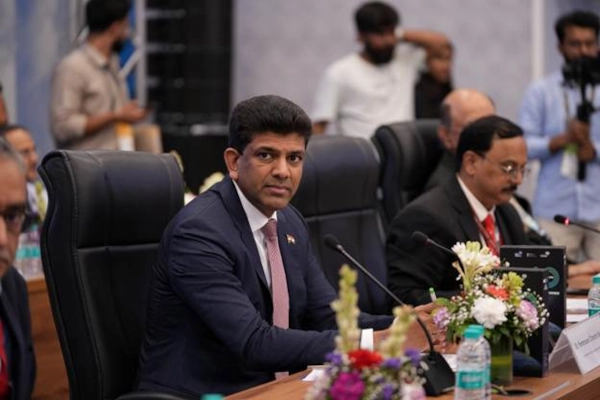
India has set an ambitious target of securing at least 10% of global 6G patents and contributions to international standards as it seeks to establish itself as a major developer of next-generation telecommunications technologies. The government has also called for the development of indigenous alternatives to critical imported network equipment, strengthening India’s technological capabilities and reducing dependence on foreign suppliers.
Union Minister of State for Communications and Rural Development Dr Chandra Sekhar Pemmasani outlined these priorities at the India Mobile Congress (IMC) 2026 on October 8. Addressing a technology leadership dialogue involving chief technology officers and industry stakeholders, he emphasised that India’s next phase of telecom development must focus on indigenous research, intellectual property, advanced manufacturing and secure network infrastructure.
The Minister identified quantum communications, artificial intelligence-native networks, indigenous telecom equipment and cybersecurity as major priorities. He also called for measurable research and standardisation targets among telecom operators, technology companies and academic institutions.
India Aims to Become a Global Contributor to 6G Standards
India’s objective of securing a 10% share of global 6G patents and standards contributions represents a strategic shift from deploying telecommunications infrastructure to developing technologies that influence future international networks.
Global telecommunications standards determine how equipment, software and communication systems from different manufacturers operate together. Participation in their development allows countries and companies to influence technical specifications, contribute innovations and establish intellectual property rights.
Dr Pemmasani urged major telecom operators to establish quarterly and annual targets for contributions to international standards, standard-essential patents (SEPs) and collaborative research with universities.
Standard-essential patents cover inventions necessary to implement particular technical standards. They can become valuable intellectual property assets, subject to applicable licensing obligations, while strengthening the position of companies participating in global technology development.
India’s 6G ambitions are supported by the Bharat 6G Vision and the Bharat 6G Alliance, which bring together industry, academic institutions, research organisations and other stakeholders to develop indigenous capabilities.
The 10% objective remains a national target rather than an achieved share of global 6G intellectual property. Its realisation will depend on sustained research, internationally recognised inventions and active participation in standard-setting organisations.
Government Calls for Indian Alternatives to 20 Critical Imported Technologies
A major priority outlined by Dr Pemmasani is reducing India’s dependence on imported telecommunications technologies.
The Minister called on industry stakeholders to identify between 10 and 20 critical network technologies currently sourced from overseas and develop competitive Indian alternatives.
He identified component manufacturing, chipsets, radio equipment, routers and advanced optical systems as important areas requiring indigenous technological development.
These technologies form essential parts of modern telecommunications infrastructure. Network processors and chipsets perform specialised computing functions, while radio systems enable wireless communication between mobile devices and network infrastructure. Routers manage the movement of data across networks, and optical systems support high-capacity data transmission.
Developing domestic alternatives would require coordinated investment in semiconductor design, telecommunications hardware, embedded software, testing facilities and advanced manufacturing.
The emphasis extends beyond assembling imported equipment. India aims to strengthen its ability to design, develop and manufacture technologies that can compete in domestic and international telecommunications markets.
A stronger indigenous equipment ecosystem could also create opportunities for Indian electronics manufacturers, semiconductor design companies, deep-tech startups and specialised engineering enterprises.
India Connects Every District with 5G Through Nearly 5.6 Lakh Base Stations
Dr Pemmasani highlighted India’s telecommunications expansion over the past five years, noting that the country has connected more than one billion people through its communications infrastructure.
According to the Minister, 5G services now reach every district, supported by nearly 5.6 lakh Base Transceiver Stations (BTS). The expansion of fourth-generation mobile networks into villages has also strengthened connectivity across rural areas.
India’s development of an indigenous 4G technology stack represents another important achievement. A domestically developed telecom stack combines network technologies and software required to operate mobile communication services, providing a foundation for further technological development.
The Minister also highlighted BharatNet and the 4G saturation projects, which aim to extend digital connectivity to underserved areas.
BharatNet focuses on expanding optical-fibre connectivity to rural regions, while the 4G saturation programme addresses mobile connectivity gaps in uncovered villages.
Together, these initiatives strengthen the infrastructure needed to support digital public services, education, healthcare, financial transactions and economic activity across India.
Telecom Technology Development Fund Supports 136 Research Projects
India’s telecommunications research ecosystem is receiving support through the Telecom Technology Development Fund (TTDF), which finances the development of indigenous communication technologies.
Dr Pemmasani said approximately 136 research and development projects worth ₹500 crore have received funding under the programme.
These projects cover advanced areas including 5G, 6G, quantum communications, non-terrestrial networks, optical communication systems, indigenous core networks and telecommunications security.
Non-terrestrial networks integrate satellite-based and other non-ground communication platforms with conventional terrestrial infrastructure. Such technologies could improve connectivity in remote areas and provide additional network resilience.
Advanced optical systems are equally important as growing data traffic requires faster and more efficient transmission infrastructure.
The Minister also highlighted the availability of 5G testbeds in academic institutions, enabling students, researchers and startups to experiment with communication technologies and develop practical applications.
These facilities provide opportunities to test network equipment, software and emerging applications before commercial deployment, helping bridge the gap between academic research and industry requirements.
C-DOT Urged to Begin Real-World Quantum Communication Trials
Quantum communication emerged as a major priority during the Minister’s address, particularly its application to securing critical telecommunications infrastructure.
Dr Pemmasani called on the Centre for Development of Telematics (C-DOT) to move quantum communication technologies beyond laboratory demonstrations and initiate trials with telecom operators.
He specifically highlighted quantum-safe encryption for critical communication links and Quantum Key Distribution (QKD) wherever economically justified.
Quantum Key Distribution uses principles of quantum physics to establish shared encryption keys and can reveal certain forms of interference or attempted interception during the key-exchange process.
Quantum-safe encryption, particularly post-quantum cryptography, uses mathematical algorithms designed to resist attacks from sufficiently capable future quantum computers. Unlike QKD, these methods can be implemented through conventional computing and communications infrastructure.
The two approaches offer different technical pathways for strengthening communication security.
Real-world operator trials would help evaluate performance, integration requirements, operational reliability and deployment costs under commercial network conditions.
Such assessments are important because technologies that perform successfully in laboratories must also meet the reliability, scalability and economic requirements of large telecommunications networks.
India Plans Transition from AI-Assisted to AI-Native Telecom Networks
Another priority is the development of AI-native telecommunications networks, in which artificial intelligence becomes an integral part of network architecture rather than an additional software application.
Conventional telecom networks increasingly use AI-assisted tools for selected functions such as traffic analysis, predictive maintenance and fault detection. AI-native networks aim to incorporate intelligent decision-making more extensively into network operations.
These capabilities could enable more automated resource allocation, dynamic network optimisation, early fault identification and improved management of complex communication environments.
The transition is especially relevant to future 6G systems, which are expected to support diverse applications with different requirements for capacity, latency, reliability and energy efficiency.
Artificial intelligence could help networks adjust their operations according to changing traffic conditions and service requirements, reducing the need for constant manual intervention.
Developing AI-native telecommunications infrastructure will require expertise in wireless communications, machine learning, distributed computing, cybersecurity and network engineering.
For India’s technology industry, the shift creates opportunities to develop indigenous network intelligence platforms, specialised software and advanced communication systems.
Telecom Security and Trusted Supply Chains Become National Priorities
Dr Pemmasani emphasised that telecommunications development must place greater importance on national security, equipment reliability, supply-chain protection and fraud prevention.
Modern communications infrastructure supports banking, government services, emergency response, industrial operations and other essential activities. Disruptions or vulnerabilities in these networks can therefore affect multiple sectors of the economy.
The Minister called for stronger safeguards covering telecommunications equipment, network infrastructure and the supply chains responsible for providing critical components.
Equipment security involves assessing hardware and software for vulnerabilities, while supply-chain security focuses on ensuring the integrity and reliability of technologies used within communication networks.
Telecommunications fraud prevention is another important requirement as digital connectivity expands and communication systems become more complex.
India’s emphasis on indigenous network technologies complements these security priorities by encouraging greater domestic expertise in equipment design, software development, testing and maintenance.
Telecommunications Act Reforms Support Technology Development
The Minister also highlighted regulatory developments under the Telecommunications Act, 2023, stating that most of its associated rules have now been notified.
He said the government’s objective is to establish a simpler and technology-neutral regulatory framework suited to the requirements of modern telecommunications.
Technology-neutral regulation seeks to accommodate changing technical approaches without unnecessarily restricting innovation to particular systems or architectures.
Dr Pemmasani invited telecom operators, equipment manufacturers and technology companies to identify regulatory areas requiring simplification or policy adjustments.
This engagement is intended to support the development of emerging communication technologies while maintaining appropriate regulatory oversight.
A predictable regulatory environment is particularly important for companies investing in advanced telecommunications infrastructure, where research, product development and deployment often require substantial capital and long development periods.
From Digital India to Intelligent India
Concluding his address, Dr Pemmasani presented India’s future telecommunications ambitions as an extension of the country’s digital transformation.
“The last decade was Digital India. Our goal is to make the next decade an Intelligent India,” he said.
The distinction reflects a shift in priorities from expanding basic digital access towards developing intelligent, secure and technologically advanced communication systems.
India’s immediate achievements in mobile connectivity, indigenous 4G development and research funding have established a foundation for this next phase. The challenge now is to translate domestic research into commercially competitive technologies, internationally recognised patents and practical network deployments.
The combination of 6G research, indigenous telecom manufacturing, quantum communication trials and AI-native networks offers an opportunity to strengthen India’s position in the global telecommunications industry.
With growing collaboration among government institutions, telecom operators, research organisations and startups, India is working towards becoming not only one of the world’s largest telecommunications markets but also a significant developer of the technologies and standards that will shape future global connectivity.
References
- Press Information Bureau, Ministry of Communications, October 8, 2026. India Targets 10% of Global 6G Patents and Standards: Union Minister of State for Communications Dr Chandra Sekhar Pemmasani.
https://www.pib.gov.in/PressReleseDetailm.aspx?PRID=2320979&lang=1®=3 - Press Information Bureau, Ministry of Communications, March 25, 2026. Under the Leadership of Prime Minister Shri Narendra Modi, India Will Achieve Global Leadership in 6G: Union Minister Jyotiraditya M. Scindia.
https://www.pib.gov.in/PressReleasePage.aspx?PRID=2245282®=3&lang=1 - Department of Telecommunications, Government of India. Bharat 6G Vision and Telecommunications Research Initiatives.
https://www.dot.gov.in/ - Centre for Development of Telematics (C-DOT). Indigenous Telecommunications Research and Development.
https://www.cdot.in/
You may also like
-
India’s Defence Procurement Approvals Cross ₹1.62 Lakh Crore as Indigenous Manufacturing Gains Momentum
-
India’s Quick Commerce Market Could Reach US$90 Billion by FY31 as Retail Shopping Undergoes Major Transformation
-
Chokuwa Rice of Assam — The Traditional “Soak-and-Eat” Grain of the Brahmaputra Valley
-
India’s Satellite Broadband Industry Nears Commercial Launch as Bharti OneWeb, Jio and Starlink Await Final Approvals
-
India’s Defence Electronics Industry Expands as BEL, Astra Microwave and Private Manufacturers Strengthen Indigenous Supply Chains
