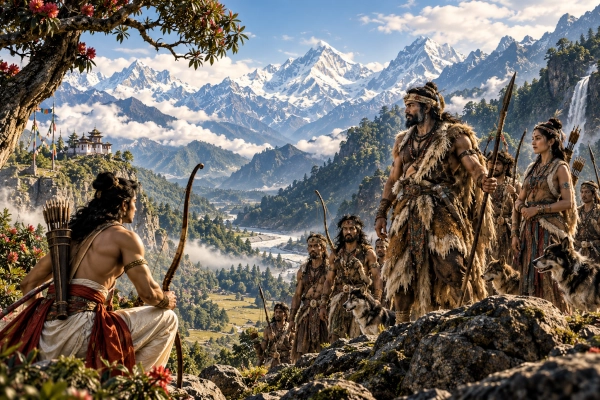
The Kiratas occupy a distinctive place in the geographical world of the Mahabharata. They are not presented as the inhabitants of a single compact kingdom with clearly defined borders. Instead, the name appears to describe a number of mountain-dwelling peoples spread across the Himalayan foothills, high valleys and eastern hill regions of ancient Bharatavarsha. In modern geographical terms, this broad cultural zone can be associated with parts of the Himalayan belt extending through northern and northeastern India, Nepal and the adjoining hills towards Bhutan, although the epic’s Kirata country cannot be reduced to the boundaries of any present-day nation.
The Mahabharata repeatedly associates the Kiratas with mountains, forests and remote frontier regions. One of its most detailed geographical descriptions places Kirata chiefs on the northern slopes of the Himavat, around mountains connected with the eastern direction and on both sides of the Lohitya region. These chiefs are described as bringing forest and mountain products to Yudhishthira during his imperial assembly, including valuable skins, gold, fragrant woods, animals and other products obtained from distant terrain. The passage conveys the picture of communities whose wealth came from the resources of the mountains rather than from the large agricultural plains that supported kingdoms such as Kuru, Panchala or Magadha.
A People Spread Across the Himalayan World
The geographical references to the Kiratas are unusually broad. They appear in accounts of expeditions towards more than one direction, suggesting that Kirata communities were distributed across a considerable portion of the Himalayan arc rather than confined to a single valley.
This explains why attempts to identify “Kirata” with one precise modern territory are difficult. The term probably covered several related or similarly perceived hill communities occupying different stretches of mountainous country. Later geographical traditions likewise placed Kiratas towards the eastern edges of Bharatavarsha and associated them with Himalayan populations. Some historical interpretations have connected the ancient name with the later Kiranti or Kirati peoples of eastern Nepal, but the range suggested by epic literature is considerably wider.
The eastern Himalayas would have formed one of the most natural environments for such communities. The region consists of steep ridges, deep river valleys, thick forests and narrow corridors linking the plains with the Tibetan plateau. From the foothills of present-day Nepal eastwards through Sikkim, northern Bengal, Arunachal Pradesh and the Bhutan Himalayan zone, numerous communities historically developed economies based on forest products, hunting, animal husbandry, shifting cultivation, trade and control of mountain routes.
The Kiratas of the Mahabharata belong to this wider geographical world.
Kiratas and the Great Himalayan Routes
Although mountainous terrain could isolate communities, the Himalayas were never an impenetrable wall. Ancient pathways connected the Gangetic plains with Himalayan valleys and regions beyond the mountains. Salt, wool, medicinal plants, forest products, metals, precious stones, animals and other commodities travelled along these routes.
The Kiratas appear in the epic as inhabitants of precisely such frontier landscapes. Their presence near routes leading into the higher Himalayas would have placed them between the great kingdoms of the plains and the peoples living farther north.
A revealing passage occurs during the Pandavas’ Himalayan journey in the Vana Parva. After travelling through difficult mountain country associated with China, Tukhara, Darada and Kulinda, the Pandavas eventually reach the realm of Suvahu, king of the Kiratas. The account places a Kirata polity within a larger chain of Himalayan territories rather than treating the Kiratas merely as isolated forest hunters.
The reference to a Kirata king is important. It shows that the epic’s use of the name could encompass organised political communities with recognised rulers. Elsewhere, several Kirata chiefs and kings appear separately, reinforcing the impression that the Kiratas consisted of numerous clans and local polities rather than one centralised empire.
The Kiratas in Yudhishthira’s Imperial World
The Kiratas become particularly visible during the Sabha Parva, when rulers and peoples from distant parts of Bharatavarsha travel to Yudhishthira’s court.
Their appearance among the tribute-bearing peoples demonstrates the immense geographical scope claimed for Yudhishthira’s Rajasuya. The epic brings together kingdoms from the Gangetic plains, northwest, Deccan, coastal regions, Himalayan valleys and distant eastern territories.
The gifts attributed to the Kiratas are themselves geographical clues. They bring products characteristic of mountains and forests—skins, aromatic woods, gold and unusual animals and birds. Such tribute differs markedly from the agricultural produce and manufactured goods associated with some of the settled kingdoms of the plains.
The description reflects an ancient understanding of economic geography. Different ecological regions contributed different forms of wealth. The plains produced grain and supported dense cities and armies; coastal regions controlled maritime commerce; mountainous territories supplied timber, minerals, animals, medicinal resources and valuable forest products.
The Kiratas represented this Himalayan frontier economy.
Bhima and the Eastern Kiratas
Kirata communities also appear in connection with the great military expeditions undertaken before Yudhishthira’s Rajasuya sacrifice.
Bhima was sent eastwards to establish Yudhishthira’s authority over the kingdoms of that direction. His route crossed a succession of territories stretching from the middle Gangetic region towards the Himalayan foothills and eastern lands. Kirata rulers are included among the peoples encountered during these campaigns.
These references help explain why Kirata geography extends so naturally towards the eastern Himalayas. The eastern expedition brought the Pandavas into contact with communities occupying the zone where the Gangetic and Brahmaputra worlds approached the mountains.
Yet the epic also knows Kiratas in other Himalayan directions. Their distribution therefore appears to have followed the mountain belt rather than a single political frontier.
Shiva as the Kirata
No episode gives the Kirata identity greater prominence than Arjuna’s encounter with Shiva in the Himalayas.
During the Pandavas’ exile, Arjuna undertakes severe austerities in the mountains in order to obtain celestial weapons. Shiva decides to test him and descends upon the Himalayas disguised as a powerful Kirata hunter, accompanied by Uma in the form of a Kirata woman and a large company similarly dressed as Kiratas.
A wild boar appears, and both Arjuna and the mysterious hunter shoot it. A dispute follows over whose arrow killed the animal. Arjuna challenges the Kirata, and an extraordinary battle begins.
Arjuna unleashes the Gandiva against his opponent, but the hunter remains unharmed. His arrows eventually run out. He attacks with his sword, then with trees, stones and finally his bare hands, yet he cannot overcome the stranger.
Only after recognising the divine nature of his adversary does Arjuna realise that the Kirata is Mahadeva himself. Shiva reveals his true form and, pleased by Arjuna’s courage and determination, grants him the terrible Pashupatastra.
The episode is remembered as the Kiratarjuniya tradition—Shiva as the Kirata confronting Arjuna—and later became one of the celebrated themes of Sanskrit literature and Indian art.
Why Shiva Appears as a Mountain Hunter
Shiva’s choice of a Kirata form is closely connected with the setting of the episode.
Arjuna is not at Hastinapura, Indraprastha or another royal centre. He has entered the wilderness of the Himalayas, a landscape outside the familiar political world of the Gangetic plains. Here the hunter rather than the courtly warrior belongs naturally to the environment.
The Mahabharata specifically portrays Shiva descending upon the Himavat in Kirata appearance. Arjuna himself initially understands his opponent as an exceptionally powerful mountain-dweller.
The story consequently preserves more than a divine disguise. It links the Kirata identity unmistakably with the Himalayan wilderness—its forests, hunting traditions, mountains and communities accustomed to terrain that an outsider such as Arjuna enters only after a demanding journey.
Shiva’s appearance also gives the Kirata figure immense symbolic dignity. The seemingly ordinary mountain hunter whom Arjuna first challenges turns out to be the supreme deity whose favour he has been seeking.
Hunters, Warriors and Mountain Communities
The Kiratas are frequently characterised through their association with hunting and archery. Such skills would have been especially valuable in heavily forested and mountainous environments where mobility, knowledge of terrain and proficiency with bows were essential.
This should not lead to the assumption that the epic portrays all Kiratas as simple wandering hunters. Its references to Kirata kings, chiefs, tribute, military forces and territories show a more complex society.
The name appears to have covered communities ranging from forest and hunting groups to organised Himalayan chiefdoms. What united them in the epic imagination was primarily geography: they belonged to the mountains and the difficult frontier country beyond the great settled plains.
Their weapons, clothing and way of life consequently appear different from those of the Kuru aristocracy. Yet they remain woven into the political and cultural landscape of Bharatavarsha.
Kirata Country and the Lohitya Region
One of the most significant geographical clues in the Mahabharata is its association of some Kiratas with Lohitya.
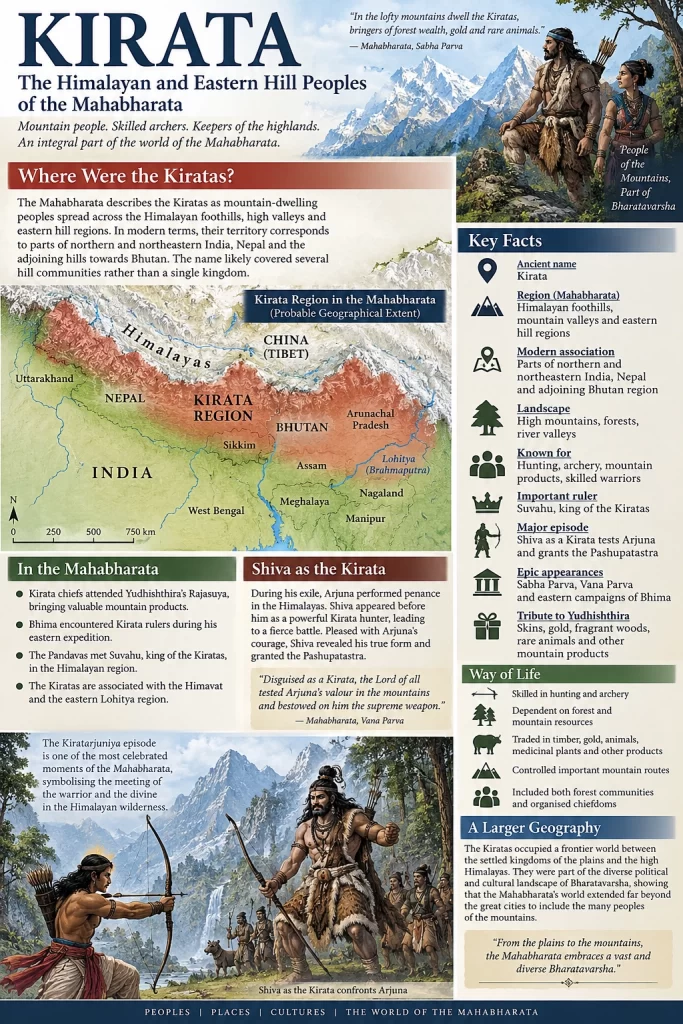
Lohitya is generally connected with the great river system of the far east, particularly the Brahmaputra region. The epic’s description of Kiratas around the Lohitya mountains therefore strengthens their association with the northeastern frontier of the subcontinent.
This eastern zone would broadly correspond today to the Himalayan and sub-Himalayan landscapes around Arunachal Pradesh, Assam’s northern approaches, eastern Bhutan and neighbouring highland regions.
At the same time, other references draw Kirata geography westwards along the Himalayas. There is consequently no single point on a modern map that can legitimately be labelled the entire “Kirata kingdom.”
It is better understood as a Kirata cultural-geographical belt.
Kirata and Ancient Nepal
Among modern regions, Nepal has preserved the Kirata name most clearly.
Historical traditions of Nepal remember Kirata or Kiranti peoples particularly in the eastern Himalayan region. Communities traditionally grouped under the wider Kiranti cultural and linguistic sphere have long inhabited the hills east of the Kathmandu Valley.
This continuity has naturally encouraged scholars to connect these Himalayan peoples with the Kiratas mentioned in Sanskrit literature. The association is plausible at the level of geography and historical naming, but the Kiratas of the Mahabharata appear to have occupied a much broader region than eastern Nepal alone. Later commentary on ancient geographical texts likewise notes that the Kirata designation was once applied across a wider portion of the southern Himalayan slopes.
Ancient Kirata geography should therefore not be treated as identical to the territory of any single modern Kirati community.
The Bhutan and Northeastern Himalayan Connection
The eastern extension of the Kirata world also brings it naturally towards the mountainous territory of modern Bhutan and northeastern India.
The ancient texts do not provide modern borders or a detailed administrative map, and it would be misleading to state that Bhutan itself was called Kirata. What can reasonably be said is that the ecological and geographical zone associated with eastern Kirata populations continued through the Himalayan and sub-Himalayan hills that today lie across this region.
The same caution applies to northeastern India. The ancient Kirata designation has sometimes been used broadly when discussing early Himalayan and northeastern populations, but modern communities possess their own distinct identities, histories and languages. An ancient literary category should not automatically be imposed upon all of them.
The Mahabharata gives us a broad geographical tradition, not a modern ethnographic classification.
Between the Plains and the High Himalayas
The position of the Kiratas becomes clearer when viewed within the larger geography of the epic.
To their south lay powerful agricultural kingdoms connected by the Ganga and its tributaries. To the north and northeast stretched increasingly difficult mountains leading towards the trans-Himalayan world. Between these two zones were forested valleys and hill societies controlling routes, resources and passages through the mountains.
The Kiratas inhabited this intermediate world.
Their country was neither wholly isolated from the plains nor absorbed into the political structures of the great Gangetic kingdoms. They traded, fought, paid tribute, maintained their own chiefs and occasionally entered the narratives of kings and warriors from the plains.
The Mahabharata consequently preserves a picture of ancient India that is considerably more diverse than a map consisting only of large kingdoms. Alongside Hastinapura, Panchala, Magadha, Gandhara and other famous states existed numerous mountain peoples whose territories formed essential parts of the subcontinent’s political geography.
Kirata in the Geography of the Mahabharata
Ancient name: Kirata
Broad region: Himalayan foothills, mountain valleys and eastern hill regions
Modern geographical association: Parts of northern and northeastern India, Nepal and the adjoining Bhutan Himalayan zone
Landscape: High mountains, wooded slopes, river valleys and Himalayan forests
Epic associations: Himalayan chiefs, archers, hunters, mountain rulers and tribute-bearing peoples
Important ruler mentioned: Suvahu, king of the Kiratas
Major Mahabharata episode: Shiva assumes the form of a Kirata and tests Arjuna before granting him the Pashupatastra
Important geographical associations: Himavat and the eastern Lohitya region
The Kiratas reveal an important side of the Mahabharata’s geography. Bharatavarsha was not imagined only through its capitals, royal dynasties and fertile river plains. Its world extended deep into forests, across mountain passes and towards communities inhabiting some of the most difficult landscapes of the subcontinent.
Among those peoples, the Kiratas stand out prominently.
They appear at Yudhishthira’s imperial gathering, in the campaigns of the Pandavas, along Himalayan pilgrimage routes and, most memorably, in one of Arjuna’s greatest encounters. When Shiva himself chooses to appear before Arjuna as a Kirata hunter on the slopes of the Himalayas, the epic permanently binds the Kirata identity to the majesty, danger and sacred character of the mountains.
Their precise ancient boundaries may no longer be recoverable, but their geographical setting remains unmistakable: the vast Himalayan and eastern hill world where the plains of Bharatavarsha rise towards the great mountains of the north and northeast.
You may also like
-
Shaka in the Mahabharata: Central Asia’s Steppe Peoples, Nakula’s Campaign and the Alliance with Duryodhana
-
Yavana in the Mahabharata: Greek Connections, Pandava Campaigns and the Warriors of Kurukshetra
-
India and Sri Lanka Launch SAMHiTA Manuscript Digitisation Project to Preserve Ancient Buddhist Heritage
-
ASI Uses Ground-Penetrating Radar to Investigate Ancient Buddhist Stupa at Ujjain After Nearly 90 Years
-
Pahlava: The Parthian World Beyond India’s Northwestern Frontiers in the Mahabharata
