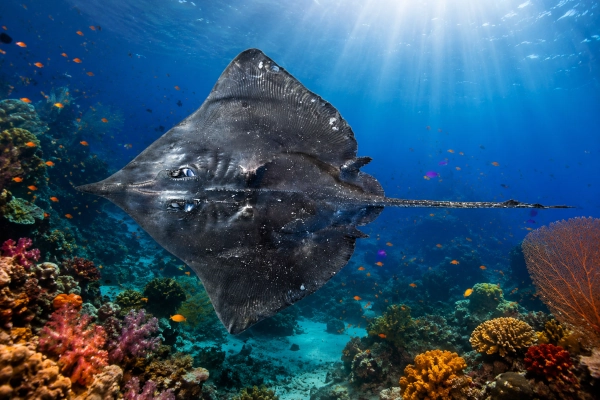
Indian scientists have described a new species of deep-sea skate from the southeastern Arabian Sea, adding another previously unrecognised species to India’s marine biodiversity and highlighting how much of the country’s deeper waters remains scientifically unexplored.
Named Dipturus dhritiae and commonly referred to as the Arabian Skate, the species was identified by scientists from the Zoological Survey of India, working with the ICAR-Central Marine Fisheries Research Institute and international collaborators. The research formed part of the Ministry of Earth Sciences’ Deep Ocean Mission, under a programme examining the taxonomy, distribution, biology and status of deep-sea sharks, rays and related cartilaginous fishes in Indian waters.
The new species has been recorded from deep waters off Kerala and the Wadge Bank region, where specimens were collected at depths ranging from approximately 400 to 600 metres. The largest known individual measured 131.5 centimetres, making the Arabian Skate a substantial member of India’s deep-sea batoid fauna.
A Deep-Sea Species Hidden in Plain Sight
One of the most interesting aspects of the discovery is that the Arabian Skate was not entirely unknown to fisheries or scientists. Specimens had been appearing for decades as incidental catch in commercial deep-sea shrimp trawls, but they were repeatedly identified as another species, Dipturus springeri.
The confusion persisted for more than four decades because closely related skates can resemble one another externally. Detailed morphological examination combined with molecular analysis eventually demonstrated that the Arabian Sea specimens represented a distinct species.
The discovery therefore illustrates an important feature of modern taxonomy. New species are not always found in places never visited by humans. Some can remain hidden within fisheries catches, museum collections or previously identified specimens until improved genetic techniques and closer anatomical studies reveal that they belong to a separate evolutionary lineage.
Five Rows of Thorns Help Distinguish the Species
The Arabian Skate possesses several physical features that helped researchers differentiate it from related members of the genus Dipturus.
One of its most distinctive characteristics is the presence of five separate rows of thorns along the tail. These structures, together with detailed measurements of body proportions and other anatomical characteristics, provided morphological evidence that the fish differed from species with which it had previously been confused.
Skates belong to the broader group of cartilaginous fishes known as chondrichthyans, which also includes sharks and rays. Unlike bony fishes, their skeletons are composed primarily of cartilage.
Their flattened bodies and enlarged pectoral fins allow them to live close to the seafloor, where many species hunt crustaceans, small fishes and other benthic animals.
DNA Confirmed That It Was a Separate Species
Morphology alone was not the only evidence used to establish the Arabian Skate.
Researchers sequenced its mitochondrial genome and compared the genetic material with closely related species. The analysis showed that Dipturus dhritiae differs genetically from the Travancore Skate, Dipturus johannisdavisi, by approximately 3.8% to 4.7% in the sequences examined.
This level of divergence, together with the anatomical differences, supported recognition of the Arabian Skate as a distinct species.
The work is an example of what scientists describe as integrative taxonomy, in which physical characteristics and molecular evidence are combined rather than relying on appearance alone.
This approach is increasingly important for sharks, skates and rays because closely related species can sometimes look extremely similar despite having distinct evolutionary histories.
Named After ZSI’s First Woman Director
The scientific name Dipturus dhritiae honours Dr Dhriti Banerjee, the first woman Director of the Zoological Survey of India.
ZSI said the name recognises her contribution to biological-diversity research and her leadership in expanding scientific investigation of India’s fauna. Banerjee is also the lead principal investigator associated with ZSI’s Deep Ocean Programme.
The naming gives the species an unusual connection with the institution responsible for documenting much of India’s animal diversity since the early twentieth century.
Part of India’s Deep Ocean Mission
The discovery emerged from a dedicated programme titled “Deep-Sea Chondrichthyans of India: Taxonomy, Distribution, Biology and Current Status.”
The project forms part of the Ministry of Earth Sciences’ Deep Ocean Mission and is designed to improve understanding of sharks, skates and rays living within India’s Exclusive Economic Zone.
ZSI’s annual reporting shows that surveys under the programme collected hundreds of deep-sea chondrichthyan specimens from different coastal regions. The work has already produced evidence of several previously unknown species and generated DNA barcodes that can help researchers identify animals more accurately in future surveys.
The Arabian Skate is therefore not an isolated discovery but part of a broader effort to create a much more detailed inventory of India’s deep-sea biodiversity.
Kerala’s Deep Waters Are Emerging as an Important Research Zone
The waters off Kerala have repeatedly produced important records of sharks, rays and other deep-sea fishes.
The newly described Arabian Skate was collected from the Kerala coast and the Wadge Bank, a productive marine area located south of the Indian peninsula.
These waters descend into deeper habitats that remain much less intensively studied than India’s coastal ecosystems.
At depths of 400 to 600 metres, sunlight is extremely limited, temperatures are lower and environmental conditions differ greatly from shallow coastal waters. Species living there may be rarely encountered except through specialised surveys or deep-water fishing operations.
The discovery demonstrates that significant components of marine biodiversity can remain poorly documented even within commercially exploited waters.
Kollam Slope Identified as Important Shark and Ray Habitat
The research team has also worked on identifying areas of special importance for sharks and rays within India’s Exclusive Economic Zone.
ZSI reported that the scientists mapped the Kollam Slope Important Shark and Ray Area, or ISRA, as part of the broader programme. The occurrence of Dipturus dhritiae within this region adds further evidence of the biological importance of the deeper waters off India’s southwest coast.
Important Shark and Ray Areas are intended to identify locations that may be particularly significant for the survival, feeding, reproduction or movement of chondrichthyan species.
Such mapping can provide scientific information for future fisheries management and marine-conservation planning.
Deep-Sea Skates Are Particularly Vulnerable to Fishing Pressure
The discovery also has an important conservation dimension.
Many deep-sea sharks and rays reproduce slowly, mature relatively late and produce fewer offspring than faster-growing bony fishes. These biological characteristics mean populations can take a long time to recover after heavy fishing mortality.
ZSI has specifically highlighted low reproductive output, slow population recovery and vulnerability to incidental capture as major concerns for deep-sea chondrichthyans.
This becomes particularly important when a species occurs as bycatch rather than as a deliberately targeted fishery.
Because the Arabian Skate had been appearing in deep-sea shrimp trawls while being mistaken for another species, fisheries records may not previously have reflected its true distribution or abundance.
Correctly identifying a species is therefore the first requirement for assessing whether its population is stable, declining or restricted to particular habitats.
Taxonomy Is the Foundation of Conservation
The discovery illustrates why taxonomy remains fundamental to wildlife conservation.
A species cannot be effectively monitored if scientists do not know that it exists. Fisheries managers cannot calculate its catch rates, assess population trends or identify critical habitats if different species are being grouped under the same name.
The recognition of Dipturus dhritiae transforms what was once considered part of another skate population into a separate biological entity requiring its own ecological assessment.
Future work will need to determine its wider distribution, population structure, reproductive biology and vulnerability to fisheries.
Without that baseline information, it is difficult to establish whether the Arabian Skate is widespread across the western Indian Ocean or restricted mainly to a comparatively narrow section of the southeastern Arabian Sea.
A Larger Survey Is Revealing India’s Hidden Batoid Diversity
ZSI’s broader work suggests that India’s skate and ray diversity may still be underestimated.
Earlier surveys covering Indian coastal waters documented dozens of batoid species and identified multiple specimens requiring further taxonomic investigation. ZSI’s annual reports record several new species and new national records emerging from these programmes.
The increased use of DNA barcoding, mitochondrial sequencing and detailed morphological measurements is allowing researchers to revisit classifications based largely on older external descriptions.
That is particularly valuable in the Indian Ocean, where marine biodiversity is exceptionally high but many deeper habitats remain poorly sampled.
The Deep Ocean Mission Is Expanding Beyond Mineral Exploration
India’s Deep Ocean Mission is often associated with deep-sea technology, mineral resources and future human-operated submersibles, but biological exploration is another important component of the programme.
Understanding the organisms inhabiting deeper Indian waters is essential before these environments undergo greater commercial or technological activity.
Projects examining sharks, rays and other deep-sea fauna provide the biodiversity baseline necessary to understand what ecosystems exist in areas that may later experience increased fishing, scientific exploration or resource development.
The discovery of the Arabian Skate demonstrates the scientific return from this biological component of deep-ocean exploration.
A New Species, But Also a Warning
The significance of Dipturus dhritiae lies not simply in adding another scientific name to India’s biodiversity records.
Its history shows that a sizeable deep-sea animal measuring more than a metre in length could remain taxonomically confused for decades despite regularly appearing in commercial fishing operations.
That raises an obvious possibility: other poorly understood deep-water species may still be hidden within Indian fisheries catches and scientific collections.
ZSI has already indicated that continued taxonomic and molecular investigation under the Deep Ocean Mission is likely to reveal additional previously undescribed chondrichthyan species from Indian waters.
The Arabian Skate therefore represents both a discovery and a reminder of how incomplete our knowledge of India’s deeper seas remains.
As scientific exploration moves further below the surface, India is beginning to document a biological world that has long existed beyond ordinary observation. From the 400–600 metre depths off Kerala, Dipturus dhritiae has now emerged from decades of mistaken identity to become a distinct part of India’s known marine wildlife.
You may also like
-
Ongole Cattle: Andhra Pradesh’s Powerful Zebu Breed That Helped Shape the Nelore and Brahman
-
Indian Scientists Map Genomes of Four Asian Hornbills to Strengthen Conservation Science
-
World’s First Captive-Bred Slender-Billed Vultures Released Into the Wild in Assam
-
Rare Migratory Smew Recorded for First Time in Assam’s Laokhowa Wildlife Sanctuary
-
Rare Siberian Sharp-Tailed Sandpiper Recorded at Najafgarh
