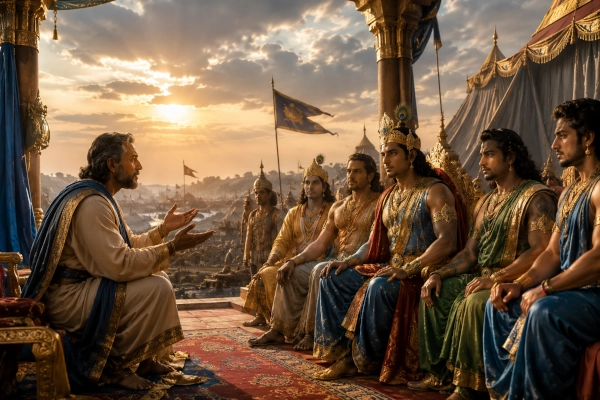
Long before the emergence of permanent embassies, professional foreign services, diplomatic cables and international organisations, the Mahabharata presented one of diplomacy’s most enduring dilemmas: what should an envoy do when he is required to faithfully represent a policy whose wisdom he privately doubts?
That dilemma falls upon Sanjaya in the Udyoga Parva, when Dhritarashtra sends him from Hastinapura to the Pandava camp at Upaplavya. Sanjaya understands both sides of the dispute unusually well. He knows the grievances of the Pandavas, recognises the military strength gathering around them and understands the danger created by Duryodhana’s refusal to compromise. At the same time, he is not travelling as an independent mediator or philosopher. He is travelling as the representative of the king of Hastinapura.
His task is therefore deeply complicated. Dhritarashtra wants him to persuade Yudhishthira to preserve peace, but the Kuru court is unwilling to make the political concession most likely to secure that peace: restoration of the Pandavas’ rightful share of the kingdom. Sanjaya must consequently defend a negotiating position whose internal contradiction he can clearly see.
Seen through a modern lens, his mission resembles the work of a professional diplomat sent abroad to defend a government policy that he may privately consider unrealistic. He cannot substitute his personal judgement for the instructions of his sovereign, yet he also has a responsibility to return home and tell his government what the situation actually looks like. It is this tension between loyalty, professional duty and honest advice that makes Sanjaya’s embassy one of the most sophisticated diplomatic episodes in the Mahabharata.
The War Has Not Yet Become Inevitable
When Sanjaya departs for Upaplavya, the armies that will eventually fight at Kurukshetra are beginning to assemble, but war has not yet become unavoidable. The Pandavas have completed their exile and are demanding restoration of their political rights. Their allies are gathering, while senior figures in Hastinapura such as Bhishma and Vidura increasingly understand that continued refusal to compromise may bring disaster upon the Kuru dynasty.
Dhritarashtra himself fears the consequences of war. He knows the capabilities of Bhima and Arjuna, understands the importance of Krishna’s support for the Pandavas and recognises that Yudhishthira has suffered grave injustice. His instructions to Sanjaya acknowledge the Pandavas’ virtues and repeatedly emphasise the desirability of peace.
Yet Dhritarashtra’s diplomacy contains a fundamental weakness. He wants peace while avoiding the political decision required to create it. He hopes that Yudhishthira can somehow be persuaded to renounce conflict without Duryodhana surrendering the territory and authority that lie at the centre of the dispute.
This transforms the negotiation into something more complicated than a genuine search for compromise. Dhritarashtra is effectively asking the injured side to bear most of the cost of preventing war. Sanjaya understands that difficulty before he even begins his mission.
Sanjaya Is an Envoy, Not the Policymaker
The distinction between the messenger and the policymaker is essential to understanding the episode. Sanjaya is not free to design a new settlement on behalf of Hastinapura. His duty is to communicate the policy he has been authorised to carry.
When he arrives before Yudhishthira and the assembled Pandava leadership, he therefore presents Dhritarashtra’s argument for peace. He praises the Pandavas, emphasises the horrors that a great war would bring and appeals strongly to Yudhishthira’s reputation for restraint and righteousness.
The argument itself is not irrational. Sanjaya understands that a war involving the major kingdoms of the subcontinent would inflict catastrophic losses on all sides. Kurukshetra will eventually confirm the accuracy of that warning, destroying armies, families and dynasties while leaving even the victors devastated.
The difficulty is that Sanjaya is effectively asking the Pandavas to avoid war by accepting permanent political dispossession. His message urges restraint without offering an adequate remedy for the injustice that created the crisis.
That is where diplomacy begins to approach its natural limit. An envoy may explain, persuade and warn, but he cannot manufacture concessions that his own government refuses to authorise.
Peace Without Settlement Is Not Sustainable Diplomacy
Yudhishthira understands the contradiction immediately. He does not reject peace and, throughout the negotiations preceding Kurukshetra, repeatedly demonstrates his willingness to accept compromise. What he refuses to accept is the idea that peace should require the Pandavas to surrender every political right while Duryodhana retains everything gained through the events that led to their exile.
For Yudhishthira, peace has to contain an element of settlement. If legitimate rights are restored, coexistence remains possible. If peace merely means accepting permanent dispossession because resisting injustice might lead to bloodshed, then the concept has lost much of its political meaning.
This distinction appears repeatedly in diplomatic history. Governments often demand that an opponent demonstrate restraint while avoiding concessions of their own. Such arrangements may delay conflict, but they rarely remove its underlying cause.
Sanjaya therefore finds himself representing a policy that seeks the benefits of peace without fully addressing the political conditions necessary to obtain it.
The Modern Equivalent: An Ambassador Defending a Difficult Position
Placed in a modern setting, Sanjaya might resemble an ambassador dispatched during a severe international crisis. Privately, the ambassador may believe his own government is underestimating the strength of the opposing state, misunderstanding its grievances or demanding concessions that the other side will never accept.
He may even have warned his foreign ministry that the policy is unlikely to succeed. Once he enters negotiations, however, he cannot simply abandon the authorised position and invent his own foreign policy.
That is one of the central disciplines of professional diplomacy. Diplomats advise governments, but governments ultimately determine policy. Once a decision has been made, the diplomat normally represents it unless the disagreement becomes so profound that resignation or reassignment becomes necessary.
Sanjaya behaves according to essentially the same principle. He does not arrive before Yudhishthira and tell the Pandavas that Dhritarashtra’s policy is hopeless or that they should ignore Hastinapura’s instructions. Had he done so, he would have ceased to function as an envoy.
Instead, he presents the argument entrusted to him as persuasively as possible while maintaining his credibility with the receiving side.
The Diplomat and the Government Are Not the Same Thing
This episode also illustrates an important distinction that remains central to diplomacy today. A diplomat’s personal judgement and the policy of the government he represents are not necessarily identical.
Ambassadors and foreign-service officers frequently defend decisions that they did not personally formulate. A diplomat may privately have advised against sanctions, military escalation or a particular negotiating strategy, yet once the government adopts that policy, the representative abroad is expected to communicate it professionally.
This does not mean that personal judgement becomes irrelevant. It means that there is a proper institutional place for disagreement.
Sanjaya demonstrates that distinction remarkably well. In the Pandava camp, he represents Dhritarashtra. When he returns to Hastinapura, however, he speaks much more candidly about what he has observed and about the dangers created by the Kuru position.
That separation between external representation and internal advice lies at the heart of effective diplomacy.
Abroad He Represents the King; At Home He Tells the King the Truth
Sanjaya’s conduct after returning from the Pandavas is perhaps the most striking part of the episode.
He does not undermine Dhritarashtra while acting as his envoy, but neither does he return to the royal court and reassure the king that everything is proceeding satisfactorily. He reports the seriousness of the situation and criticises the policy that has brought the kingdom so close to catastrophe.
Dhritarashtra is deeply disturbed by Sanjaya’s report. His anxiety becomes so intense that he cannot sleep and summons Vidura for counsel. The episode shows that Sanjaya has returned not merely with the Pandavas’ words but with a strategic assessment that the king finds difficult to confront.
In modern diplomatic practice, this distinction would be immediately recognisable. Abroad, an ambassador is expected to represent the authorised position of the state. In confidential communications with the government, however, that same ambassador is expected to provide an accurate assessment, even when the conclusions contradict political assumptions in the capital.
A diplomat who publicly contradicts his government loses credibility as a representative. A diplomat who privately tells the government only what its leaders want to hear becomes equally dangerous. Sanjaya avoids both failures.
His Most Important Contribution Is His Assessment
Diplomacy is often visible through summits, speeches, joint statements and formal meetings, but much of its most important work occurs through observation and analysis. Governments need to know what another state actually wants, how far it is willing to compromise, how united its leadership is, what military capabilities it possesses and what may happen if negotiations collapse.
Sanjaya’s journey to Upaplavya provides exactly this kind of information.
He does not merely meet Yudhishthira. He sees the coalition assembling behind the Pandavas. He encounters Krishna, Arjuna, Bhima, Drupada, Virata, Satyaki and other influential figures. He can observe their confidence, their military preparations and their political unity.
He therefore returns to Hastinapura with something much more valuable than a simple verbal reply. He carries a strategic assessment of Pandava intentions and capabilities.
In modern diplomatic language, Sanjaya might have returned with a confidential report stating that the Pandavas strongly preferred a negotiated settlement but would not accept permanent dispossession, that their coalition possessed credible military strength, that Krishna supported their position and that continued refusal to compromise would make war increasingly likely.
Such a report would be uncomfortable for any government whose leadership had already committed itself to an unrealistic position. Dhritarashtra’s reaction suggests precisely that kind of discomfort.
Governments Sometimes Know the Truth but Refuse to Act on It
One of the deeper political lessons of the episode is that governments do not always fail because they lack information. Sometimes they possess accurate information but cannot bring themselves to act upon it.
Dhritarashtra repeatedly receives sound advice. Vidura warns him. Bhishma understands the danger. Sanjaya reports what he has seen. Krishna will later make the consequences even clearer.
The problem is therefore not an absence of intelligence. The problem is political paralysis.
Dhritarashtra understands that Duryodhana’s position is dangerous, but he repeatedly fails to impose the decision required to change it. The ruler receives information that challenges his preferences, recognises much of its truth and still allows policy to continue along the same path.
Modern governments can experience exactly the same failure. Intelligence services, diplomats and military commanders may all warn that an adversary is stronger than expected or that a chosen strategy is not working, yet political leaders may continue because reversing course carries domestic or personal costs.
Sanjaya’s mission therefore becomes an early study not only of diplomacy but also of the problem of decision-makers refusing to absorb inconvenient information.
A Negotiator Cannot Offer What His Government Will Not Authorise
Every serious negotiation requires some form of bargaining space. States may exchange territory for security guarantees, sanctions relief for inspections, prisoners for prisoners or withdrawal for ceasefires. Even when the terms are difficult, there must usually be something that each side is authorised to offer.
Sanjaya’s difficulty is that his negotiating mandate appears extremely narrow.
Dhritarashtra wants him to secure peace but does not equip him with the political concession most likely to achieve it. Sanjaya can appeal to morality, prudence and the horrors of war, but he cannot independently restore the Pandavas’ kingdom.
This remains one of the most common weaknesses in modern diplomacy. Governments sometimes send senior envoys to negotiate while withholding the authority needed to make meaningful concessions. The diplomats may hold extensive meetings and issue optimistic statements, but the underlying political gap remains untouched.
A capable messenger cannot compensate indefinitely for a defective mandate.
Personal Credibility Cannot Rescue an Incoherent Policy
Sanjaya possesses an enormous diplomatic advantage because the Pandavas trust him. He is known to them, respected by them and regarded as someone capable of speaking without unnecessary malice.
In modern diplomacy, this would amount to considerable personal credibility. Experienced ambassadors and special envoys often become valuable precisely because opposing governments believe that their words are reliable and that they understand the interests of both sides.
Yet personal trust has limits.
Even the most respected envoy cannot provide guarantees his government refuses to authorise, surrender territory he has no authority to surrender or alter policy merely because he understands that the existing position is failing.
Sanjaya’s credibility allows the dialogue to remain civil and serious. It cannot create the political compromise that Hastinapura refuses to offer.
Yudhishthira Understands That the Messenger Is Not the Enemy
Yudhishthira’s treatment of Sanjaya offers an equally important diplomatic lesson. He strongly disagrees with the position the envoy brings, but he does not treat Sanjaya himself as an enemy.
This distinction is fundamental to diplomacy.
An ambassador may deliver sanctions, warnings, demands or even an ultimatum without personally creating the policy behind them. If every difficult diplomatic message were treated as a personal insult by the receiving state, communication between rival powers would quickly become impossible.
Yudhishthira therefore preserves the channel even while rejecting much of the substance.
This is one of the reasons states continue to maintain embassies during periods of severe tension. Communication may become more important, rather than less important, when relations deteriorate.
The messenger is valuable precisely because disagreement exists.
Diplomacy Requires Emotional Discipline
The Mahabharata also draws attention to Sanjaya’s temperament. He is valued not merely because he can speak well, but because he can remain composed in difficult circumstances.
Diplomacy frequently requires a representative to hear accusations against his ruler, country or government without responding impulsively. Negotiations may include deliberate provocation, harsh rhetoric and statements intended for domestic political audiences.
A diplomat who treats every insult as a personal challenge can destroy months of preparation.
Sanjaya demonstrates the opposite quality. He can listen to painful arguments, understand the grievances behind them and maintain the communication channel without allowing personal anger to overwhelm his mission.
That emotional discipline would be entirely familiar to a modern foreign service.
Understanding an Opponent Is Not the Same as Supporting Him
Sanjaya’s knowledge of the Pandava position also gives him something modern strategists often describe as strategic empathy.
He knows why the Pandavas are angry. He knows the history of the dice game, Draupadi’s humiliation, the exile and the failure to restore their political position afterward. He therefore cannot reduce their mobilisation to irrational hostility.
This does not make him a partisan of the Pandavas. It makes him a better observer.
Strategic empathy requires understanding how the other side perceives the conflict, even when one does not accept that interpretation. Without that understanding, governments risk designing policy around an imaginary opponent rather than the real one.
Modern conflicts frequently demonstrate the same problem. Territorial disputes are rarely only about geography, just as alliance disputes are rarely only about treaty clauses. Behind them lie historical memory, political legitimacy, fear, prestige and perceptions of betrayal.
Sanjaya understands that the Pandavas’ military preparations are connected to a deeply held belief that they have exhausted peaceful remedies.
That makes his warning to Hastinapura substantially more valuable.
His Personal Morality Does Not Become Freelance Diplomacy
Sanjaya is not emotionally detached from the consequences of the crisis. He genuinely fears the destruction that war will bring and appears personally committed to finding a peaceful outcome.
Yet he does not convert that moral concern into unauthorised policymaking.
This is another important feature of professional diplomacy. A diplomat may possess strong personal convictions, but official negotiations cannot function if every representative begins redesigning national policy according to individual judgement.
The professional challenge is therefore not to become morally indifferent, but to exercise judgement within an institutional framework.
Sanjaya fulfils his mandate abroad and directs his strongest criticism toward the people who actually possess the authority to change policy.
That is far more effective than publicly abandoning his instructions in the Pandava court.
Loyalty Is Different From Flattery
The episode also raises a larger question about what loyalty to a ruler actually means.
Poorly governed courts often treat agreement as loyalty. Advisers who confirm the ruler’s assumptions are rewarded, while those who present inconvenient facts are treated as obstacles.
The Mahabharata repeatedly demonstrates the danger of such a system.
Dhritarashtra has access to unusually capable advisers. Vidura understands politics and morality. Bhishma understands war and statecraft. Sanjaya sees the opposing coalition directly. Krishna eventually communicates the consequences with absolute clarity.
The tragedy is therefore not that good advice is absent.
The tragedy is that political authority repeatedly fails to act upon it.
Sanjaya represents a more demanding form of loyalty. He serves the king by refusing to deceive him. A reassuring report might make Dhritarashtra comfortable for one evening, but an accurate warning might still save the dynasty.
Modern governments require exactly the same distinction between loyal service and institutional flattery.
Diplomacy Also Communicates Resolve
Sanjaya’s mission is not only about exchanging peace proposals. It also gives the Pandavas an opportunity to communicate their resolve.
Yudhishthira must accomplish something politically difficult. He wants the Kauravas to understand that the Pandavas genuinely prefer peace, but he must prevent that preference from being interpreted as weakness.
States routinely face the same challenge.
A government that refuses every compromise may appear unreasonable and make war more likely. A government that makes repeated concessions without demonstrating limits may encourage the opponent to demand still more.
Effective diplomacy often requires sending two messages simultaneously: the state remains willing to negotiate, but it is also prepared to resist if negotiations fail.
Yudhishthira communicates precisely that balance. He does not demand conflict, yet behind his willingness to negotiate stand Bhima, Arjuna, Krishna and an increasingly formidable coalition.
Peace is being offered, but surrender is not.
Military Power and Diplomacy Work Together
The episode also shows that diplomacy and military strength are not necessarily opposites.
Negotiations are shaped by what each side believes will happen if negotiations collapse. Sanjaya cannot assess the Pandavas’ position without considering their military power, just as Yudhishthira cannot ignore the forces assembled by Duryodhana.
The approaching balance of power therefore influences the bargaining environment.
A state possessing no credible means of resistance may struggle to obtain favourable terms. A state possessing military strength but refusing diplomacy may stumble into an unnecessary conflict.
Successful statecraft requires the intelligent combination of both.
The Kuru crisis contains military power and extensive diplomatic communication, but political wisdom at the decisive level remains absent.
The Four Responsibilities of a Professional Envoy
Viewed through modern diplomatic practice, Sanjaya performs four important functions simultaneously.
He represents the authorised position of his government, maintains communication with the other side, observes and assesses the political and military environment, and returns home with candid advice about what he has learned.
These roles remain central to professional diplomacy today.
Representation without assessment produces diplomats who merely repeat official talking points. Assessment without loyalty produces representatives who no longer speak for their governments. Communication without candour may preserve appearances while allowing strategy to drift away from reality.
Sanjaya manages the difficult balance better than many of the rulers around him.
The Failure Is Political Rather Than Diplomatic
The road to Kurukshetra is sometimes described simply as a failure of diplomacy, but Sanjaya’s embassy suggests a more complicated conclusion.
The two sides communicate repeatedly. Messengers travel between courts. Grievances are clearly explained. Military consequences are understood. Compromise remains possible. Later, Krishna himself will undertake an even more ambitious peace mission.
The problem is therefore not that the parties cannot speak to each other.
The problem is that the political leadership in Hastinapura is unwilling or unable to make the concession required for settlement.
This distinction remains important in modern international crises. More meetings do not automatically produce peace. Sometimes rival governments understand one another perfectly well but still regard the necessary compromise as politically unacceptable.
Diplomacy cannot force leaders to accept an agreement they are determined to reject.
Sanjaya Can Report Reality but Cannot Make the Decision
Ultimately, this is the limit that confronts every diplomat.
Sanjaya can travel to the Pandava camp, present his king’s message, listen to the response, assess the balance of power and warn Dhritarashtra of the consequences.
What he cannot do is make the political decision that matters most.
Only the leadership of Hastinapura can restrain Duryodhana and restore sufficient rights to the Pandavas to make peace possible.
The diplomat can expand the ruler’s understanding, but he cannot replace the ruler.
This remains as true in a modern foreign ministry as it was in the court of the Kurus.
Sanjaya’s Embassy in the Modern World
If Sanjaya’s mission were transplanted into the twenty-first century, its essential structure would remain remarkably familiar.
The journey by chariot would become a diplomatic flight. Upaplavya would become a foreign capital. Dhritarashtra’s oral instructions would become an encrypted diplomatic brief. Sanjaya would meet political leaders, national security advisers and military officials before sending confidential assessments back to his foreign ministry.
He might report that the opposing government continued to prefer negotiation but would not accept permanent dispossession, that its military coalition was stronger than policymakers at home believed and that refusing compromise would probably make war unavoidable.
His government might nevertheless instruct him to continue demanding restraint from the other side without altering its own position.
That is essentially Sanjaya’s predicament.
The technology of diplomacy has changed enormously, but the institutional dilemma has not.
The Messenger Who Refused to Become Either a Rebel or a Yes-Man
What makes Sanjaya exceptional is his ability to avoid two opposite failures.
He does not become a freelance negotiator who abandons his sovereign’s instructions and substitutes his own preferred policy. At the same time, he does not become a court flatterer who hides reality from Dhritarashtra merely because the truth is uncomfortable.
Instead, he occupies the difficult professional space between those extremes.
He represents his government faithfully before the opposing side, observes the strategic environment carefully and then gives his ruler an honest assessment when he returns.
That combination of discipline and candour is remarkably close to the ideal expected of a professional diplomatic service today.
The Mahabharata’s Larger Lesson on Diplomacy
Sanjaya’s embassy does not prevent the war, but that does not mean Sanjaya himself fails.
The distinction is important because diplomats are sometimes blamed for conflicts that political leaders have made impossible to resolve.
In the Kuru crisis, communication exists. The Pandavas respond. The dangers are clearly identified. Possible settlements remain available. Military consequences are understood. The diplomatic machinery continues functioning.
What fails is the political machinery responsible for converting information into decisions.
Sanjaya sees the danger. Vidura sees it. Bhishma sees it. Krishna will eventually state it with even greater clarity. Dhritarashtra himself senses that catastrophe is approaching.
Yet policy remains trapped by attachment, indecision and Duryodhana’s refusal to compromise.
Kurukshetra therefore becomes more than the failure of one peace mission. It demonstrates a much deeper problem of statecraft: governments can possess capable diplomats, accurate intelligence and multiple opportunities for settlement and still march toward disaster when political leaders cannot bring themselves to make the necessary decision.
Sanjaya stands at the centre of that tragedy. He carries a policy whose weaknesses he understands, delivers it with professional discipline, returns with an accurate assessment and tells his ruler what he needs to hear rather than what he wants to hear.
More than two millennia later, that remains one of the hardest duties in diplomacy.
You may also like
-
India and Russia Hold Seventh Strategic Security Dialogue on Pakistan and Afghanistan
-
Indian Coast Guard and Korea Coast Guard Strengthen Maritime Cooperation at 14th High-Level Meeting in Incheon
-
Indian Navy Completes Historic First Command of Combined Task Force 154, Training Personnel from 39 Nations
-
India and Brunei Strengthen Trade and Economic Cooperation
-
India Leads BIMSTEC Security Cooperation as Seven Nations Adopt Delhi Declaration
