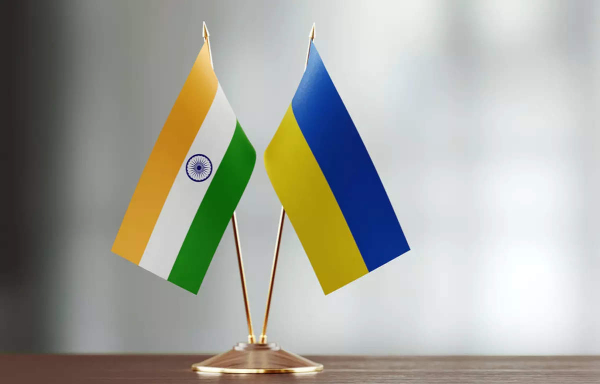
India has reaffirmed its readiness to contribute to efforts to end the Russia-Ukraine war as External Affairs Minister S. Jaishankar held high-level talks in Kyiv with Ukrainian President Volodymyr Zelenskyy and Foreign Minister Andrii Sybiha. The discussions combined the immediate question of ending the conflict with a broader effort to rebuild and expand India-Ukraine relations in areas ranging from pharmaceuticals and agriculture to education, digital technologies and innovation.
The September 3 visit carries particular diplomatic significance because Ukrainian Foreign Minister Andrii Sybiha described it as the first dedicated bilateral visit by an Indian External Affairs Minister to Ukraine. Welcoming Jaishankar to Kyiv, Sybiha described India as a “global power” and welcomed Prime Minister Narendra Modi’s renewed call for an end to the prolonged conflict. He also said Ukraine remained ready for diplomacy.
Jaishankar’s central message was that the war cannot produce a durable political settlement through continued fighting. Reiterating India’s longstanding position, he said that solutions would not emerge from the battlefield and stressed that every additional day of conflict brought further deaths and destruction.
His remarks followed Prime Minister Modi’s meeting with Russian President Vladimir Putin in Bishkek earlier in the week, where Modi called for the transition from an endless war towards an end to the war. Jaishankar told the Ukrainian side that although the parties directly involved would ultimately have to find a way forward, India remained prepared to assist peace efforts wherever it could.
The message was subsequently carried directly to President Zelenskyy. During their meeting in Kyiv, Jaishankar briefed the Ukrainian President on his discussions with Sybiha about expanding bilateral cooperation, while their conversation focused substantially on possible approaches to ending the war.
Zelenskyy, in turn, welcomed India’s emphasis on ending the conflict and acknowledged New Delhi’s consistent argument that the present period should not become an era defined by war. indiaThe exchange highlights the increasingly visible diplomatic position India occupies because it maintains working relations with both Moscow and Kyiv while continuing to advocate dialogue and negotiation.
The visit therefore represented more than a reiteration of familiar calls for peace. Jaishankar said he would take back to New Delhi the positions and assessments shared by the Ukrainian leadership, indicating that India intends to remain engaged with both sides as diplomatic efforts surrounding the war evolve.
One of the important issues discussed was the deteriorating security environment surrounding commercial shipping and the Black Sea. India raised concerns about attacks affecting merchant vessels, noting that Indian seafarers serve aboard ships sailing under numerous national flags and have been among those exposed to the consequences of the conflict.
For New Delhi, maritime disruption is not only a European security problem. Interruptions to shipping and food-export routes can create wider economic consequences for developing countries through higher prices or shortages of food, fuel and fertilisers. Jaishankar therefore linked the security of commercial shipping with the interests of the broader Global South.
Sybiha similarly emphasised the importance of restoring freedom of navigation in the Black Sea and safeguarding global food security. Ukraine remains an important agricultural exporter, and prolonged disruption of ports and maritime supply routes can have consequences well beyond Europe, particularly for countries dependent on imported grain and other agricultural commodities.
Humanitarian cooperation also featured prominently in the talks. India has supplied Ukraine with 19 consignments comprising around 160 tonnes of humanitarian assistance, including medicines, medical equipment and generator sets. Jaishankar reiterated India’s humanitarian approach to the conflict while expressing condolences over the continuing loss of civilian lives.
The visit took place against a particularly sensitive backdrop for India. An Indian national had been killed in Kyiv during an attack earlier in the week, an incident referred to by Jaishankar while discussing the human cost of the conflict. He expressed sympathy for those affected and used the episode to reinforce India’s argument that a prolonged military confrontation would only produce further casualties and destruction.
Despite the war, India and Ukraine are also trying to prevent their bilateral relationship from becoming defined solely by the conflict. Jaishankar and Sybiha discussed cooperation across health, education, agriculture, digital technologies, innovation, diplomatic training and development cooperation, pointing towards a considerably wider agenda for relations between the two countries.
Economic ties remain an important part of that relationship. India-Ukraine trade covers pharmaceuticals, food and agricultural products, fertilisers, machinery, chemicals and consumer goods. The war and accompanying logistical disruptions have affected traditional trade routes, but both sides believe there are opportunities to rebuild commercial links and identify new areas of cooperation.
The pharmaceutical sector is particularly relevant because India is a major global producer of generic medicines, while Ukraine will require considerable healthcare and reconstruction capacity over the longer term. Cooperation in agriculture and food security could similarly become more important as normal commercial networks are gradually restored.
Technology represents another emerging area. Jaishankar highlighted India’s rapidly expanding capabilities in digital infrastructure, start-ups and innovation, while pointing to artificial intelligence as a technology capable of opening new opportunities in health, education, agriculture and governance. Ukraine, which has developed considerable expertise in digital government and technology-driven public services during the conflict, could become a useful partner in some of these areas.
The two sides also discussed infrastructure, pharmaceuticals, technological innovation and digitalisation, with Ukraine signalling its intention to realise more of the economic potential in the relationship. Sybiha has invited greater Indian engagement at a time when reconstruction requirements are expected eventually to create major opportunities across infrastructure, energy, healthcare and technology.
Jaishankar invited Sybiha to visit India for the next meeting of the India-Ukraine Intergovernmental Commission, providing an institutional mechanism through which many of these economic and development initiatives can be taken forward.
The diplomatic importance of Jaishankar’s visit also lies in India’s distinctive position in the Ukraine conflict. New Delhi has maintained extensive strategic and economic relations with Russia while simultaneously keeping diplomatic channels open with Ukraine, providing humanitarian assistance and repeatedly calling for respect for dialogue and diplomacy.
This approach allows India to communicate directly with both sides without formally aligning itself with either military bloc surrounding the conflict. It also reflects India’s broader policy of strategic autonomy, under which New Delhi seeks to protect its national interests while retaining the diplomatic flexibility to engage competing powers.
Ukraine’s public description of India as a global power is therefore significant. Kyiv increasingly appears to recognise that India’s economic weight, relations with Russia and influence across the Global South could make New Delhi an important participant in any wider international effort aimed at creating conditions for negotiations.
India, however, has avoided presenting itself as a country capable of imposing a settlement. Jaishankar’s formulation remained deliberately measured: Moscow and Kyiv ultimately have to determine the terms of any agreement, but India is prepared to contribute if its involvement can help.
That distinction is important. India’s potential role is more likely to involve diplomatic communication, confidence building, humanitarian engagement and support for negotiations than attempting to dictate the contours of a peace settlement.
Jaishankar’s Kyiv visit therefore marks a notable stage in India’s engagement with Ukraine. The conversation has expanded from managing the consequences of war towards discussing peace diplomacy, maritime security, reconstruction, trade, technology, health, agriculture and education.
For Ukraine, deeper engagement with India provides a stronger relationship with one of the world’s largest economies and a country that retains unusual diplomatic access to Moscow. For India, maintaining substantive relations with Kyiv strengthens its ability to pursue an independent European policy while demonstrating that its relationship with Russia does not prevent engagement with Ukraine.
The larger message emerging from Kyiv is consequently one of parallel diplomacy. India intends to maintain its strategic relationships while continuing to argue that an open-ended military confrontation cannot provide the eventual solution. Ukraine, by welcoming Modi’s peace appeal and publicly recognising India as a global power, has indicated that it wants New Delhi to remain actively engaged.
You may also like
-
India and Italy Hold First Maritime Security Dialogue in Rome, Strengthen Strategic Maritime Cooperation
-
India and Azerbaijan Agree to Strengthen Security, Trade, Energy and Economic Cooperation
-
Jaishankar Meets Azerbaijan President Ilham Aliyev in Baku, Discusses Trade, Technology and Strategic Cooperation
-
Piyush Goyal Holds High-Level Talks in Berlin to Strengthen India–Germany Trade, Investment and Industrial Cooperation
-
Indian Navy to Host Indo-Pacific Regional Dialogue 2026 with Experts from 18 Countries on Maritime Science and Technology
