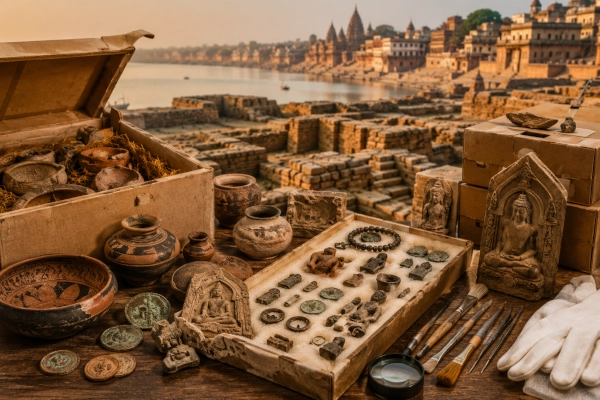
A remarkable archaeological collection connected with one of the earliest known settlements of Varanasi has returned to scholarly attention after nearly seven decades, after Banaras Hindu University opened 22 boxes containing material recovered during excavations at Rajghat in 1957.
The boxes were opened on 20 August 2026 at BHU’s Department of Ancient Indian History, Culture and Archaeology. Inside were more than 10,000 archaeological objects, ranging from pottery and ancient coins to seals, sculptures, tools and objects fashioned from copper, ivory and bone. Some of the pottery is believed to be nearly 3,000 years old, potentially taking parts of the collection back to the early stages of urban settlement in the middle Ganga Valley.
The significance of the rediscovered material goes far beyond the number of objects involved. Rajghat is one of the most important archaeological sites for reconstructing the emergence and development of ancient Varanasi, or Kashi, with occupation at the site extending from at least the early first millennium BCE through successive historic periods and into the medieval age.
Twenty-Two Boxes Waiting Since the 1957 Excavation
The artefacts were recovered during archaeological work at Rajghat in 1957, documented and transferred to the museum of BHU’s Department of Ancient Indian History, Culture and Archaeology. Although the wider excavation was subsequently studied and published, a substantial portion of the material preserved in the boxes had never received detailed modern investigation.
According to Professor Mahesh Prasad Ahirwar, head of the department, BHU has now established specialised research teams to undertake the conservation, cataloguing and detailed study of the collection. This work could gradually convert thousands of stored objects into archaeological evidence capable of illuminating the chronology, economy, administration, craft production and everyday life of ancient Kashi.
The opening of the boxes should therefore not be understood as the discovery of objects that were completely unknown. They had been excavated and stored decades ago. What is new is that an enormous body of material that had remained largely unavailable for detailed analysis can now be examined using modern archaeological, scientific and conservation techniques.
Pottery Could Reach Back Nearly 3,000 Years
Among the oldest material reported from the collection is painted black pottery believed to be approximately 3,000 years old.
Pottery is one of archaeology’s most valuable chronological tools because ceramic traditions change over time. Differences in clay preparation, firing, surface treatment, vessel shape and decoration can allow archaeologists to compare individual layers with securely dated assemblages elsewhere.
Rajghat’s wider archaeological sequence is particularly important in this respect. Archaeological Survey of India documentation divides its earliest occupation into several stages beginning around 800 BCE, although subsequent investigations have suggested that elements of the underlying cultural sequence may potentially extend earlier.
The earliest documented Rajghat assemblage includes Black-and-Red Ware, Black Slipped Ware and red wares. By approximately the sixth century BCE, Northern Black Polished Ware, one of the ceramic traditions strongly associated with increasing urbanisation in the Gangetic plains, had appeared at the settlement.
The material now being reopened at BHU may therefore help researchers refine the chronology of some of the formative centuries in Varanasi’s development.
Rajghat Represents the Archaeological Core of Ancient Varanasi
Rajghat lies on the north-eastern side of present-day Varanasi, near the meeting of the Ganga and Varuna rivers. Archaeologists regard the mound as representing a major portion of the ancient settlement associated with Varanasi.
This is especially important because Varanasi occupies an exceptional place in India’s historical and religious traditions. Literary sources describe Kashi as an important ancient kingdom and urban centre, but archaeology provides a different kind of evidence: physical remains left by generations of people who actually inhabited the city.
One of the most decisive discoveries linking Rajghat with ancient Varanasi was an inscribed sealing recovered during early archaeological work. Archaeological Survey of India records note that a seal written in Gupta-period Brahmi referred to the administration of Varanasi, helping establish the identification of Rajghat with the ancient city.
BHU researchers have similarly pointed to seals and sealings bearing the name of Varanasi among the material recovered from the site.
The Story Began With Railway Construction
Rajghat’s archaeological importance came to modern attention almost accidentally.
Ancient remains were encountered while earth was being removed during expansion and remodelling work associated with the Kashi railway station around 1939–1940. The material attracted archaeological attention, prompting Krishna Deva of the Archaeological Survey of India to undertake trial excavation in 1940.
Those early investigations revealed brick structures, pottery, seals, sealings and terracotta objects, demonstrating that a substantial ancient settlement lay beneath the Rajghat plateau.
More extensive excavations were subsequently undertaken by Banaras Hindu University and the Archaeological Survey of India, particularly from 1957 onward. The principal investigations were associated with BHU archaeologist A. K. Narain and T. N. Roy, with excavation seasons extending through much of the 1960s.
The 22 boxes opened in August 2026 originate from the beginning of this major phase of research.
Six Archaeological Periods Trace Centuries of Urban Life
One reason Rajghat occupies such an important position in Indian archaeology is the depth and continuity of its cultural deposits.
The BHU excavations divided the site’s history into six broad cultural periods, beginning around 800 BCE and continuing into the medieval period.
During the earliest phase, settlement evidence consisted principally of ceramic assemblages. By the period associated with Northern Black Polished Ware, the inhabitants had undertaken substantial works including a massive clay embankment, apparently intended to protect the settlement against flooding.
Later centuries brought increasingly visible signs of urban development. Archaeological evidence from approximately the last centuries BCE includes baked-brick construction, while the first centuries CE produced substantial houses, wells, markets, coins, seals and sealings. ASI documentation describes the period from roughly the first to third centuries CE as one of Rajghat’s most prosperous phases.
Subsequent occupation continued through the Gupta and post-Gupta centuries and into the medieval period, leaving an unusually long archaeological record of changing urban life at Varanasi.
Coins and Seals Could Reveal Ancient Administration and Commerce
Among the objects inside the reopened boxes are ancient coins, stamp seals and inscribed sealings.
Several seals reportedly carry inscriptions, including examples written in Brahmi script. BHU plans to involve epigraphists in their examination, and specialists from other institutions may be consulted where necessary.
These small objects can be disproportionately important historically.
A sculpture can reveal artistic and religious traditions, but an inscribed sealing may identify an institution, administrator, merchant, place or official function. Coins can provide evidence for political authority, monetary circulation and commercial connections. When their archaeological context is known, these objects can help reconstruct how an ancient city actually functioned.
Professor Ahirwar has indicated that study of the newly accessible material could shed light on writing systems, governance, trade and economic organisation during the periods represented at Rajghat.
Ivory and Bone Objects Reveal Another Side of Ancient Kashi
The boxes also contain objects manufactured from ivory and bone, together with copper artefacts and tools.
Such finds offer evidence for specialised craftsmanship within the ancient city. The working of ivory, bone and metal required skilled artisans, access to raw materials and economic networks capable of supporting specialised production.
An ivory die is among the reported objects from the collection, providing a small but evocative glimpse into recreation or gaming within the historic settlement. Other artefacts may eventually help archaeologists reconstruct production techniques, patterns of consumption and social differences among Rajghat’s inhabitants.
These seemingly ordinary objects are particularly valuable because archaeological history is not reconstructed only from kings, inscriptions and monumental architecture. Tools, household vessels, figurines, gaming pieces and discarded objects can reveal the daily activities of people whose names never entered written records.
Terracotta Figurines Form an Important Part of Rajghat’s Archaeology
Terracotta objects have been one of the characteristic finds from decades of excavation at Rajghat.
Human and animal figurines, decorative objects and moulded pieces have been recovered from different occupation periods. The newly examined material includes further examples that can potentially be compared with known artistic traditions from the Mauryan, Shunga, Kushan, Gupta and later periods.
Terracotta figurines can provide clues about clothing, ornaments, hairstyles, animals, religious imagery and popular artistic traditions. Because clay objects could be produced relatively inexpensively, they sometimes preserve aspects of ordinary cultural life that are underrepresented in elite stone sculpture.
One reported pottery fragment from the Rajghat collection carries sacred Buddhist motifs including the Dharmachakra and Triratna, illustrating the range of religious traditions represented within ancient Varanasi’s archaeological record.
Thousands of Historic Photographs Were Found With the Artefacts
The boxes yielded another major archival resource: approximately 3,000 glass photographic slides and more than 5,000 negatives.
Importantly, these photographs are not limited to Rajghat. They document archaeological monuments, excavations and sculptures at sites across India, including Rajghat, Manjhi, Ratnagiri, Ajanta and Ellora.
The photographic archive may prove nearly as valuable as the artefacts themselves.
Historic archaeological photographs preserve information about monuments and landscapes before decades of restoration, weathering, construction and environmental change altered their appearance. They can show structures that have subsequently deteriorated, sculptures before damage occurred and excavation contexts that no longer survive.
Among the images are rare photographs of sculptures and religious imagery associated with Vishnu, Shiva and the Buddha.
Digitising and systematically cataloguing this material could create an important visual archive for researchers studying several of India’s archaeological sites.
Another Long-Sealed Rajghat Box Contained a Human Skeleton
The opening of the 22 artefact boxes follows another extraordinary development at BHU earlier in August.
Researchers opened a separate wooden container holding a human skeleton recovered from Rajghat during the 1957 excavations. The remains had likewise been preserved for nearly seven decades.
The skeleton is provisionally believed to be about 1,000 years old, although researchers have stressed that its age must be established through radiocarbon dating.
Scientists have selected well-preserved bones for ancient DNA analysis, while stable-isotope studies are expected to provide clues about the person’s diet. Mitochondrial DNA could help investigate maternal ancestry, while the apparently male skeleton may also yield Y-chromosome information concerning paternal lineage.
The study illustrates how archaeological collections excavated generations ago can acquire entirely new scientific value.
Methods such as ancient DNA sequencing, isotope analysis, high-resolution microscopy and advanced chemical characterisation were either unavailable or far less developed when the Rajghat excavation began in 1957.
Why Leaving Some Collections Untouched Can Preserve Future Evidence
The long period during which portions of the Rajghat collection remained relatively untouched may now offer an unexpected advantage.
Archaeological science has advanced dramatically during the seven decades since the objects were recovered. Modern researchers can extract information from minute residues, pigments, bones and manufacturing traces that earlier archaeologists could not have analysed.
The condition of the recently opened skeleton illustrates this point particularly well. Researchers reported that the bones had not been treated with chemical preservatives, increasing their suitability for DNA analysis.
Similar opportunities may emerge from the artefact boxes if organic traces, manufacturing residues or other scientifically useful material survive.
The challenge now is to conserve the collection carefully while ensuring that any destructive scientific testing is conducted selectively and only where it can answer important archaeological questions.
Rajghat Documents the Growth of an Early Indian City
The reopened collection has significance far beyond Varanasi.
Rajghat is one of the key archaeological sites in the middle Ganga Valley, a region that witnessed profound transformations during the first millennium BCE. Agricultural expansion, iron technology, long-distance exchange, coinage and increasingly complex settlements accompanied the emergence of major towns and states.
Kashi was among the prominent political and cultural centres of this environment.
The Rajghat sequence gives archaeologists an opportunity to examine this transformation not merely as a historical narrative but through successive physical layers deposited over centuries.
Early pottery and earthen structures gradually give way to fortification works, baked-brick buildings, wells, markets, coins and extensive administrative material. Later layers document the city’s continued transformation under successive political and cultural traditions.
Few places offer such a long material sequence within a city that has continued to flourish into the present.
Ancient Kashi Was More Than a Religious Centre
Modern Varanasi is most widely known as one of Hinduism’s holiest cities, but Rajghat’s archaeological record reveals the complexity of its earlier urban history.
The settlement was simultaneously a centre of habitation, administration, craftsmanship, trade and religious activity.
Coins and sealings point towards organised economic and governmental systems. Ivory, bone and metal objects reveal specialised craft production. Domestic structures document ordinary urban life, while Buddhist and Brahmanical imagery reflects the coexistence and evolution of religious traditions across centuries.
This is one reason archaeology is so important to understanding Kashi.
Texts preserve philosophical, political and sacred memories of the city. Archaeology adds the physical city beneath those traditions—the homes, workshops, drains, vessels, tools and administrative objects created by people who lived there.
The Collection Could Generate Years of Research
Opening the boxes is only the beginning of the investigation.
More than 10,000 artefacts must now be cleaned where appropriate, stabilised, catalogued, photographed, classified and linked with their original excavation records. Inscribed objects will need to be deciphered, coins identified and ceramics compared with dated archaeological sequences.
BHU’s decision to create specialised research teams recognises the scale of the task.
One of the most important objectives will be reconstructing archaeological context. An object becomes far more informative when researchers know precisely which trench, depth and occupational layer produced it.
The original Rajghat excavations were documented extensively by A. K. Narain and his colleagues, and published archaeological records may allow many of the stored finds to be reconnected with their original stratigraphic positions.
If this can be accomplished systematically, the collection could support dissertations, specialist studies and scientific investigations for years.
A 70-Year-Old Collection Opens a New Window Into Kashi
The reopening of BHU’s 22 Rajghat boxes is ultimately a reminder that archaeological discoveries do not always require a new excavation.
Sometimes important evidence has already been recovered but is waiting in museum stores and university collections for a new generation of researchers to examine it.
At Rajghat, more than 10,000 artefacts excavated in 1957 have now re-emerged into active research. Pottery potentially approaching three millennia in age sits alongside coins, seals, sculptures, tools, ivory, bone and metal objects. Thousands of historical photographs preserve archaeological landscapes as earlier generations saw them.
Together, they provide another opportunity to reconstruct the long development of Kashi from an early settlement on the banks of the Ganga and Varuna into one of South Asia’s great enduring cities.
The 22 boxes do not contain a single spectacular treasure that rewrites the history of Varanasi overnight. Their importance is potentially greater than that. They preserve thousands of individual pieces of evidence which, when carefully studied together, can reveal how ancient Varanasi was built, governed, supplied, inhabited and transformed over more than two millennia.
With modern conservation, epigraphy, archaeometry and biological science now being brought to material excavated almost seventy years ago, Rajghat’s archaeological story is entering a new chapter—without another spade of earth necessarily having to be removed.
You may also like
-
Assam’s Dehing Patkai Rainforest Emerges as Butterfly Diversity Stronghold With 165 Species Recorded
-
Century-old limit on Turning Heat Into Electricity Surpassed, Enabling Ultrasensitive Temperature Sensing
-
From Human Digital Twins to Indigenous 5G Radios: Technologies Emerging from India’s Cyber-Physical Systems Mission
-
Skyroot Ships Second Vikram-1 Hardware to Sriharikota as India’s Private Rocket Programme Accelerates
-
ISRO Readies EOS-05, India’s First Imaging Satellite from Geosynchronous Orbit
