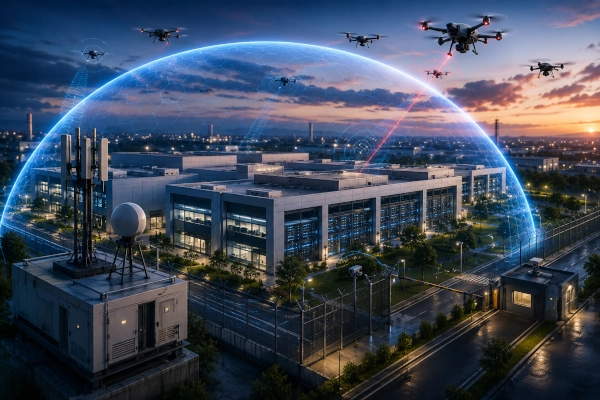
Indian defence technology company Zen Technologies Limited has unveiled ZEN CITADEL, an indigenous counter-unmanned aircraft system developed specifically to protect critical infrastructure such as data centres, semiconductor fabrication plants and other high-value installations from increasingly sophisticated drone threats.
Announced on 31 August 2026, CITADEL — short for Critical Infrastructure Threat Detection & Electronic Layer — represents an expansion of counter-drone technology beyond conventional military bases and battlefield environments. Zen Technologies has positioned the system as a configurable protective layer for facilities whose uninterrupted operation has become increasingly important to India’s digital, industrial and strategic infrastructure.
Designed Around Individual Critical Facilities
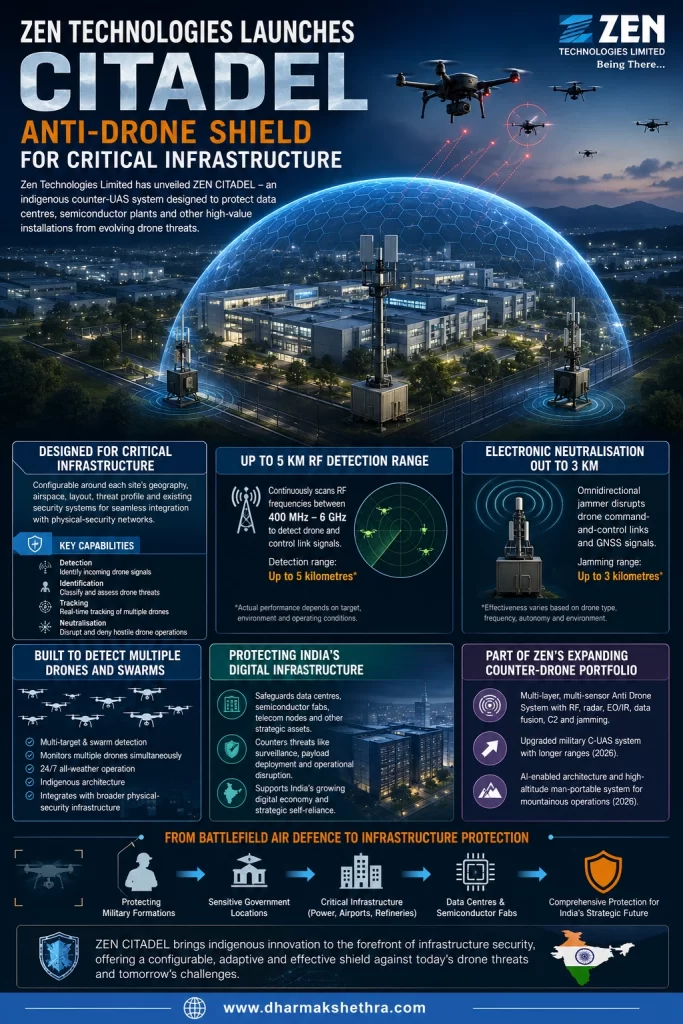
Rather than offering CITADEL as a single standardised installation, Zen Technologies says the system can be configured around the characteristics and security requirements of individual sites. Factors such as surrounding geography, airspace, the physical layout of the installation, anticipated threat profile, existing surveillance systems and established security protocols can be incorporated while designing a deployment.
This approach is particularly relevant for data centres and semiconductor plants because these facilities can differ significantly in size, surrounding terrain and proximity to urban or restricted airspace. A counter-drone architecture designed around a particular site can potentially integrate drone surveillance with the facility’s wider physical-security network rather than operating as an isolated system.
Zen says CITADEL provides capabilities spanning detection, identification, tracking and neutralisation of unauthorised drones. It is intended to operate continuously and provide security personnel with an electronic defensive layer against small unmanned aircraft entering protected airspace.
Up to Five-Kilometre RF Detection Range
According to specifications released by the company, CITADEL continuously scans radio frequencies between 400 MHz and 6 GHz to identify signals associated with drones and their control links. Zen Technologies states that the system can detect drones at distances of up to five kilometres, although actual detection performance would depend on the target, surrounding electromagnetic environment and deployment conditions.
Radio-frequency detection is an important component of counter-UAS architecture because many commercially available and modified drones depend on wireless communication between the aircraft and a ground-based operator. Monitoring these frequencies can allow a defensive system to detect the presence of such aircraft before they reach the protected installation.
Zen already has considerable experience in this field. Its broader counter-drone architecture incorporates technologies including RF-based drone detection, radar, electro-optical identification and tracking, data fusion, command-and-control systems and electronic jamming, with configurations depending on operational requirements.
Electronic Neutralisation Out to Three Kilometres
CITADEL also incorporates an electronic countermeasure capability. Zen Technologies says its omnidirectional jammer can operate at ranges of up to three kilometres, targeting both drone command-and-control links and Global Navigation Satellite System signals.
The objective of such electronic warfare measures is to prevent an unauthorised aircraft from continuing normally towards its target by disrupting the communications or navigation systems on which it depends. The effectiveness of jamming can nevertheless vary considerably depending on drone type, operating frequency, autonomy level, environmental conditions and counter-countermeasure technologies employed by the aircraft.
The system is therefore particularly relevant against conventional remotely controlled drones and satellite-navigation-dependent platforms. More sophisticated autonomous aircraft that operate without continuous external communications represent a more difficult counter-UAS challenge and are one reason modern anti-drone architectures increasingly combine several different detection technologies and effectors.
Built to Detect Multiple Drones and Swarms
Another significant feature claimed for CITADEL is multi-target and swarm detection. The system is intended to identify and monitor multiple unmanned aircraft operating simultaneously, addressing scenarios in which several comparatively inexpensive drones could be used together to overwhelm conventional perimeter security.
Drone swarms and coordinated multi-aircraft attacks have become an increasingly important consideration in modern defence planning. The proliferation of inexpensive commercial drones, autonomous navigation technology and readily available electronic components has dramatically lowered the technological barrier to operating multiple unmanned aircraft simultaneously.
Zen Technologies says CITADEL has consequently been designed for 24-hour, all-weather operation and uses an indigenous architecture. The system can also be integrated into the broader physical-security infrastructure surrounding the facility being protected.
Protecting India’s Expanding Digital Infrastructure
The decision to develop a dedicated counter-drone system for data centres and semiconductor fabs reflects the changing definition of critical national infrastructure. Strategic facilities are no longer limited to military installations, power stations, airports, refineries and government complexes. Semiconductor manufacturing plants, hyperscale computing facilities, telecommunications nodes and major data centres increasingly support essential financial, communications, artificial-intelligence and government services.
Even a relatively small unmanned aircraft can create security problems around such installations. Depending on its configuration, a drone could potentially be used for unauthorised surveillance, intelligence collection, delivery of disruptive payloads or interference with sensitive operations. Security planners therefore increasingly have to consider threats approaching from above in addition to conventional perimeter intrusion.
India’s rapid expansion of semiconductor manufacturing and digital infrastructure makes this security problem particularly relevant. New fabrication plants and data-centre campuses represent substantial concentrations of capital, technology and strategically important computing capability, increasing the requirement for specialised protective systems around them.
Part of Zen’s Expanding Counter-Drone Portfolio
CITADEL is not Zen Technologies’ first counter-UAS platform. The Hyderabad-headquartered company has been developing drone detection and neutralisation systems alongside its longstanding military simulation and training business.
Zen’s existing Anti Drone System uses a multi-layer and multi-sensor architecture incorporating RF detection, video-based identification and tracking, radar, data fusion, command-and-control functions and electronic countermeasures. The company’s architecture also supports hard-kill options in certain configurations.
Earlier in 2026, Zen unveiled an upgraded counter-UAS system for military applications with substantially longer detection and electronic-countermeasure ranges than those quoted for CITADEL. That distinction is important because CITADEL appears to have been optimised for protecting fixed civilian and strategic infrastructure rather than serving as a direct replacement for the company’s battlefield-oriented counter-drone systems.
The company has also expanded its counter-drone portfolio during 2026 with an integrated AI-enabled anti-drone architecture and a high-altitude man-portable anti-drone system intended for mountainous operational environments.
From Battlefield Air Defence to Infrastructure Protection
The emergence of CITADEL highlights a broader change taking place in counter-drone warfare. Technology originally developed primarily to defend military formations and sensitive government locations is increasingly being adapted to protect civilian infrastructure that has strategic importance.
Data centres, semiconductor plants and other advanced manufacturing installations require particularly careful counter-UAS deployment because they can be situated near populated areas and conventional air traffic. Systems intended for these locations therefore have to balance early warning and electronic protection with regulatory, spectrum-management and civilian aviation considerations.
By developing CITADEL as an infrastructure-specific and configurable system, Zen Technologies is attempting to address that emerging market with technology developed domestically.
You may also like
-
Indian Navy Vice Chief Inspects Japan’s Mogami-Class Stealth Frigate as India-Japan Shipbuilding Cooperation Expands
-
India and Russia Explore Joint Icebreaker Construction as Maritime Industrial Cooperation Expands
-
Philippine Marine Wargames Reportedly Show BrahMos Can Penetrate Chinese Destroyer Air Defences
-
Safran Signs 18 Agreements with Indian Aerospace Suppliers, Expanding Make in India Manufacturing Partnerships
-
Indian Army’s Vajra Corps Certifies First Batch of Drone Operators, Strengthens Battlefield Surveillance
