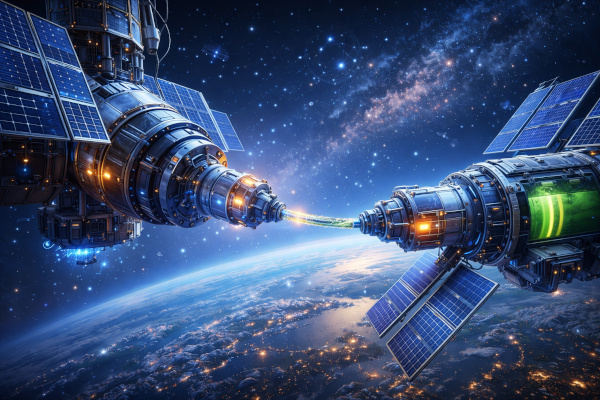
India’s emerging on-orbit servicing industry is preparing for an important technology demonstration, with Chennai-based OrbitAID Aerospace targeting the first quarter of 2027 for a two-spacecraft mission designed to demonstrate inspection, autonomous rendezvous, proximity operations, docking, refuelling and satellite life extension in Low Earth Orbit.
OrbitAID disclosed the updated mission timeline on 25 August 2026, saying that two spacecraft — AayulSAT-2A, serving as the chaser, and AayulSAT-2B, serving as the target — will be launched together for the demonstration. The company intends to validate the complete sequence required for servicing an operational spacecraft rather than testing individual rendezvous or docking functions in isolation.
The planned mission represents a substantial technological step for India’s private space sector. Successful on-orbit servicing requires two independently flying spacecraft to locate each other, precisely control their relative motion, approach safely, establish a secure mechanical connection and then transfer propellant without destabilising either spacecraft.
OrbitAID is developing these capabilities around its indigenous Standard Interface Docking and Refuelling Port, or SIDRP, a specialised interface designed to provide mechanical docking while also enabling propellant, power and data transfer between spacecraft.
AayulSAT-2A and AayulSAT-2B to Fly Together
The Q1 2027 mission has been structured around a chaser-and-target architecture. AayulSAT-2A will act as the servicing spacecraft, while AayulSAT-2B will represent the client satellite whose condition and remaining operational capability are to be assessed and extended.
OrbitAID’s planned mission sequence begins with the chaser independently detecting and inspecting the target spacecraft. It will then undertake rendezvous and proximity operations before approaching closely enough to dock using the company’s proprietary interface.
Following docking, the mission is intended to demonstrate propellant transfer between the spacecraft. The sequence will then progress to raising the target spacecraft to a higher orbit, demonstrating the fundamental operations required to extend the useful life of an orbiting satellite.
The company describes the mission as an end-to-end satellite life-extension demonstration because inspection, rendezvous, docking, refuelling and orbital repositioning are being combined into one continuous mission architecture.
Why Satellite Refuelling Matters
Most conventional satellites are launched with a fixed quantity of propellant. That fuel is required for orbit raising, station keeping, collision avoidance, attitude control and other manoeuvres throughout the spacecraft’s operational life.
A satellite can remain electronically and mechanically healthy even when its propellant reserves approach depletion. Once its ability to manoeuvre is exhausted, however, the spacecraft may no longer be able to maintain its operational orbit safely.
On-orbit refuelling seeks to change this model by enabling another spacecraft to replenish the satellite’s fuel after launch. Instead of treating fuel exhaustion as the end of the mission, operators gain the ability to extend the useful service life of an expensive orbital asset.
This approach has particular commercial significance for large communications and other high-value satellites, where replacing an otherwise functioning spacecraft requires manufacturing an entirely new satellite and purchasing another launch.
SIDRP Forms the Core of OrbitAID’s Technology
At the centre of OrbitAID’s programme is the Standard Interface Docking and Refuelling Port, which combines the functions of a docking interface with the hardware necessary for propellant transfer.
The Government of India formally highlighted SIDRP in March 2026, when the Technology Development Board under the Department of Science and Technology announced financial assistance to OrbitAID for the development of docking and refuelling systems for satellite life extension.
At that stage, the government described SIDRP as a Technology Readiness Level-7 system designed for autonomous docking and propellant transfer between spacecraft. The interface integrates a satellite fill-and-drain valve with a dual docking mechanism and incorporates multiple redundancies intended to support reliable operation in ground and microgravity environments.
The government-backed programme is specifically intended to advance the technology through further testing and in-space demonstration, creating the foundations for an indigenous Indian on-orbit servicing ecosystem.
Docking Requires Extreme Precision
Satellite docking is one of the more demanding forms of autonomous spacecraft operation because orbital vehicles move at several kilometres per second relative to the Earth while their motion relative to each other must ultimately be controlled to extremely small values.
The servicing spacecraft must first enter an orbit compatible with the target. It then gradually reduces the separation while continuously determining the target’s position, velocity and orientation.
OrbitAID’s servicing architecture uses LiDAR, optical and infrared sensing, together with guidance, navigation and control algorithms, to support this process. The servicing spacecraft approaches the target through progressively closer manoeuvres before entering the final docking sequence.
Once contact begins, the docking mechanism must perform a soft capture before securing the two vehicles mechanically. Propellant transfer can then begin through the connected interface.
A failure in relative navigation, alignment or capture during this process can damage both spacecraft, making autonomy, sensing accuracy and fault protection central to the technology.
OrbitAID Developing Autonomous Rendezvous Technology
OrbitAID is also developing the software required to conduct autonomous rendezvous and proximity operations rather than relying entirely on continuous commands from the ground.
The company says its tanker satellite architecture combines high-resolution sensors, precise thruster control and autonomous navigation algorithms to calculate and execute approach trajectories. Multiple proximity sensors support spacecraft recognition, alignment and docking.
Autonomy becomes particularly important during the final stages of a rendezvous because communication delays, limited ground-station visibility and the speed of the operation make continuous manual intervention impractical.
These technologies also have applications beyond refuelling. The same core capabilities can support satellite inspection, relocation, repair, active debris removal and eventually assembly of larger structures in orbit.
The Mission Builds on AayulSAT
OrbitAID’s current programme follows its earlier AyulSat demonstration, which was carried aboard ISRO’s PSLV-C62 mission on 12 January 2026.
ISRO’s official mission documentation listed AyulSat as an OrbitAID payload intended to demonstrate in-orbit fuelling technology. The 25-kg spacecraft was designed as an early technology demonstrator for the company’s wider servicing architecture.
The mission was intended to demonstrate internal propellant transfer and validate technologies associated with SIDRP before a later spacecraft performed an actual rendezvous and docking operation.
PSLV-C62, however, encountered an anomaly near the end of its PS3 stage, preventing the mission from achieving its intended objectives. ISRO subsequently constituted a national-level expert committee to examine the anomaly.
OrbitAID therefore did not receive the orbital demonstration opportunity originally planned for AyulSat.
Company Rebuilt the Programme After PSLV-C62
Following the loss of the January mission, OrbitAID decided to move ahead with a redesigned two-spacecraft demonstration.
The company initially announced plans for a chaser and target mission by the end of 2026. The programme was subsequently updated to Q1 2027, with the new AayulSAT-2A and AayulSAT-2B architecture designed to demonstrate the entire servicing sequence within a single flight.
The revised mission is consequently more ambitious than the original internal-transfer experiment aboard AyulSat. Instead of validating fluid transfer within a single spacecraft, OrbitAID is preparing to demonstrate the interaction between two independently flying vehicles.
That distinction is fundamental because a commercially useful servicing spacecraft must be able to find, approach and connect with another object in orbit before any fuel transfer can take place.
From Refuelling to Complete Satellite Life Extension
OrbitAID’s strategy goes beyond proving that fuel can be transferred in microgravity.
The company is developing a wider satellite life-extension architecture in which servicing spacecraft can inspect orbital assets, replenish fuel and reposition them into useful operational orbits.
The Q1 2027 demonstration is designed to culminate in an orbital manoeuvre that raises the target spacecraft after refuelling. This links fuel transfer directly to an operational outcome and demonstrates how additional propellant can translate into extended mission capability.
The same technology can ultimately support satellites requiring additional station-keeping capacity or orbital repositioning after their original fuel reserves have declined.
This is particularly relevant to high-value spacecraft whose payloads may remain functional for considerably longer than their original propellant supply.
Government of India Supporting the Programme
OrbitAID’s development programme has received formal support from the Technology Development Board of the Department of Science and Technology.
On 12 March 2026, TDB announced financial assistance for the project titled “Development of Docking and Refueling Systems for In-Space Life Extension of Satellites.” The government specifically identified on-orbit servicing and satellite life extension as an emerging frontier of commercial space activity.
The support is intended to accelerate development, testing and in-space demonstration of SIDRP and associated servicing technologies.
Government involvement also reflects the strategic significance of establishing these capabilities domestically. Satellite servicing technologies combine advanced propulsion, autonomous navigation, computer vision, robotics, precision docking mechanisms and spacecraft systems engineering.
Developing this technology within India consequently creates capabilities extending well beyond the commercial refuelling market.
India Already Demonstrated National Docking Capability Through SpaDeX
OrbitAID’s programme is developing against the backdrop of India’s successful national demonstration of spacecraft docking through ISRO’s Space Docking Experiment, or SpaDeX.
ISRO successfully docked the two SpaDeX spacecraft, SDX-01 and SDX-02, for the first time on 16 January 2025. India subsequently demonstrated undocking in March before completing a second autonomous docking on 20 April 2025.
During the second docking sequence, the spacecraft completed the operation autonomously from an inter-satellite distance of 15 metres. ISRO then successfully demonstrated bidirectional electrical power transfer between the docked satellites on 21 April.
These achievements made India the fourth country to demonstrate space docking technology. The capability is essential for future missions involving lunar sample return, complex multi-launch spacecraft assembly and the Bharatiya Antariksh Station.
OrbitAID represents the emerging commercial side of this technological domain, with the startup concentrating specifically on servicing, refuelling and extending the life of operational satellites.
On-Orbit Servicing Is Becoming a New Space Market
The traditional satellite industry has largely operated through a manufacture-launch-operate-replace cycle. Spacecraft are built on Earth, placed into orbit with all the fuel and hardware they require, operated until they can no longer perform their mission and eventually replaced.
On-orbit servicing introduces an entirely different model in which spacecraft become maintainable infrastructure.
Refuelling represents one component of that model. Other services include inspection, relocation, component replacement, repair, orbit correction and potentially installation of new payloads.
OrbitAID is also developing a soft-capture robotic arm intended for in-space servicing. The company describes the system as incorporating machine vision, adaptive force control and an internal fluid pathway capable of supporting fuel-transfer operations.
Together with SIDRP and the company’s tanker spacecraft concept, these technologies form part of a broader attempt to create an Indian commercial in-space servicing platform.
Refuelling Can Change Satellite Economics
The economic attraction of life extension is particularly strong for expensive satellites whose payloads continue performing normally after their propellant reserves decline.
A large communications spacecraft can represent an investment of hundreds of millions of dollars when satellite manufacturing, launch and insurance are considered together. Extending the operating life of such an asset can therefore generate considerable additional revenue without immediately replacing the spacecraft.
The Government of India has also identified the cost advantage of such technology, noting that in-orbit refuelling can extend satellite life at a fraction of the expense associated with launching a replacement spacecraft.
Servicing can also improve mission flexibility. A spacecraft operator with access to future refuelling capability can use propellant more actively during the mission instead of preserving every kilogram solely to maximise operational lifetime.
GEO Represents a Major Long-Term Market
Although the upcoming demonstration is planned for Low Earth Orbit, OrbitAID sees Geostationary Earth Orbit as an important commercial market for satellite life extension.
GEO contains many of the world’s most valuable communications and broadcasting satellites. These spacecraft maintain positions approximately 35,786 kilometres above the equator and expend propellant throughout their operational lives to preserve their designated orbital slots.
OrbitAID says technologies and experience developed through the LEO demonstration will feed into its subsequent GEO servicing programme, with commercial discussions already underway for life-extension operations in geostationary orbit.
The technical challenge becomes considerably greater at GEO because of the distance from Earth, navigation requirements and mission duration, but the potential economic value of extending the lives of large geostationary satellites is also substantial.
Refuelling Can Contribute to Space Sustainability
On-orbit servicing also has implications for the growing problem of space debris.
Thousands of active satellites now operate alongside large numbers of defunct spacecraft, spent rocket stages and fragments. Continued growth of satellite constellations is increasing pressure on heavily used orbital regions.
Life-extension technologies can reduce the need to replace functioning satellites simply because they have exhausted their manoeuvring propellant. Servicing spacecraft can also provide the navigation, rendezvous and capture technologies required for future debris-removal missions.
OrbitAID lists active debris removal, satellite inspection and on-demand orbital mobility alongside life extension within its longer-term servicing portfolio.
These capabilities support a broader shift towards treating orbital space as infrastructure that must be maintained rather than as an environment in which spacecraft are simply discarded after use.
A New Frontier for India’s Private Space Industry
India’s private space sector has expanded rapidly since reforms opened satellite, launch and downstream space activities to greater private participation.
Much of the first wave of Indian space startups concentrated on launch vehicles, Earth observation, satellite manufacturing and propulsion. OrbitAID is targeting another emerging category: in-space servicing, assembly and mobility.
The technological barriers are substantial because a servicing spacecraft must combine autonomous guidance, sensors, propulsion, precision navigation, docking mechanisms and fluid-transfer systems within one operational platform.
These same capabilities also overlap with technologies required for future orbital logistics, station assembly and complex deep-space missions.
OrbitAID’s programme therefore represents more than a specialised commercial refuelling experiment. It contributes to an industrial capability that will become increasingly relevant as India expands human spaceflight, lunar missions and permanent infrastructure in orbit.
Q1 2027 Mission Marks the Next Major Test
OrbitAID’s planned AayulSAT-2A and AayulSAT-2B mission will bring together technologies the company has been developing across propulsion, autonomous rendezvous, docking, sensors and refuelling.
The mission is designed to begin with inspection and characterisation of the target spacecraft, proceed through autonomous rendezvous and proximity operations, establish a physical docking connection through SIDRP, transfer propellant and subsequently demonstrate the practical value of the transferred fuel through orbital life extension.
That sequence makes the programme considerably more ambitious than a standalone docking experiment or a simple fluid-transfer demonstration.
The January 2026 loss of AyulSat prevented OrbitAID from completing its original orbital refuelling experiment, but the company has responded by expanding the next mission into a complete two-spacecraft servicing demonstration.
Supported by India’s growing private space ecosystem, government backing through the Technology Development Board and a national base of rendezvous and docking expertise established by ISRO’s SpaDeX programme, OrbitAID is now moving towards one of the most technologically demanding areas of commercial spaceflight.
The Q1 2027 mission is designed to demonstrate a new proposition for India’s space industry: satellites need not necessarily remain untouchable machines after launch. They can increasingly become serviceable, refuellable and reusable assets in orbit, opening the foundations of a new in-space logistics economy.
You may also like
-
India’s Economic Warfare Challenge: Strategic Autonomy, Energy Security and the Rise of a Global Power
-
India-US Trade Deal Stalemate: Why Washington’s Tariff Pressure Has Failed to Secure an Agreement
-
US Double Standards in Foreign Policy: 16 Recent Cases Involving India, Russia, China and Global Trade
-
India’s Arctic Energy Ambitions: Russian Oil, LNG and a New Sea Route to Indian Ports
-
India and Russia Explore Joint Icebreaker Construction as Maritime Industrial Cooperation Expands
