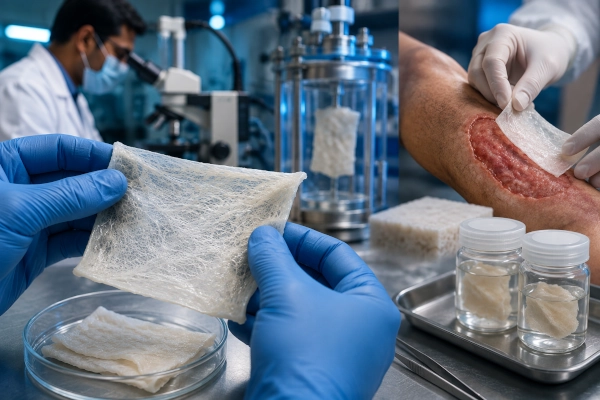
India is moving to strengthen its capabilities in advanced wound-care materials with the Technology Development Board (TDB) supporting Vadodara-based medical-device startup OrthoGraft Pvt. Ltd. to establish manufacturing infrastructure for indigenous tissue-derived biological dressings.
The Department of Science and Technology-backed initiative, announced on 19 August 2026, will support OrthoGraft’s project titled “Production Set-up for Advanced Tissue Derived Biological Dressings.” The proposed products are being developed for difficult-to-heal wounds, including chronic wounds, diabetic foot ulcers and burns.
Turning Human Tissue Into Advanced Wound-Care Material
OrthoGraft is developing proprietary methods for processing suitable human biological tissue into shelf-stable tissue substitutes while attempting to preserve structural and biochemical characteristics considered useful for wound healing.
At the centre of the technology is a specialised processing method designed to achieve effective cellular removal, or decellularisation, while retaining the underlying tissue structure and useful bioactive components. Removing cellular material can be important when developing biological scaffolds because the objective is to retain a supportive extracellular framework while minimising unwanted cellular elements.
The resulting material is being developed as a biological dressing rather than merely as a conventional wound covering. Such dressings are intended to provide a physical environment conducive to healing while retaining characteristics inherited from the original biological tissue.
Designed for Chronic and Hard-to-Heal Wounds
The technology is particularly relevant to chronic wounds, which can remain open for prolonged periods because the normal sequence of tissue repair has been disrupted.
Diabetic foot ulcers represent one of the most challenging examples. Reduced circulation, neuropathy, infection and impaired healing can cause relatively small wounds to progress into serious complications. Burns and other complex wounds can similarly require dressings that protect the damaged tissue while maintaining an appropriate healing environment.
OrthoGraft’s proposed dressings are being developed with improved tensile strength, high retention of biologically active factors and a Moisture Vapour Transmission Rate comparable with commercially available moist wound dressings.
Moisture Vapour Transmission Rate, or MVTR, is an important property of wound dressings because it influences the amount of water vapour that can escape through the material. A dressing must prevent excessive drying of the wound while also avoiding excessive accumulation of moisture.
Combining Tissue Engineering and Biomaterials Science
The project combines tissue engineering, biomaterials science and specialised biological processing to convert suitable biomedical tissue into a clinically useful material.
Unlike ordinary gauze or synthetic coverings that primarily provide physical protection, tissue-derived dressings can potentially retain elements of the extracellular matrix — the complex network of proteins and structural molecules that normally surrounds cells in living tissue.
That matrix can provide a scaffold over which cells involved in tissue repair can migrate and organise. Preserving useful parts of this architecture while removing unwanted cellular components is therefore one of the central technical challenges in producing tissue-derived medical products.
OrthoGraft’s processing platform is intended to balance these competing requirements: sufficiently processing the tissue for use as a medical material while preserving characteristics relevant to healing.
Production Infrastructure Coming Up in Vadodara
With TDB assistance, OrthoGraft will strengthen its manufacturing capabilities at the Savli Technology Business Incubator in Vadodara, operated within the Government of Gujarat’s biotechnology ecosystem.
The company has leased a bio-incubation facility there, providing access to specialised biotechnology infrastructure required for the development and translation of medical devices and tissue-based products.
This stage is significant because translating tissue-engineering research into a manufacturable medical product requires much more than demonstrating that the underlying material works experimentally.
Production methods must be reproducible, tissue processing has to be carefully controlled, contamination risks must be addressed, product characteristics need to remain consistent from batch to batch, and manufacturing must operate within an appropriate regulatory framework.
The TDB programme is therefore focused on helping the company cross the difficult transition between laboratory-scale technology and commercially manufacturable wound-care products.
CDSCO Licence Obtained for Testing
OrthoGraft has obtained the required Central Drugs Standard Control Organisation licences for manufacturing medical devices for testing purposes.
This is an important distinction: the programme is moving toward commercialisation, but the products should not yet be interpreted as having completed every step required for unrestricted commercial clinical use.
The company is exploring collaborations with tertiary-care hospitals and medical institutions for further development and clinical translation of the technology.
Such collaborations can help determine how biological dressings behave in realistic clinical environments and whether their laboratory and engineering characteristics translate into meaningful benefits in wound management.
Two US Patents and Collaboration With IIT Ropar
OrthoGraft is a DPIIT-recognised medical-device startup specialising in tissue substitutes for clinical reconstruction and functional repair.
The company currently holds two granted US patents related to its technological work and has also been collaborating with institutions including IIT Ropar and multispecialty hospitals as it develops and translates its tissue-processing platform.
It has previously participated as an industry startup partner in Government of India-supported multi-institutional research and commercialisation programmes, giving the company experience in moving biomedical research toward practical applications.
Building an Indigenous Advanced Wound-Care Industry
The TDB investment carries a wider significance for India’s medical-device sector.
Advanced biological dressings sit at the intersection of biotechnology and medical devices, two areas where product development requires specialised infrastructure, lengthy validation and substantial translational research.
Supporting domestic production can help India build expertise not only in the finished wound dressing but also in tissue processing, biomaterial characterisation, sterilisation, quality assurance, biological testing and specialised manufacturing.
TDB Secretary Rajesh Kumar Pathak described advanced biomaterials and tissue-engineered products as an important frontier for India’s medical-technology ecosystem, saying the support is intended to help translate OrthoGraft’s tissue-processing expertise into commercially manufacturable products.
From Conventional Dressings to Bioactive Materials
Wound-care technology has gradually evolved from simple materials designed primarily to cover an injury toward increasingly sophisticated products that attempt to create an environment favourable to tissue repair.
Modern dressings may control moisture, protect against infection, manage wound exudate or incorporate materials capable of interacting with the wound environment. Tissue-derived dressings represent another stage in that progression because their architecture originates in biological material rather than being constructed entirely from synthetic substances.
For India, developing these materials domestically could create opportunities not only in wound care but eventually across wider areas of regenerative medicine, tissue reconstruction and biomaterials engineering.
OrthoGraft itself intends to build a broader indigenous portfolio of advanced tissue substitutes rather than restrict its technology to a single wound-care product.
You may also like
-
Aditya-L1 Detects Early Warning Signs Hours Before Major Solar Flares
-
ICAR-CIFRI Patents Indigenous Nano-Technology to Combat Fish Ectoparasites
-
India Backs Home-Grown Agentic AI Platform as One2X Moves From Research to Commercial Deployment
-
ICAR Identifies VL 3040 Wheat With Improved Rust Resistance for India’s Northern Hill Regions
-
IISc Researchers Turn Cow-Gut Enzyme Into Potential Weapon Against Drug-Resistant Bacterial Biofilms
