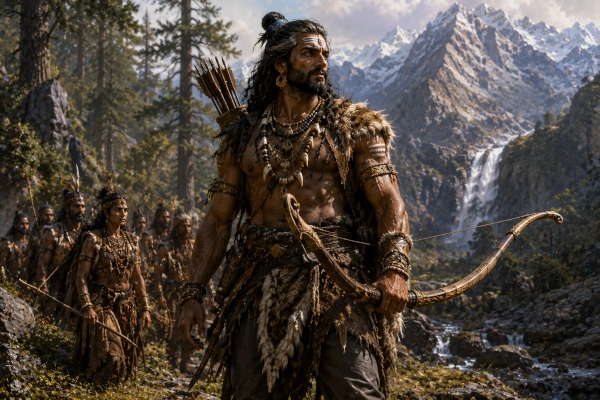
High in the Himalayas, far from his brothers and the comforts of royal life, Arjuna stood alone performing severe austerities. He had travelled into the mountains seeking celestial weapons that would one day be needed against warriors such as Bhishma, Drona, Karna and Kripa. His journey had taken him beyond ordinary forests into a wilderness associated with sages, Siddhas and the gods themselves.
Arjuna believed that mastering greater weapons would strengthen the Pandavas for the struggle that lay ahead. Yet before he could receive the most terrible weapon of all, he would first have to face an opponent whose identity he could not recognise. That encounter would begin with the sudden appearance of a monstrous wild boar and end with Arjuna discovering that the mysterious hunter before him was none other than Mahadeva.
Arjuna Leaves His Brothers to Seek Divine Weapons
The roots of the episode lie in the Pandavas’ exile. Yudhishthira understood that any future war against the Kauravas would place his brothers against some of the greatest warriors of the age. Bhishma possessed unmatched experience, Drona had mastery over celestial weapons, Karna was a formidable archer, and Ashvatthama carried terrible powers of his own.
Vyasa therefore advised the Pandavas that Arjuna should obtain divine weapons. Yudhishthira passed the necessary knowledge to his younger brother and encouraged him to travel north towards the Himalayas, where austerity and divine favour might bring him the weapons required for the battles ahead.
Armed with the Gandiva, his inexhaustible quivers, a sword and protective armour, Arjuna departed after receiving the blessings of his brothers, Draupadi and the Brahmanas who accompanied them. He did not undertake the journey for personal glory. His purpose was tied to the restoration of his brothers’ kingdom and the future security of those he loved.
During the journey, Indra appeared before Arjuna in the form of an ascetic and offered him celestial pleasures. Arjuna rejected them because he could not enjoy heavenly happiness while his brothers remained exiled and their kingdom remained in the hands of their enemies. Indra was pleased by his determination and told him that he must first obtain the favour of Shiva.
Arjuna Begins His Penance on Indrakila
Arjuna continued deeper into the mountains until he reached the region traditionally associated with Indrakila. The landscape was magnificent, with towering peaks, clear streams, dense forests and secluded places where ascetics performed penance far from human settlements.
There Arjuna began his Tapas. His austerities became progressively more severe as the months passed, and he gradually reduced his dependence upon food. Eventually, he stood for long periods with his arms raised, concentrating his mind upon the purpose for which he had come.
The force of his penance became so intense that the sages living in the region grew concerned. They approached Shiva and told him that the austerities of the son of Pandu seemed to fill the surrounding wilderness with extraordinary heat and energy.
Shiva already knew what Arjuna desired. He assured the sages that there was no cause for fear and declared that he would personally test the Pandava before granting him the weapon he sought.
Shiva Comes as a Mountain Hunter
Shiva did not descend before Arjuna in his familiar divine form. Instead, he assumed the appearance of a powerful Kirata, a hunter of the mountains. His body appeared strong and rugged, and he carried a magnificent bow suited to a warrior accustomed to the wilderness.
Parvati accompanied him in the form of a Kirata woman, while Shiva’s attendants also assumed the appearance of mountain people. Together they entered the forest where Arjuna was performing his austerities.
As the divine company approached, the atmosphere of the wilderness changed. The sounds of birds and animals faded, and an unusual stillness settled over the mountains. Arjuna sensed that something extraordinary was happening, although he could not yet understand its meaning.
Then a violent disturbance erupted through the trees.
Muka Charges in the Form of a Wild Boar
A gigantic wild boar came thundering through the forest towards Arjuna. Its body was massive, its movements violent, and its charge clearly threatened the Pandava’s life. The creature was no ordinary animal but the demon Muka, who had assumed the form of a boar in order to attack Arjuna while he was isolated in the mountains.
Arjuna’s warrior instincts immediately took control. Whatever austerities he had undertaken, the Gandiva remained beside him, and he seized the bow the moment he recognised the danger. He strung an arrow and prepared to kill the charging animal before it could reach him.
At precisely that moment, the mysterious Kirata appeared nearby and called out to Arjuna. The hunter claimed that the boar was already his prey and warned Arjuna not to interfere.
Arjuna ignored the warning. The creature was rushing directly at him, and he had no intention of waiting for another man to decide whether he could defend himself. He drew the Gandiva while the Kirata simultaneously raised his own bow.
Two Arrows Fly Towards the Same Target
For a brief instant, both warriors stood with their bows drawn. Arjuna focused upon the charging boar from one side, while the mysterious hunter took aim from another.
Then both bowstrings sounded.
Two arrows tore through the mountain air almost simultaneously and struck the enormous boar. Muka crashed violently to the earth, and the terrible creature that had intended to kill Arjuna lay dead between the two archers.
With death, the deception surrounding the animal became apparent. The being that had charged through the forest was revealed as a demonic attacker rather than an ordinary wild boar. Arjuna now knew that his decision to shoot had saved his life.
Yet the immediate danger had passed only to create another conflict. Arjuna believed that his arrow had killed the demon, while the Kirata calmly claimed that the victory belonged to him.
The Dispute Over the Boar
Arjuna turned angrily towards the stranger and accused him of interfering with another warrior’s target. According to Arjuna, he had already selected the boar and prepared to shoot before the hunter released his own arrow.
The Kirata was completely unimpressed by the Pandava’s claim. He insisted that he had seen and targeted the boar first and suggested that Arjuna’s pride in his own abilities was preventing him from accepting what had happened.
Neither warrior was willing to retreat from the argument. Arjuna regarded the hunter’s behaviour as arrogant, while the Kirata deliberately challenged the celebrated son of Pandu.
Words became sharper, and the disagreement soon passed beyond any possibility of a peaceful settlement. Arjuna raised the Gandiva, convinced that the mysterious hunter needed to be taught a lesson.
The Kirata simply smiled and prepared to fight.
Arjuna Unleashes the Gandiva
Arjuna attacked with tremendous force. Arrows poured from the Gandiva so rapidly that they seemed to fill the space between the trees, and the Pandava expected the stranger to fall beneath the assault.
The Kirata did not fall. Arjuna’s arrows struck him, yet they appeared incapable of causing serious harm. The hunter remained calm and even seemed amused by the growing intensity of the attack.
Arjuna increased the speed and power of his archery. He had defeated skilled warriors and supernatural enemies before, and he knew that very few beings could survive such a storm from the Gandiva.
Still the hunter remained standing.
For the first time, Arjuna began to wonder whether the person before him could possibly be an ordinary human being. The stranger’s endurance defied everything Arjuna understood about warfare.
Arjuna Begins to Suspect the Truth
As the battle continued, an unsettling possibility entered Arjuna’s mind. Perhaps this was no ordinary hunter at all. The stranger might be a Yaksha, a powerful Asura, a celestial being or even Rudra himself.
The thought did not immediately stop Arjuna from fighting. He had not yet received any certain sign of the hunter’s identity, and his warrior instinct drove him to continue the contest until the mystery was resolved.
Another torrent of arrows flew towards the Kirata, but the result remained unchanged. The hunter seemed as immovable as the mountain itself, while Arjuna’s anger slowly gave way to astonishment.
Then an even more extraordinary thing happened. The arrows upon which Arjuna had always depended were no longer available to him.
The Inexhaustible Quivers Fail
Arjuna possessed quivers associated with an inexhaustible supply of arrows. In ordinary battle, he did not have to fear running out of shafts while wielding the Gandiva.
Against the mysterious Kirata, however, even this advantage seemed to disappear. Arjuna reached repeatedly for arrows until he discovered that none remained for him to draw.
The moment would have shaken any archer, but Arjuna refused to surrender. If the Gandiva could no longer send arrows towards his enemy, then the bow itself would become a weapon.
He rushed forward and struck at the hunter with the celestial bow. The Kirata simply seized the Gandiva and tore it from Arjuna’s grasp.
Arjuna had lost his arrows, and now he had lost his bow. Yet the Pandava still refused to accept defeat.
The Sword Shatters
Arjuna immediately drew his sword and charged again. He swung the blade with tremendous force towards the hunter, expecting that even if arrows had failed, steel at close range would succeed.
The sword shattered upon impact.
Pieces of the broken weapon fell around Arjuna while the Kirata remained standing before him. The mysterious hunter showed no fear and no sign that Arjuna’s attacks had placed him in serious danger.
Arjuna then seized stones from the ground and hurled them. When stones failed, he tore branches and trees from the earth and used them as weapons.
Nothing worked.
Every layer of Arjuna’s martial superiority was being stripped away. His archery had failed, his bow had been taken, his sword was broken, and the very forest around him had become useless as a source of weapons.
Only Arjuna himself remained.
Arjuna Fights With His Bare Hands
Arjuna rushed at the hunter with his fists. The two warriors exchanged tremendous blows, and the force of their combat echoed through the mountain wilderness.
The Kirata answered every strike effortlessly. Arjuna then grappled with him, attempting to overpower the stranger through physical strength after every weapon had failed.
But the being he was wrestling was Shiva.
Arjuna had unknowingly wrapped his arms around the power before which gods and demons themselves trembled. The contest could therefore have only one conclusion.
The hunter seized Arjuna with overwhelming force. The Pandava continued struggling until his strength deserted him completely, and at last he fell unconscious upon the ground.
For perhaps one of the rarest moments in Arjuna’s life, every martial resource available to him had failed.
Defeat Turns Arjuna Towards Worship
After some time, Arjuna regained consciousness. His body was bruised and exhausted, and the man who had travelled into the Himalayas confident in his abilities now confronted the reality that he had met an opponent entirely beyond his strength.
Yet Arjuna did not surrender to despair. Instead, his mind turned towards Shiva, the very deity whose blessing he had come to seek.
Arjuna fashioned an image of Mahadeva and began worshipping it with devotion. He offered flowers and bowed before the form, seeking divine grace after discovering the limits of his own power.
Then he noticed something extraordinary.
The flowers he had offered were no longer resting upon the image.
They were upon the head of the Kirata.
Arjuna Recognises Mahadeva
The meaning became clear in an instant. The hunter who had endured his arrows, taken the Gandiva from his hands, shattered his confidence and defeated him in close combat was not an ordinary mountain warrior.
He was Shiva.
The entire battle changed meaning before Arjuna’s eyes. What he had regarded as an insulting dispute over a dead boar was actually the divine test for which his austerities had prepared him.
The Pandava immediately abandoned every trace of hostility. He approached the hunter with reverence and bowed at his feet.
The warrior who moments earlier had attacked with arrows, sword, stones and fists now stood before Mahadeva as a devotee.
Arjuna Seeks Shiva’s Forgiveness
Arjuna understood that he had fought Shiva only because he had failed to recognise him. He therefore asked for forgiveness and praised Mahadeva with humility.
Shiva was not angry. The battle had been his own test, and Arjuna had behaved exactly as a courageous warrior would when confronted by an unknown challenger. What mattered now was that once the truth became clear, Arjuna possessed the humility to abandon pride and bow.
Mahadeva embraced the Pandava and praised his courage, endurance and martial ability. Arjuna had continued fighting even when every conventional advantage disappeared, and Shiva regarded that determination as proof that the son of Pandu was worthy of greater power.
The duel had never been intended to destroy Arjuna. It had been intended to reveal him.
Why Shiva Tested Arjuna
Arjuna had come to the Himalayas seeking a weapon of almost unimaginable destructive force. Shiva could not grant such power simply because a warrior requested it.
The person who carried such a weapon needed courage, discipline and the ability to withstand terrible pressure. More importantly, he needed to understand that possessing great power did not make him supreme.
Arjuna entered the mountains already confident in his abilities. He possessed Gandiva, celestial arrows and an unmatched reputation as an archer.
The Kirata encounter forced him to experience the limits of everything he trusted. His arrows became useless, his bow was taken, his sword shattered, and even his physical strength could not save him.
Only after that defeat could Arjuna receive a weapon greater than those he already possessed.
Shiva Restores Arjuna
After revealing himself, Shiva restored Arjuna from the injuries and exhaustion caused by their battle. The Gandiva remained Arjuna’s weapon, and the strange failure that had overtaken his quivers ended with the conclusion of the test.
The Pandava now stood before Mahadeva not as an angry rival, but as a warrior who had discovered how small even extraordinary human power could appear before the divine.
Shiva invited him to ask for a boon.
Arjuna did not hesitate. He requested the terrible weapon for which he had undertaken the journey and the austerities that had brought him to this point.
He asked for the Pashupata Astra.
The Gift of the Pashupata
Shiva granted Arjuna the Pashupata, one of the most formidable celestial weapons described in the Mahabharata. Mahadeva also gave him the knowledge necessary to invoke, control and withdraw it.
The gift, however, came with a grave warning. The Pashupata was not an ordinary battlefield weapon that could be used against common soldiers or released merely because a warrior found himself in difficulty.
Its destructive force was so terrible that irresponsible use could bring catastrophe far beyond the intended target. Arjuna therefore received not merely power, but a responsibility to exercise restraint.
This warning completes the meaning of Shiva’s test. Before being entrusted with overwhelming force, Arjuna had to learn that true mastery includes knowing when not to use power.
Muka’s Attack Becomes the Doorway to Divine Grace
Muka had entered the Himalayan forest intending to kill Arjuna. By assuming the form of a giant wild boar, the demon hoped to strike the Pandava while he was isolated and engaged in austerities.
Instead, the attack became part of something far greater.
Muka’s charge forced Arjuna and Shiva to shoot at the same target. Their simultaneous arrows created the disagreement that led to the duel. The duel stripped Arjuna of his confidence in ordinary weapons, and that defeat eventually led him towards recognition and surrender.
The demon who came to destroy Arjuna unknowingly became the catalyst for one of the greatest blessings of the Pandava’s life.
Why Shiva Appeared as a Kirata
Shiva could easily have appeared before Arjuna in his divine splendour, holding the trident and surrounded by celestial radiance. Had he done so, Arjuna would immediately have bowed and the test would have ended before it began.
By appearing as a hunter, Shiva removed the advantage of recognition. Arjuna had to react naturally to a stranger who challenged his skill and pride.
The disguise revealed Arjuna’s courage, confidence, temper and determination. It showed that he would fight with everything he possessed rather than flee from an opponent merely because that opponent appeared stronger than expected.
Yet the disguise also created the opportunity for another quality to emerge. Once Arjuna understood that the hunter was Shiva, his pride disappeared immediately and devotion took its place.
The Kirata therefore became both opponent and teacher.
Arjuna Had to Lose Before Receiving Greater Power
Arjuna entered the encounter as one of the greatest warriors alive. He had already fought extraordinary enemies and possessed weapons that ordinary kings could scarcely imagine.
Yet Shiva did not reward him simply for past achievements. Before receiving the Pashupata, Arjuna needed to understand that his existing strength had limits.
His defeat was therefore not humiliation for its own sake. It was preparation.
When his arrows failed, Arjuna continued. When Gandiva was taken, he continued. When his sword shattered, he continued. When stones and trees failed, he continued with his bare hands.
But perseverance alone was not enough. The final lesson came when he recognised Shiva and understood that there are powers before which even the greatest warrior must bow.
Arjuna received the Pashupata not because he proved himself unbeatable, but because he proved that he could endure defeat without losing either courage or reverence.
Courage and Humility Meet in the Himalayas
The episode presents a powerful balance between courage and humility. Before recognising the Kirata, Arjuna refuses to surrender to an unknown opponent. He uses every weapon available to him and continues fighting long after most warriors would have accepted defeat.
After recognising Shiva, however, he does not cling to wounded pride. He immediately bows and asks forgiveness.
Both reactions are important. Courage without humility can become arrogance, while humility without courage can become weakness.
Arjuna demonstrates the ability to stand fiercely before a challenger and then bow completely before a truth greater than himself. That balance is one of the reasons Shiva considers him worthy of divine weaponry.
The Two Arrows That Began Everything
The most memorable image from the beginning of the story remains the wild boar racing through the Himalayan forest. Arjuna stands on one side with Gandiva drawn, while the mysterious Kirata stands elsewhere with his own bow ready.
Neither fully acknowledges the other’s claim.
Two bowstrings release almost together.
Two arrows flash across the forest.
Both strike Muka.
The demon falls between them.
For a short time, Arjuna believes that the question of who killed the boar is enormously important. He soon discovers that the argument over the animal was only the doorway to something much greater.
The hunter beside him was not seeking credit for a successful shot. Mahadeva had come to test the warrior who wished to carry his most terrible weapon.
From Conflict to Revelation
The story changes character repeatedly as it unfolds. A demonic attack becomes a hunting dispute, and the dispute becomes an archery contest. The contest becomes close combat, and the battle finally ends in Arjuna’s defeat.
Defeat then becomes worship. Worship produces recognition, and recognition leads to divine grace.
This progression gives the episode much of its dramatic power. At every stage, Arjuna appears to be losing more of what he values. His weapons fail, his physical strength collapses and his confidence is broken.
Yet every apparent loss brings him closer to the purpose of his journey.
Only after Arjuna has nothing left to prove through combat does Shiva reveal that the entire battle was itself the answer to his penance.
Power Must Be Accompanied by Restraint
The Pashupata was not simply another addition to Arjuna’s collection of weapons. Shiva’s warning made clear that possessing overwhelming destructive power creates an equally great responsibility.
A powerful weapon cannot be treated like an ordinary tool. The greater the potential destruction, the greater the judgement required from the person who holds it.
This principle reaches far beyond the battlefield. Power without restraint can become dangerous even in the hands of a capable person.
Shiva therefore gives Arjuna both the weapon and the discipline that must govern its use.
The test in the forest had demonstrated courage. The warning attached to the Pashupata demanded wisdom.
The Legacy of the Kirata Encounter
The meeting between Arjuna and Shiva became one of the most celebrated episodes in later Indian literature and art. The story inspired Bharavi’s famous Sanskrit Mahakavya Kiratarjuniya, which greatly expanded the confrontation between Arjuna and Shiva in the form of the mountain hunter.
The scene also became a popular subject in temple sculpture and traditional art. Artists repeatedly depicted the wild boar, the competing arrows, the Kirata and the moment when Arjuna recognises Shiva.
Its appeal is easy to understand. The episode combines adventure, divine mystery, heroic combat, pride, defeat, devotion and revelation within a single story.
More importantly, it transforms apparent failure into spiritual and martial advancement.
What the Story of Arjuna and the Wild Boar Teaches
The story teaches that true strength eventually has to meet humility. Arjuna was already one of the greatest warriors of his age, but greater power demanded a deeper understanding of his own limitations.
It also celebrates perseverance. Arjuna does not give up simply because his preferred weapon fails. He adapts repeatedly and continues fighting until every physical option has been exhausted.
Yet the final lesson is not that persistence can defeat everything. Some realities are greater than individual strength, and wisdom begins when a person can recognise them.
Arjuna therefore emerges from the encounter stronger not only because he receives the Pashupata, but because his understanding of power changes. He learns that the greatest warrior is not necessarily the one who never bows. Sometimes greatness lies in knowing before whom one must bow.
When Arjuna Shot the Same Boar as Shiva
A demon came charging through the Himalayan forest disguised as a monstrous wild boar. Arjuna lifted Gandiva to defend himself, unaware that another bow had already been raised nearby by a mysterious mountain hunter.
The two archers released their arrows together, and both shafts struck Muka. The demon fell, but the disagreement over who had killed him immediately drew Arjuna and the hunter into confrontation.
Arjuna attacked with all the skill for which he was famous. His arrows failed, his quivers emptied, Gandiva was taken from him and his sword shattered. He fought with rocks, trees and finally his bare hands until the Kirata overwhelmed him and left him unconscious.
When Arjuna recovered, he turned towards Shiva in devotion. He offered flowers before an image of Mahadeva and then discovered those same flowers resting upon the head of the hunter who had defeated him.
In that moment, anger vanished and understanding took its place. The impossible opponent was Shiva, and the humiliating battle had been a divine test.
Arjuna bowed before Mahadeva and received forgiveness, praise and the terrible Pashupata weapon. Muka had entered the forest hoping to end Arjuna’s life, but his attack instead opened the path towards one of the Pandava’s greatest divine blessings.
The wild boar therefore became the unexpected beginning of a remarkable transformation. Before Arjuna could carry the weapon of Mahadeva, the greatest archer among men first had to discover what it meant to stand against Mahadeva himself.
Mahabharata Source
The episode belongs to the Kairata Parva within the Vana Parva of the Mahabharata. Arjuna’s severe Himalayan austerities lead to Shiva’s appearance in the form of a Kirata, while Muka approaches disguised as a wild boar and is struck by the arrows of both Arjuna and Shiva.
The dispute over the fallen boar develops into the celebrated duel between the Pandava and the mysterious hunter. After Arjuna recognises Shiva, Mahadeva praises his courage and grants him the Pashupata Astra, beginning the next stage of Arjuna’s acquisition of celestial weapons.
You may also like
-
Durga versus Mahishasura: Weapons, Battlefield Tactics and the Triumph of Shakti
-
National Institute of Naturopathy Opens Admissions for BNYS Programme at Pune for 2026–27
-
Yudhishthira’s Counter-Diplomacy With Shalya: Working With an Ally Who Has Joined the Other Side
-
Gnani AI Launches Nationwide Challenge Offering Up to 100 Paid AI Internships
-
NMMSS Scholarship Application Deadline Extended to October 31, 2026
