India’s ambitions in aerospace, defence, space, semiconductors and advanced electronics depend on more than designing sophisticated products. The country must also possess the machines capable of manufacturing their most demanding components.
Bengaluru-based Ethereal Machines is working on this less-visible layer of industrial capability. The company designs, builds and operates proprietary multi-axis CNC systems in India. Its flagship Nimbus five-axis machining platform is designed for complex components that demand micron-level precision.
The company has taken an unusual route. Instead of relying entirely on imported high-end machine tools, Ethereal developed much of its machining technology internally. It then began using those machines to manufacture precision parts for customers.
This combination of machine-tool engineering and component manufacturing places Ethereal within an important part of India’s emerging deep-tech manufacturing ecosystem.
From Bengaluru to Advanced Manufacturing
Ethereal Machines was founded in Bengaluru by Kaushik Mudda and Navin Jain. The company traces its operations to 2014 and has gradually developed proprietary multi-axis machining technology.
Its manufacturing operations now cover three-axis and five-axis CNC machining, inspection and finishing. The company works with materials such as aluminium, titanium, engineering steels and nickel-based superalloys including Inconel.
Ethereal serves industries including aerospace, healthcare, electronics, semiconductors and energy. Its investors also identify defence among the sectors served by the company.
These industries often require components with complicated curves, internal pockets, angled holes and extremely tight dimensional tolerances.
That is where five-axis machining becomes important.
What Makes Five-Axis CNC Different?
A conventional three-axis CNC machine moves a cutting tool along the X, Y and Z axes. This works well for many industrial components.
Complex aerospace or turbine components present a different challenge.
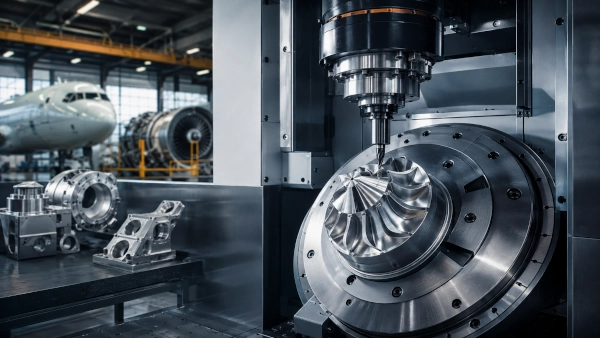
A five-axis machine adds two rotational axes. The workpiece can therefore be positioned at several angles relative to the cutting tool.
This allows engineers to reach complicated surfaces without repeatedly removing and repositioning the component.
Reducing these additional setups can improve dimensional consistency. It also reduces the possibility of alignment errors between machining operations.
Components such as impellers, turbine parts, aerospace brackets, propulsion components, housings and complex structural parts can benefit greatly from this approach.
For India, the technology has another importance. High-end multi-axis machine tools have historically depended heavily on overseas technology and imported systems.
Building such capability domestically therefore strengthens the industrial base behind advanced products.
Nimbus: Ethereal’s Indigenous Five-Axis Platform
At the centre of Ethereal Machines’ technology is Nimbus, its internally developed five-axis CNC platform.
Nimbus was designed, built and tested by Ethereal in India. The company developed the platform to machine materials ranging from aluminium and copper to titanium, steel and Inconel.
The machine has a cylindrical working envelope of approximately 400 mm diameter and 200 mm height. Its C-axis provides 360-degree rotation, while the B-axis operates from approximately minus 50 degrees to plus 110 degrees.
Nimbus also incorporates:
- rapid traverse speeds of up to 48 metres per minute;
- machining feed rates up to 30 metres per minute;
- a 12,000 RPM spindle;
- laser-based tool measurement;
- feedback systems on linear and rotary axes; and
- capability to machine materials rated up to approximately 65 HRC.
Ethereal states that Nimbus achieves linear positioning accuracy around 4 microns using linear scales on the X, Y and Z axes and dedicated encoders for the rotary axes.
For perspective, one micron is one-thousandth of a millimetre.
At such scales, factors including machine rigidity, temperature, tool wear, vibration and mechanical backlash can affect the finished component.
Engineering the Rotary Axes
One of the difficult problems in five-axis machining involves maintaining accuracy while rotating the workpiece under heavy cutting loads.
Ethereal developed a proprietary architecture for the Nimbus rotary system. The design separates the mechanical transmission of cutting forces from the measurement of the rotary position.
High-resolution optical encoders monitor the actual position of the rotary table. The control system can then compensate for mechanical variation during machining.
According to the company, the Nimbus architecture underwent independent testing through the Advanced Machine Tool Testing Facility at the Central Manufacturing Technology Institute (CMTI). Ethereal reports a rotary reversal error of around 0.6 arc-seconds and bi-directional accuracy of about 2.1 arc-seconds during the reported tests.
Such accuracy becomes particularly valuable when manufacturing complex aerospace, medical and other high-value components.
From Machine Tool to Finished Component
Ethereal Machines has also adopted a different commercial model from a conventional machine-tool manufacturer.
The company currently operates Nimbus within its own manufacturing ecosystem rather than simply selling the platform as a standalone machine. Ethereal explicitly states that Nimbus is not presently offered for sale.
Instead, customers send designs and drawings to Ethereal. Its engineers assess manufacturability, develop machining processes and manufacture the components on the company’s own machines.
This model is described as Machining-as-a-Service.
The strategy gives Ethereal direct feedback from production. Engineers designing the machines can observe how they behave while cutting difficult materials and manufacturing real components.
Machine design, machining processes, inspection and production can therefore evolve together.
Aerospace and Defence Applications
Advanced aerospace and defence manufacturing demands precise components made from difficult materials.
Aircraft structures need lightweight components with complex geometries. Gas turbines and propulsion systems use heat-resistant alloys. Drones, satellites and avionics require lightweight housings, brackets and precision assemblies.
Ethereal lists aerospace applications including airframe brackets, propulsion components, avionics housings, drone components and space-technology parts.
The company’s investor Avataar Ventures also identifies aerospace and defence among Ethereal’s customer sectors.
This makes indigenous precision machining capability strategically relevant beyond the machine-tool industry itself.
A country may design an advanced aircraft, missile, satellite or turbine. However, those designs ultimately require physical components produced within extremely tight specifications.
Manufacturing technology therefore forms part of the foundation beneath strategic engineering programmes.
Beyond Aerospace
The same capabilities have applications across several fast-growing industries.
In semiconductor manufacturing, precision machining is required for wafer-handling equipment, vacuum-chamber hardware and specialised fixtures.
Electronics manufacturers require RF housings, microwave enclosures, heat sinks and instrument structures.
Healthcare companies require surgical instruments, diagnostic equipment and intricate components made from medical-grade titanium or stainless steel.
Energy systems need turbine, pump and flow-control components capable of operating under demanding thermal and mechanical conditions. Ethereal lists all these areas among its manufacturing capabilities.
An indigenous precision-machining ecosystem can therefore support several industries simultaneously.
The Next Frontier: An Indigenous CNC Controller
Building the mechanical structure of a CNC machine solves only part of the localisation challenge.
The CNC controller is effectively the machine’s brain. It coordinates motors, encoders, tool paths, spindle operation and the precise movement of multiple axes.
Ethereal is now developing what it describes as India’s first indigenous multi-axis CNC controller.
This could represent an important next step in localisation.
In June 2026, the company announced a $28.5 million Series B funding round led by Avataar Ventures, with participation from Peak XV Partners and other investors.
Ethereal said the investment would support development of the indigenous controller, an AI-driven factory software platform and a new 300,000-square-foot manufacturing facility near Bengaluru.
The company also plans to expand manufacturing capacity for aerospace, healthcare, semiconductor and electronics components.
From Import Dependence to Industrial Capability
Machine tools are sometimes called the machines that make machines.
Almost every advanced manufactured product eventually depends on equipment capable of shaping metal with sufficient accuracy.
Aircraft engines, launch vehicles, satellites, medical devices, semiconductor equipment and defence systems all rely on this deeper manufacturing infrastructure.
India has already developed significant capability in designing advanced systems. The next stage involves strengthening the industrial equipment used to manufacture those systems at scale.
Ethereal Machines represents this transition.
Its importance lies not simply in producing another CNC machine. The deeper achievement is developing proprietary machine architecture, control systems, manufacturing processes and metrology knowledge within India.
Such capabilities are difficult to acquire quickly because they require years of accumulated engineering experience.
Building the Machines Behind Make in India
The success of Make in India will ultimately depend on much more than assembling final products.
A mature industrial economy must control critical manufacturing technologies deeper inside the supply chain.
That includes machine tools, controllers, sensors, tooling, industrial software, metrology systems and production processes.
Ethereal Machines is attempting to build capability at precisely this level.
Nimbus demonstrates that advanced five-axis machining platforms can be engineered and operated from India. The company’s work on an indigenous multi-axis CNC controller could push localisation even further.
As India expands its aerospace, defence, semiconductor, space and advanced-engineering industries, such technologies will become increasingly important.
The most visible symbol of industrial self-reliance may be an aircraft, satellite or sophisticated machine.
But behind every one of them stands another machine that shaped its components.
Ethereal Machines is working on building those machines in India.
Sources
Ethereal Machines — official company and manufacturing information.
Ethereal Machines — official technical information on the Nimbus five-axis platform.
Ethereal Machines — technical report on Nimbus rotary-axis architecture and CMTI verification.
Ethereal Machines — June 2026 Series B announcement and indigenous CNC controller programme.
Avataar Ventures — portfolio profile of Ethereal Machines.
You may also like
-
India’s Economic Warfare Challenge: Strategic Autonomy, Energy Security and the Rise of a Global Power
-
India-US Trade Deal Stalemate: Why Washington’s Tariff Pressure Has Failed to Secure an Agreement
-
US Double Standards in Foreign Policy: 16 Recent Cases Involving India, Russia, China and Global Trade
-
India’s Arctic Energy Ambitions: Russian Oil, LNG and a New Sea Route to Indian Ports
-
India and Russia Explore Joint Icebreaker Construction as Maritime Industrial Cooperation Expands
