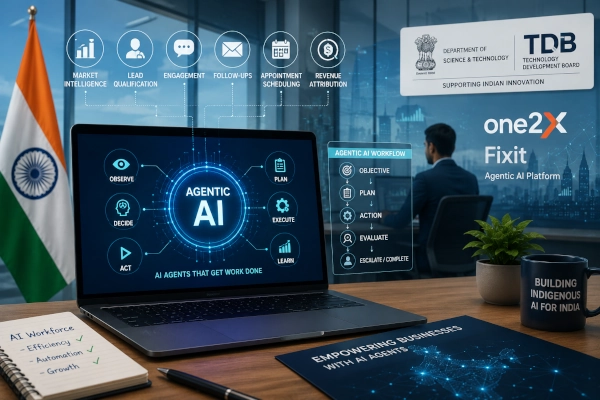
India is backing the commercialisation of an indigenous Agentic Artificial Intelligence platform developed by Delhi-based startup One2X Tech Pvt. Ltd., marking another step in the effort to build domestically developed AI technologies capable of moving beyond conversational assistance into the direct execution of business processes.
The Technology Development Board (TDB) under the Department of Science and Technology has entered into an agreement with One2X Tech to support the commercialisation of its Fixit platform. The initiative was announced on 20 August 2026 and is intended to strengthen the platform’s orchestration capabilities, enterprise integrations, security and scalability as it moves towards wider commercial deployment.
From AI Assistants to AI Agents
Fixit belongs to the rapidly emerging category of Agentic AI, in which artificial-intelligence systems are designed not merely to answer questions or generate content but to pursue defined objectives through a sequence of actions.
An agentic system can interpret an objective, identify the next required step, interact with connected software or databases, evaluate the outcome and continue working towards completion. In an enterprise environment, this means AI can potentially participate directly in workflows that would traditionally require repeated human intervention.
For example, rather than simply preparing a summary of prospective customers, an AI agent could identify a lead, retrieve relevant information, initiate contact, schedule follow-ups, update enterprise systems and determine when the lead should be transferred to a human sales representative.
This shift from generative AI to execution-oriented AI is one of the reasons agentic systems are attracting significant attention across the global technology industry.
Multi-Agent Architecture at the Core of Fixit
Fixit combines several AI capabilities within a common architecture, including multi-agent orchestration, contextual memory, AI reasoning, reinforcement learning, real-time decision-making and secure tool execution.
Instead of relying on a single general-purpose AI model to perform every function, the platform can coordinate specialised agents responsible for different stages of a workflow.
These agents can retrieve contextual information, determine appropriate actions, interact with enterprise systems and observe the consequences of their actions. Depending on the result, the system can then proceed, retry a task or escalate it for human intervention.
The architecture also incorporates guardrails, observability and human oversight, which are particularly important when AI systems are allowed to take actions rather than merely provide recommendations.
Observability allows organisations to monitor how agents behave and what actions they perform, while guardrails can restrict what tools, data or operations individual agents are permitted to access. Human oversight provides another layer of control for tasks involving greater judgement or risk.
Initial Deployment Focuses on Revenue Operations
One2X is initially commercialising Fixit for revenue operations, where companies often have to coordinate large numbers of repetitive interactions across sales and customer-engagement systems.
The platform is being developed to support functions including market intelligence, customer engagement, lead qualification, nurturing, follow-ups, appointment scheduling, sales handover and revenue attribution.
The aim is to create a continuous workflow in which information from customer interactions feeds back into AI decision-making, allowing the system to determine what action should occur next rather than simply recording what has already happened.
One2X’s own description of Fixit shows this approach in practice. The platform can engage new leads rapidly, communicate through phone calls and messaging, qualify potential customers and maintain automated follow-ups so that prospective opportunities are not lost because of delayed human response.
Real Estate Chosen as the First Major Market
The startup’s initial sectoral focus is real estate, an industry where customers often take weeks or months to make purchasing decisions and may interact with a company repeatedly before completing a transaction.
Such long sales cycles create a significant coordination challenge. Sales teams must track enquiries, contact prospects, determine customer intent, organise property visits, maintain follow-ups and identify when a prospective buyer is ready for direct intervention.
One2X believes agentic AI can automate much of this repetitive work while leaving human teams responsible for functions requiring negotiation, judgement, relationships and strategic decision-making.
The underlying architecture, however, is not inherently restricted to real estate. The same approach could potentially be adapted to other sectors involving complex, multi-step workflows across multiple software systems.
Building an ‘AI Workforce’ for Smaller Businesses
One of the broader objectives behind Fixit is the development of what the company describes as an AI workforce.
Under this model, specialised AI agents undertake repetitive execution, monitoring, analysis and coordination, while human employees concentrate on activities requiring creativity, strategy, entrepreneurship and interpersonal judgement.
The concept could be particularly relevant to startups and MSMEs, which often cannot afford large specialist teams for sales operations, market intelligence, customer support or workflow management.
If such platforms become reliable and affordable, a smaller company could potentially access operational capabilities that previously required much larger teams and extensive software infrastructure.
Government Support Targets Commercialisation, Not Just Research
The importance of the TDB agreement lies in its focus on moving an indigenous technology from development towards commercial deployment.
The Technology Development Board was established specifically to promote the development and commercial application of indigenous technologies. It provides financial assistance and other support to Indian enterprises attempting to transform research and technological innovation into market-ready products.
For One2X, the support is intended to strengthen four areas that become increasingly important as an AI platform moves from controlled demonstrations into real business environments: AI orchestration, enterprise integration, security and scalability.
Enterprise deployment poses challenges substantially different from laboratory development. AI agents may have to communicate with customer-management platforms, databases, communications systems and other business software while simultaneously maintaining access controls, audit trails and reliable behaviour.
Commercialisation therefore requires not only increasingly capable AI models but an engineering layer capable of making those models dependable enough for everyday use.
Part of India’s Push for Indigenous AI Capability
The project also fits into India’s wider effort to develop sovereign and indigenous AI capabilities rather than remaining dependent entirely on foreign-developed platforms.
TDB Secretary Rajesh Kumar Pathak said India’s AI development increasingly needs to move beyond adoption towards the creation and commercialisation of indigenous technologies, identifying Agentic AI as an important area capable of transforming how enterprises operate and scale.
That distinction is significant. Much of the first phase of generative-AI adoption involved Indian companies building services around foundational models developed elsewhere. A stronger domestic ecosystem would involve Indian companies developing more of the orchestration software, specialised models, data infrastructure, enterprise systems and application technologies themselves.
One2X describes its broader objective as building the underlying infrastructure required for industries to operate with AI at the centre of their workflows rather than simply adding individual AI features to existing software.
From Generating Answers to Executing Work
The potential significance of Fixit therefore goes beyond one sales-automation application.
Generative AI demonstrated that machines could increasingly create, summarise and analyse information. Agentic AI attempts to add another layer: enabling software to decide what needs to happen next and then carry out the required actions across connected systems.
That capability also introduces greater technical and governance challenges. Reliability, access control, security, auditability and effective human supervision become substantially more important when an AI system is authorised to perform actions on behalf of an organisation.
The design emphasis on guardrails, observability and human oversight suggests that these challenges are being treated as part of the platform architecture rather than as secondary considerations.
The TDB-backed commercialisation programme will now provide an important test of whether a home-grown Indian Agentic AI architecture can progress from specialised deployment in real-estate revenue operations towards a scalable enterprise platform.
You may also like
-
DRDO Pushes Indigenous Multi-Drone Formation Technology Through Technology Development Fund
-
ICAR Identifies VL 3040 Wheat With Improved Rust Resistance for India’s Northern Hill Regions
-
India Builds Indigenous Nuclear Technology Ecosystem as Three-Stage Programme Moves Towards Thorium Era
-
MosChip Technologies: Building India’s Full-Stack Chip Design Capability from RTL to Silicon
-
Nav Wireless Technologies: Building India’s Light-Based Communications Frontier
