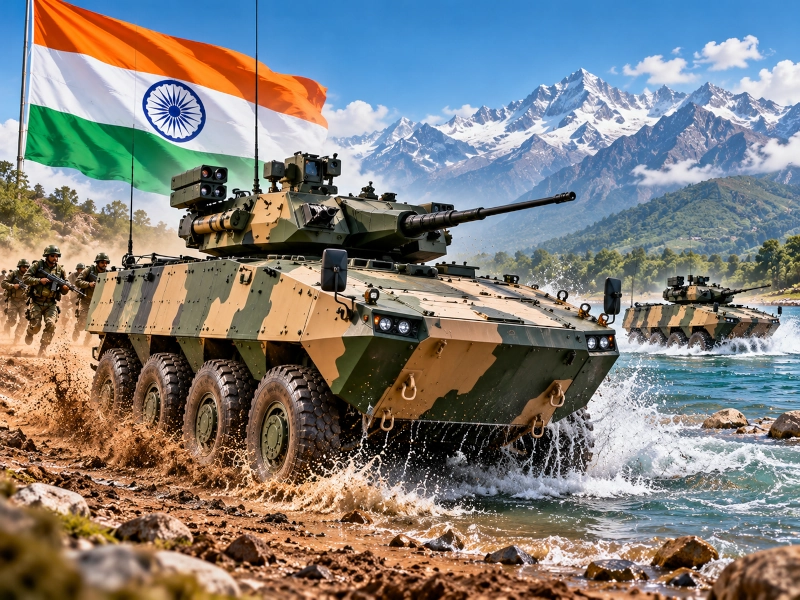
The Defence Research and Development Organisation (DRDO) has achieved an important milestone in the development of its indigenous Vikram VT-21 infantry combat vehicle programme, with the wheeled variant successfully meeting key operational requirements during development trials. The vehicle has demonstrated mobility, trench-crossing capability and amphibious performance while equipped with its turret, marking progress in the development of advanced armoured platforms for the Indian Army.
According to a report published by The Times of India on 29 October 2026, a senior DRDO official confirmed that extensive trials of the wheeled platform had produced encouraging results. The trials assessed the vehicle’s performance across important mobility parameters, while development testing of the tracked variant is progressing simultaneously.
Wheeled Vikram VT-21 Demonstrates Key Mobility Capabilities
The wheeled Vikram VT-21 has successfully demonstrated its ability to meet mobility requirements, cross trenches and undertake amphibious operations during development testing.
A senior DRDO official stated that the wheeled platform had undergone extensive trials and met important operational requirements, including amphibious capability with its turret installed.
The ability to negotiate obstacles and water crossings forms part of the operational requirements for modern infantry combat vehicles, which are designed to transport troops while providing mobility, protection and fire support in combat environments.
The encouraging results represent a development milestone for the wheeled variant. The Indian Army will undertake further evaluations before the platform can be considered for operational acceptance.
Developed by DRDO’s Vehicles Research and Development Establishment
The Vikram VT-21 programme has been developed by the Vehicles Research and Development Establishment, a DRDO laboratory located at Ahilyanagar in Maharashtra.
The programme includes both wheeled and tracked Advanced Armoured Platforms designed to address emerging operational requirements of the Indian Armed Forces.
The platforms have been developed through collaboration between DRDO and Indian private defence manufacturers, including Tata Advanced Systems Limited and Bharat Forge Limited, with support from micro, small and medium enterprises.
DRDO officially unveiled the tracked and wheeled platforms on 25 April 2026 at its Ahilyanagar facility. The unveiling was conducted by DRDO Chairman and Secretary, Department of Defence Research and Development, Dr Samir V. Kamat.
The Ministry of Defence stated that the Advanced Armoured Platforms had been designed and developed to meet requirements relating to mobility, firepower and protection.
Indigenous 30 mm Unmanned Turret and Advanced Protection Systems
Both variants of the Vikram VT-21 incorporate an indigenously designed and developed 30 mm crewless turret.
According to the Ministry of Defence, the turret is integrated with a 7.62 mm PKT machine gun and provision for launching anti-tank guided missiles. The configuration is intended to provide infantry combat vehicles with firepower while allowing operators to remain within the protected vehicle hull.
The platforms are equipped with high-power engines and automatic transmissions designed to provide a favourable power-to-weight ratio, higher speed capabilities and improved performance when negotiating gradients and obstacles.
The vehicles also incorporate modular ballistic and blast protection systems designed around STANAG Level 4 and Level 5 requirements.
Their amphibious capabilities are supported by hydrojet propulsion systems intended to improve water-obstacle crossing performance.
These technologies were identified by the Ministry of Defence during the official unveiling of the platforms in April 2026.
Wheeled and Tracked Variants Under Development
The Vikram VT-21 programme includes wheeled and tracked configurations intended to address different operational mobility requirements.
The wheeled platform is designed to provide mobility suited to road networks and rapid movement, while the tracked configuration is intended to address requirements involving difficult terrain and off-road operations.
Both platforms have been developed to perform infantry combat vehicle and armoured personnel carrier roles.
DRDO has confirmed that the development and testing of the tracked variant are progressing alongside the wheeled platform.
The two configurations form part of the broader effort to develop indigenous armoured combat vehicles capable of meeting the evolving requirements of the Indian Army’s mechanised forces.
Indian Army to Conduct Further Trials Across Different Terrains
Following the development trials, the Vikram VT-21 platforms are expected to undergo additional evaluations by the Indian Army.
According to the senior DRDO official quoted in the 29 October report, the Army will conduct trials across desert regions, plains and high-altitude environments.
These evaluations will examine mobility, weapon systems, firing capabilities and vehicle performance under different operational conditions.
Feedback received during the trials will guide further modifications and development before the platforms progress towards possible induction.
DRDO has indicated that the programme is targeting induction by 2029, subject to successful completion of testing and acceptance by the Indian Army.
The completion of the latest wheeled-platform development trials does not constitute final Army acceptance or approval for operational induction.
Indigenous Development Supports Armoured Vehicle Modernisation
The Vikram VT-21 programme is associated with the Indian Army’s efforts to modernise its mechanised infantry fleet, which currently includes Russian-origin BMP-II infantry combat vehicles.
DRDO’s programme brings together indigenous vehicle design, armoured protection technologies, mobility systems and weapon integration capabilities through cooperation with Indian defence manufacturers.
According to the Ministry of Defence’s April 2026 announcement, the Advanced Armoured Platforms were developed with approximately 65% indigenous content, with plans to increase localisation to 90%.
The participation of Indian private defence manufacturers and supporting enterprises forms an important part of the development programme.
The successful demonstration of mobility, trench-crossing and amphibious capabilities during the latest trials marks further progress towards DRDO’s stated objective of developing advanced indigenous armoured platforms for the Indian Armed Forces.
The Ministry of Defence has described the Vikram VT-21 platforms as an important development in meeting the emerging operational requirements of India’s defence forces through indigenous research, engineering and manufacturing capabilities.
You may also like
-
Hindustan Shipyard Signs MoU With Kakinada Seaports to Expand Shipbuilding Capabilities in Andhra Pradesh
-
CCS Reportedly Clears ₹40,000-Crore Project for Eight Next-Generation Corvettes for Indian Navy
-
Indian Air Force Reportedly Evaluates Shield AI’s V-BAT Drones as JSW Defence Expands Indigenous Manufacturing
-
INS Samarthak: India’s Indigenous Multi-Purpose Warship Designed to Serve as a Mothership for Naval Drones
-
Indian Defence Firm Tonbo Imaging Secures European EO/IR Seeker Export Order with €13 Million Potential
