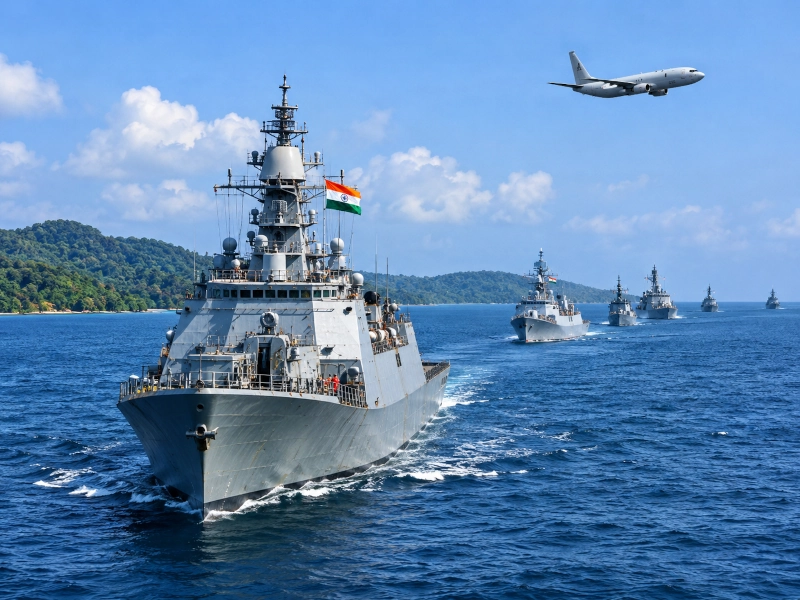
Sri Vijaya Puram, October 31, 2026: India is hosting the inaugural BIMSTEC Maritime Security Exercise in the Andaman and Nicobar Islands, bringing together seven South and Southeast Asian nations to strengthen maritime cooperation, operational coordination and regional security in the Bay of Bengal.
The exercise, which commenced on October 30 and will continue until November 3, 2026, represents an important step towards developing stronger maritime security partnerships among members of the Bay of Bengal Initiative for Multi-Sectoral Technical and Economic Cooperation (BIMSTEC).
Bangladesh, Bhutan, India, Myanmar, Nepal, Sri Lanka and Thailand are participating in the initiative, which seeks to improve interoperability, maritime domain awareness and coordination among member countries.
The Ministry of Defence announced the exercise on October 31, describing it as an important milestone in translating regional commitments into practical maritime cooperation.
Strengthening Maritime Cooperation Across the Bay of Bengal
The inaugural maritime security exercise builds upon the commitments made during the sixth BIMSTEC Summit held in Thailand.
At the summit, which adopted the theme BIMSTEC: Prosperous, Resilient and Open, Prime Minister Narendra Modi announced an initiative to strengthen regional maritime security cooperation through joint exercises.
The exercise translates this commitment into practical engagement among member nations, providing opportunities to improve operational coordination and establish stronger working relationships between maritime security establishments.
According to the Ministry of Defence, the initiative focuses on improving interoperability, strengthening maritime domain awareness, developing coordination mechanisms and facilitating the exchange of operational knowledge and best practices.
These measures are intended to improve the ability of BIMSTEC nations to cooperate in addressing maritime security challenges affecting the Bay of Bengal region.
Five-Day Exercise Combines Operational Planning and Maritime Engagement
The BIMSTEC Maritime Security Exercise is being conducted over five days, combining professional discussions with maritime activities.
According to News On AIR, the programme includes three days of tabletop exercises followed by a two-day harbour phase involving ships from BIMSTEC member countries.
Tabletop exercises provide a structured environment for participating nations to discuss maritime security situations, examine coordination procedures and consider operational responses to potential challenges.
Such engagements help maritime authorities develop a shared understanding of security requirements and identify opportunities for improved cooperation.
The subsequent harbour phase provides a platform for professional engagement among participating maritime forces, supporting the broader objective of improving communication, coordination and interoperability.
The exercise is designed to strengthen regional cooperation rather than focus exclusively on conventional naval combat operations.
Strategic Importance of the Andaman and Nicobar Islands
The selection of Sri Vijaya Puram in the Andaman and Nicobar Islands as the venue underscores the strategic importance of India’s island territories in the Bay of Bengal.
Located close to major international shipping routes, the Andaman and Nicobar Islands occupy an important geographical position between the Indian Ocean and Southeast Asia.
The surrounding maritime region connects important commercial routes supporting international trade, energy transportation and economic activity.
The islands also provide India with a strategically located base for maritime surveillance, regional security cooperation, search and rescue operations, and humanitarian assistance.
The Ministry of Defence highlighted the role of the Andaman and Nicobar Command, India’s first integrated tri-service command, in supporting maritime security activities across the region.
The command brings together elements of the Indian Army, Navy and Air Force under an integrated military structure.
Its geographical location and operational capabilities make it an important component of India’s maritime security architecture and regional engagement efforts.
Improving Maritime Domain Awareness and Operational Coordination
A central objective of the BIMSTEC exercise is to strengthen maritime domain awareness among participating countries.
Maritime domain awareness refers to the ability to monitor, identify and understand activities taking place across maritime areas, including the movement of vessels and potential security threats.
Improved coordination in this field can help countries develop a clearer understanding of developments affecting commercial shipping, coastal security and maritime safety.
For the Bay of Bengal region, these capabilities are particularly important because its waters support substantial commercial activity and connect the economies of South and Southeast Asia.
The exchange of operational knowledge and best practices can also contribute to more effective cooperation in responding to maritime emergencies and other regional challenges.
By bringing together countries with different maritime capabilities and geographical circumstances, the exercise provides an opportunity to develop stronger institutional relationships and improve collective preparedness.
Maritime Security and Disaster Response Cooperation
The Bay of Bengal is not only an important commercial maritime region but also an area frequently affected by severe weather systems, cyclones and natural disasters.
Consequently, regional maritime cooperation extends beyond traditional security responsibilities to include humanitarian assistance, disaster relief and search and rescue operations.
The Andaman and Nicobar Command possesses capabilities relevant to these activities, including maritime surveillance and coordination of emergency responses.
Improved cooperation among BIMSTEC countries can support the development of more coordinated approaches to maritime emergencies and disaster-related challenges.
The Ministry of Defence has identified humanitarian assistance, disaster relief and search and rescue as important elements of the Andaman and Nicobar Command’s regional maritime security role.
The exercise therefore contributes to a broader framework of cooperation in which maritime security, disaster preparedness and regional stability are closely connected.
Bringing Together South and Southeast Asian Nations
BIMSTEC provides a regional cooperation framework connecting five South Asian countries and two Southeast Asian countries.
Its seven members are Bangladesh, Bhutan, India, Myanmar, Nepal, Sri Lanka and Thailand.
The organisation seeks to strengthen cooperation across several sectors, including connectivity, security, trade, technology and economic development.
Maritime security is particularly relevant because the Bay of Bengal provides an important geographical connection between the two regions.
Although Bhutan and Nepal are landlocked countries, their participation in BIMSTEC reflects the wider regional significance of secure maritime trade routes, economic connectivity and cross-border cooperation.
The inaugural exercise represents an effort to translate the organisation’s broader security objectives into structured operational engagement.
It also provides a platform for developing stronger relationships among the participating countries’ maritime security and defence establishments.
India’s Role in Regional Maritime Security
India’s hosting of the inaugural BIMSTEC Maritime Security Exercise reflects its role in promoting maritime cooperation across the Bay of Bengal.
The country’s geographical position, maritime infrastructure and defence capabilities enable it to contribute to regional surveillance, security coordination and humanitarian assistance.
The Andaman and Nicobar Islands are particularly important in this context because of their proximity to maritime routes connecting the Indian Ocean with Southeast Asia.
Hosting the exercise also creates opportunities for India to strengthen professional engagement with neighbouring countries and support the development of practical regional security arrangements.
The initiative complements India’s broader emphasis on maritime partnerships, regional connectivity and cooperative approaches to security challenges in the Indian Ocean region.
By encouraging operational coordination and the exchange of expertise, the exercise seeks to improve the collective ability of BIMSTEC members to address shared maritime concerns.
Advancing a Shared Vision for Maritime Stability
The inaugural BIMSTEC Maritime Security Exercise marks a significant development in the organisation’s efforts to strengthen practical security cooperation.
By combining operational planning, professional engagement and maritime coordination, the initiative provides a foundation for closer cooperation among participating countries.
The Ministry of Defence has emphasised that the exercise reflects a collective commitment to maintaining a secure, open and inclusive maritime environment.
The programme also highlights the growing importance of the Andaman and Nicobar Islands as a centre for regional maritime engagement.
As the exercise continues until November 3, it demonstrates the willingness of BIMSTEC member nations to move beyond diplomatic commitments towards practical mechanisms for maritime cooperation.
The initiative reflects the broader principle of shared seas, shared security and shared prosperity, underscoring the importance of regional cooperation in safeguarding the Bay of Bengal and supporting long-term stability and economic development.
You may also like
-
Quad Announces Over $85 Million Initiative to Expand Trusted Artificial Intelligence Across Indo-Pacific
-
Air Chief Marshal Ashutosh Dixit Takes Charge as India’s 29th Chief of Air Staff
-
DRDO’s Indigenous Vikram VT-21 Wheeled Combat Vehicle Clears Key Development Trials
-
Hindustan Shipyard Signs MoU With Kakinada Seaports to Expand Shipbuilding Capabilities in Andhra Pradesh
-
CCS Reportedly Clears ₹40,000-Crore Project for Eight Next-Generation Corvettes for Indian Navy
