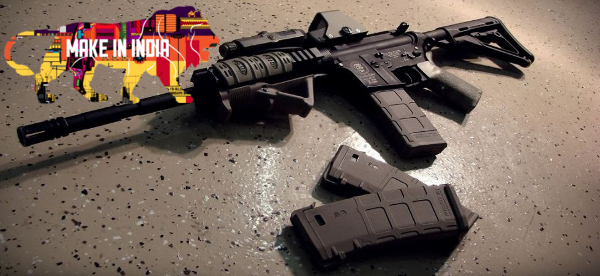
India has reached a major milestone in the localisation of its infantry weapons programme with the successful manufacture and test-firing of the first AK-203 ‘Sher’ assault rifle made entirely from Indian components and input materials at the Indo-Russian Rifles Private Limited facility in Korwa, Amethi.
The achievement marks the transition of the AK-203 programme from progressively localised production to complete indigenisation of the manufacturing supply chain, with every component and material used in the latest rifle sourced from Indian industry.
Indo-Russian Rifles Private Limited, or IRRPL, is now producing additional fully indigenised prototypes that will be handed over to the Indian Army for formal trials during September 2026. If the trials validate the locally sourced configuration, the development will clear an important stage towards large-scale manufacture of the AK-203 using an entirely Indian component ecosystem.
First Fully Indigenised AK-203 Successfully Fired
The first completely indigenised rifle has already undergone firing tests at the Korwa manufacturing facility, including burst firing, with the initial results described by IRRPL as encouraging.
The company says the milestone represents something substantially deeper than the localisation of a few major assemblies. Every component and input material used in the rifle has now been sourced from Indian manufacturers.
IRRPL Chief Executive Officer and Managing Director Major General S.K. Sharma described the achievement as genuine end-to-end indigenisation and confirmed that the company is now manufacturing the required number of prototypes for Army trials scheduled for September.
The upcoming trials will be important because the Army will need to establish that rifles built entirely around the Indian supply chain meet the same standards of reliability, accuracy, durability and operational performance expected from the AK-203 configuration.
Successful factory firing is therefore an important milestone, but Army trials represent the next stage of validation before fully indigenised rifles can form the basis of continued mass production.
Why ‘100% Indigenous’ Needs to Be Understood Correctly
The latest AK-203 is frequently being described as India’s first “100% indigenous AK-203”, but the expression refers specifically to manufacturing and components rather than the original weapon design.
The AK-203 belongs to the Russian Kalashnikov family of assault rifles. India obtained manufacturing technology through the Indo-Russian programme and has progressively transferred production from Russian-supplied kits towards domestic manufacture.
What has now been achieved is that all components and input materials required to manufacture the rifle can be sourced from within India.
This distinction is important because the achievement lies in building the industrial capability to manufacture and sustain the rifle independently rather than in claiming that the underlying Kalashnikov design originated in India.
From a defence self-reliance perspective, however, complete localisation of the supply chain is extremely significant. A weapon manufactured domestically but dependent upon imported barrels, receivers, springs, metals or other critical components would still remain vulnerable to external supply disruptions.
The latest configuration is intended to eliminate that dependency.
From Imported Kits to Indian Components
The AK-203 programme has undergone a gradual indigenisation process rather than moving immediately into completely domestic manufacture.
Initial production at Korwa began using semi-knocked-down components supplied from Russia, after which Indian content progressively increased as manufacturing processes, tooling and component supply chains were established domestically.
The programme was deliberately structured around phased technology transfer. As Indian industry mastered additional processes and components, dependence on imported inputs declined.
The production of the first AK-203 using entirely Indian components therefore represents the culmination of this localisation process.
It demonstrates that India has moved beyond simply assembling a foreign-origin rifle and has created the industrial ecosystem required to manufacture the weapon domestically from its constituent parts.
AWEIL, OSL and Indian Industry Support the Supply Chain
IRRPL has credited Advanced Weapons and Equipment India Limited, Ordnance Systems Limited and a wider network of Indian MSMEs and industrial partners with helping establish the domestic supply chain required for full indigenisation.
This distributed industrial ecosystem is an important aspect of the programme.
A modern assault rifle may appear relatively simple compared with a fighter aircraft or missile, but achieving reliable mass production requires extremely tight manufacturing tolerances across numerous components. Barrels, receivers, bolts, springs, magazines and other parts must function reliably even after prolonged exposure to dust, heat, moisture, rough handling and intensive firing.
Building these components domestically therefore requires precision machining, metallurgy, heat treatment, quality assurance and large-scale production expertise.
Once these manufacturing capabilities are established, they can potentially support future Indian small-arms programmes as well.
More Than Six Lakh AK-203 Rifles Planned
India’s Ministry of Defence signed a contract with IRRPL in December 2021 for 601,427 AK-203 rifles for the Indian military.
The programme represents one of the largest infantry small-arms manufacturing projects undertaken in India.
Initial production progressively increased after the Korwa facility became operational, with the first 35,000 rifles delivered to the Indian Army in 2024.
The eventual objective is to manufacture more than six lakh rifles domestically, creating a standard modern assault-rifle capability across substantial portions of the Indian Army.
The scale of the order is one reason why achieving complete indigenisation has strategic importance. Even relatively small imported components can create substantial foreign dependency when multiplied across hundreds of thousands of rifles and several decades of service.
Domestic production can also provide the Army with a more secure source of spare parts and replacement components throughout the weapon’s operational life.
IRRPL Targets One Rifle Every 100 Seconds
IRRPL is also increasing the production efficiency of the Korwa facility as the programme moves towards larger volumes.
The company says it is working towards a production rate of approximately one AK-203 every 100 seconds.
Such a rate would enable the factory to manufacture rifles on an industrial scale while maintaining the quality-control requirements associated with military weapons.
IRRPL has indicated that improvements in capacity, indigenisation and production optimisation could also allow it to complete deliveries of approximately six lakh rifles to the Indian Army nearly one year ahead of the original schedule.
If achieved, faster delivery would allow Army formations to transition more rapidly towards the newer weapon while simultaneously reducing the logistical burden created by operating multiple rifle types.
AK-203 Replaces an Older Generation of Infantry Weapons
The AK-203 programme forms part of India’s wider effort to modernise the individual weapons carried by its soldiers.
The Indian Army has relied heavily on the 5.56×45 mm INSAS rifle family, which entered service in the 1990s. Over time, the Army began seeking replacements better suited to contemporary operational requirements.
The AK-203 uses the 7.62×39 mm cartridge, providing a different balance of range, recoil and terminal effect from the smaller-calibre INSAS ammunition.
Its Kalashnikov operating mechanism is based on a design family known internationally for reliability under difficult environmental conditions.
For Indian soldiers who may operate in deserts, mountains, forests, high-altitude areas and humid environments, reliability under adverse conditions remains one of the most important characteristics of an infantry weapon.
The ‘Sher’ Identity Marks a New Stage
The locally manufactured rifle has increasingly been associated with the name ‘Sher’, reflecting the Indian identity being developed around the domestic production programme.
The significance of the name is less about changing the basic AK-203 configuration and more about distinguishing the increasingly Indianised production ecosystem surrounding the rifle.
As manufacturing transitions towards complete domestic sourcing, the weapon becomes progressively less dependent upon the original foreign supply chain even though the underlying design remains Russian.
This is broadly similar to the evolution seen in several major defence programmes where technology transfer provides the starting point but sustained localisation gradually creates indigenous manufacturing expertise.
September Trials Are the Next Major Milestone
The September 2026 Army trials will now become the next important stage to watch.
IRRPL is producing multiple rifles using the newly established 100% Indian component supply chain so that the Army can evaluate whether the fully indigenised configuration performs consistently across multiple weapons.
Military acceptance testing is generally designed to establish not merely whether a single rifle fires successfully, but whether production weapons maintain required levels of accuracy, reliability and durability under extended use.
Weapons may be subjected to sustained firing, environmental exposure and other demanding conditions intended to reproduce the stresses encountered during operational service.
Successful completion would validate both the rifle and the Indian companies producing its individual components.
That makes the forthcoming trials as much a test of the domestic manufacturing ecosystem as of the weapon itself.
Supply-Chain Independence Is the Larger Achievement
The strategic importance of the programme extends beyond the AK-203.
Modern conflicts have repeatedly demonstrated that military readiness depends heavily on access to replacement components, ammunition and maintenance infrastructure.
Even relatively simple weapons can become difficult to sustain if essential parts must be imported during a period of geopolitical disruption.
Complete localisation provides greater control over production schedules and replacement components while also making it easier to increase output if operational demand suddenly rises.
For an infantry rifle intended to equip hundreds of thousands of soldiers, this supply-chain resilience can be especially important.
Technology Transfer Can Build Domestic Capability
The AK-203 programme also provides an example of how foreign defence cooperation can potentially be structured around increasing levels of Indian manufacturing capability.
The project began as an India-Russia joint venture, but the intended direction was always towards progressively higher indigenous content.
Rather than indefinitely importing completed rifles, India sought to absorb production technology, establish manufacturing lines and create domestic component suppliers.
The arrival of the first rifle manufactured entirely from Indian components suggests that this process has now reached one of its most important milestones.
It also demonstrates the potential difference between simple licensed assembly and deeper technology-transfer programmes.
Assembly may provide domestic jobs, but indigenous component manufacture creates engineering knowledge, supplier networks and industrial capacity that can support future weapons programmes.
India Is Building a Broader Small-Arms Manufacturing Base
The AK-203 programme is part of a wider expansion in India’s small-arms manufacturing ecosystem.
Public-sector manufacturers, private companies and joint ventures are increasingly developing rifles, carbines, machine guns, sniper weapons, ammunition and accessories for the Armed Forces, Central Armed Police Forces and export customers.
Greater domestic competition could eventually allow India to move beyond meeting internal requirements and become an exporter of small arms and related equipment.
The scale of the AK-203 programme provides an important industrial foundation because manufacturing hundreds of thousands of rifles develops skills and supplier capacity that can potentially be transferred to future indigenous designs.
From Local Assembly to Genuine Manufacturing
The production of the first AK-203 Sher using 100% Indian components and input materials therefore represents a significant transition in India’s infantry-weapons programme.
When production began, important parts and materials still came through the Russian supply chain. Through progressive localisation and technology transfer, Indian companies have now reached the stage where the entire weapon can be manufactured using domestically sourced inputs.
The September 2026 Army trials will determine whether that fully indigenised configuration meets military requirements across a wider batch of prototypes.
If successful, the programme will have crossed one of its most important industrial milestones: India will not simply be assembling the AK-203 within its borders but will possess a domestic supply chain capable of producing the weapon at scale.
With more than six lakh rifles planned, production potentially accelerating towards one rifle every 100 seconds, and deliveries expected to finish ahead of schedule, the AK-203 programme is evolving into one of the clearest examples of India’s attempt to use international defence cooperation as a pathway towards increasingly independent domestic manufacturing.
The rifle may have originated from a Russian design, but the factories, materials, components and industrial ecosystem behind the latest AK-203 Sher are now Indian — and the Army trials in September 2026 will be the next decisive test of that achievement.
You may also like
-
Indian Navy Vice Chief Inspects Japan’s Mogami-Class Stealth Frigate as India-Japan Shipbuilding Cooperation Expands
-
India and Russia Explore Joint Icebreaker Construction as Maritime Industrial Cooperation Expands
-
Philippine Marine Wargames Reportedly Show BrahMos Can Penetrate Chinese Destroyer Air Defences
-
Safran Signs 18 Agreements with Indian Aerospace Suppliers, Expanding Make in India Manufacturing Partnerships
-
Indian Army’s Vajra Corps Certifies First Batch of Drone Operators, Strengthens Battlefield Surveillance
