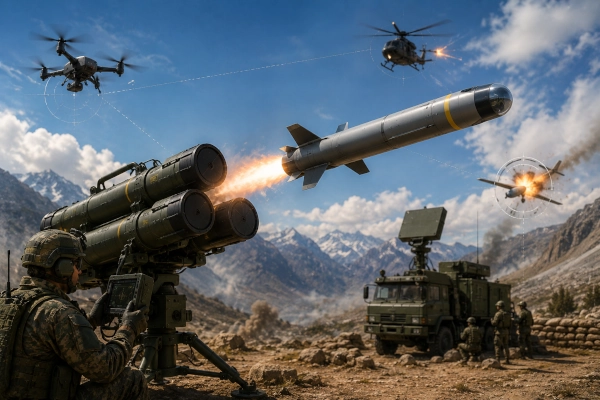
India and the United Kingdom are moving closer to finalising a major government-to-government agreement for the supply of Thales Lightweight Multirole Missiles (LMM) to the Indian Army, potentially giving frontline formations a compact precision weapon capable of engaging drones, helicopters and other low-altitude threats.
The latest development, reported on indicates that negotiations are approaching the Inter-Governmental Agreement stage. The planned acquisition has reportedly expanded significantly since India and the UK first formally announced their intention to proceed with the procurement in October 2025.
The original package was valued by the British government at approximately £350 million and covered UK-manufactured LMM missiles and launchers for India. Fresh indications suggest the eventual requirement could involve several hundred missiles, although the final quantity has not yet been officially disclosed by the Indian Ministry of Defence.
The LMM, also known in British service as Martlet, is manufactured by Thales at Belfast in Northern Ireland. It is a lightweight precision-guided missile developed to engage a broad range of targets while remaining compact enough to be deployed from land, naval and airborne platforms.
Weighing approximately 13 kg, the missile can be used against threats including unmanned aerial vehicles, helicopters, low-flying aircraft and small surface targets. Its compact dimensions also allow several missiles to be carried on a launcher, providing greater engagement capacity against multiple threats.
The system has gained increasing importance as inexpensive drones and loitering munitions reshape short-range air defence requirements. Militaries require interceptors that are accurate enough to destroy small aerial targets but sufficiently compact and affordable to be fielded in large numbers.
For the Indian Army, LMM could provide another layer between conventional gun-based counter-drone systems and heavier surface-to-air missile networks. Such weapons can be deployed with tactical formations to defend command posts, artillery positions, logistics nodes and other forward assets from low-altitude aerial attack.
The programme is also intended to move beyond a straightforward import arrangement. India and the UK have been developing a longer-term industrial partnership involving Thales and Bharat Dynamics Limited (BDL) for missile manufacturing in India.
Thales and BDL have already established cooperation in laser-beam-riding missile systems. In February 2025, the companies announced an initial Indian supply of the STARStreak Laser Beam Riding MANPAD system, with the weapon manufactured with significant Indian content. The companies separately stated that their partnership would subsequently expand into the co-production of LMM in India.
This distinction is important. STARStreak and LMM are related products within Thales’ short-range precision-weapons portfolio, but they are separate missile systems. The latest India-UK negotiations specifically concern the Lightweight Multirole Missile.
The proposed LMM programme therefore has two dimensions. The immediate requirement would provide the Indian Army with additional short-range precision weapons, while the longer-term arrangement could integrate BDL and other Indian manufacturers into Thales’ global missile supply chain.
India and the UK formally confirmed the programme during British Prime Minister Keir Starmer’s visit to India on October 9, 2025. Their joint statement said the two governments had agreed to proceed through the government-to-government route for an initial supply of LMM systems and linked the programme to longer-term cooperation on complex weapons.
Since then, battlefield developments worldwide have reinforced the importance of short-range air defence against drones. Small unmanned aircraft are increasingly being used for reconnaissance, precision attack and loitering-munition missions, creating demand for mobile defensive systems capable of responding rapidly at tactical level.
The reported increase in India’s planned LMM requirement consequently points towards a broader effort to build larger inventories of short-range interceptors rather than acquiring only a limited number for evaluation.
You may also like
-
Dhaksha Opens New Drone Manufacturing Facility in Tamil Nadu, Unveils Indigenous Agricultural UAVs
-
India Develops Indigenous Real-Time Health Monitoring Technology for Fighter Aircrew
-
HAL-Safran Sign Final Contract for 3,500–4,000 shp Aravalli Engine to Power IMRH and DBMRH
-
DRDO Successfully Tests Indigenous Military Combat Parachute System From 22,000 Feet at Nyoma
-
DRDO Advances Plans for New Trisonic Wind Tunnel at RCI Hyderabad for Advanced Aerospace Testing
