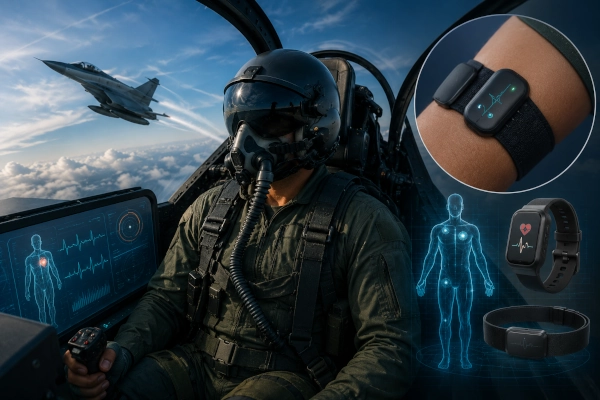
India’s defence innovation ecosystem is developing an indigenous real-time in-flight health monitoring system for aircrew, aimed at continuously measuring the physiological condition of fighter pilots during demanding missions and providing early warning of potentially dangerous medical abnormalities.
The requirement originated under the Ministry of Defence’s Defence India Startup Challenge-4, launched through Innovations for Defence Excellence in September 2020. The project seeks a non-invasive monitoring system capable of functioning during extended fighter flying while also generating physiological data for aeromedical research.
Unlike conventional medical monitoring equipment used in hospitals or ground facilities, the proposed system must operate independently aboard an aircraft. The requirement calls for the system to be self-reliant in power supply, onboard data storage and communications, allowing it to function without depending completely on aircraft systems.
Wearable sensors could continuously measure parameters such as heart rate, blood pressure, respiratory rate, body temperature, blood-oxygen saturation, electrocardiogram signals and other physiological indicators. The system is also expected to generate real-time alerts when measurements indicate acute or critical deviations.
Such monitoring has particular relevance to fighter aviation because pilots operate in an environment involving rapid acceleration, high G-forces, changes in atmospheric pressure, intense workload and prolonged physiological stress. Hypoxia, fatigue, cardiovascular strain and other conditions can impair judgement and physical performance before the pilot fully recognises the problem.
Real-time physiological monitoring could provide an additional layer of flight safety by identifying these changes at an early stage. Recorded information could also allow aerospace-medicine specialists to analyse how individual pilots respond to different flight profiles, mission durations and workload conditions.
A mature system could eventually move beyond simple threshold warnings. By combining multiple physiological measurements with data analytics, future versions could potentially identify patterns associated with fatigue, excessive stress or impending incapacitation before a critical condition develops.
The programme is also significant from an indigenisation perspective. Wearable sensors, secure communications, onboard processing, specialised algorithms and aeromedical analytics could be developed within India’s defence technology ecosystem instead of relying entirely on imported systems.
The technology could eventually have applications across fighter aircraft and other demanding military aviation environments where monitoring crew health during flight can contribute to both operational effectiveness and aviation safety.
India’s work on real-time aircrew health monitoring therefore represents an emerging intersection between aerospace medicine, wearable electronics, data analytics and military aviation. Rather than monitoring only the health of the aircraft, future combat aviation systems could increasingly monitor the pilot as an integral part of the overall weapon system.
You may also like
-
IndigoTex Raises ₹5 Crore to Scale Indigenous Advanced Textile Technologies
-
Sunfox Technologies Raises $7 Million to Take India-Built Spandan ECG Platform Global
-
DRDO Opens Actuators, Infrared Seeker, Lightweight Torpedo and Armour Technologies to Indian Industry
-
Indian Army to Add 225 Indigenous FPV Drones; Aerodrone Says Systems Were Tested Up to 17,500 Feet
-
India Helps Build a Machine Hotter Than the Sun: INOX India’s Cryogenic Role in ITER
