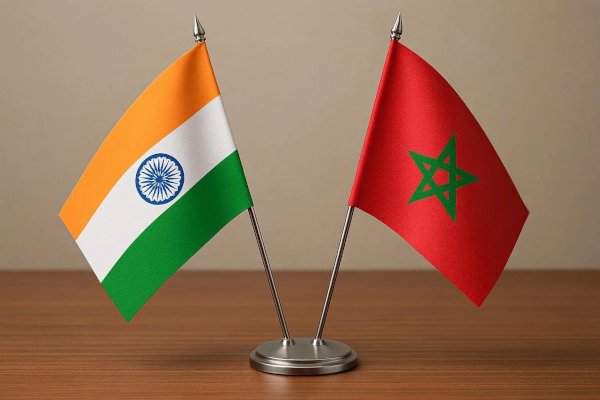
India and Morocco have agreed to work towards doubling bilateral trade over the next five years, while creating a new institutional mechanism to explore the feasibility of a Preferential Trade Agreement (PTA) between the two countries. The decision emerged from the 7th India–Morocco Joint Commission, giving fresh momentum to a relationship that is increasingly expanding from traditional trade into technology, healthcare, renewable energy and advanced manufacturing.
The Joint Commission was co-chaired during Minister of State for Commerce and Industry and Electronics and Information Technology Jitin Prasada’s visit to Morocco from August 24–25, 2026. India and Morocco reviewed their commercial relationship and agreed that greater market access, diversification of the trade basket and stronger investment partnerships could unlock substantially more economic activity. Bilateral trade reached approximately $4 billion in 2025.
A significant outcome was the decision to establish an India–Morocco Joint Working Group that will examine opportunities for expanding bilateral commerce and assess the feasibility of a preferential trade arrangement. Such an agreement could eventually provide selected products from both countries with lower tariffs or preferential market access, while creating a more predictable framework for businesses entering each other’s markets.
The two countries identified a wide range of sectors for stronger trade, including fertilisers and chemicals, mineral resources, machinery, electrical equipment, automotive components, vehicles, building materials, polymers, agricultural and food products, metals and tourism. The breadth of these sectors reflects an effort to move the relationship beyond a narrow set of commodities and develop more diversified industrial linkages.
Healthcare and pharmaceuticals have emerged as an especially important component of the partnership. India and Morocco agreed on the importance of providing predictable and timely market access for pharmaceutical products, an area with considerable potential because of India’s large generic-drug manufacturing base and Morocco’s position as an important commercial gateway to North and West Africa. Discussions also covered hospitals, diagnostics, medical devices and digital-health technologies.
The partnership is simultaneously moving into emerging technology sectors. At the Morocco–India Business Forum in Casablanca, India highlighted opportunities in artificial intelligence, electric-vehicle components, precision automotive manufacturing, renewable energy, energy storage, grid management, fintech and start-ups. Indian and Moroccan companies are being encouraged to establish joint ventures and build production and investment partnerships rather than limiting engagement to conventional imports and exports.
Fertilisers remain one of the foundations of India–Morocco economic relations. Morocco possesses some of the world’s most important phosphate resources, while India is a major consumer of phosphate-based fertilisers for its agricultural sector. This complementarity has created a longstanding strategic economic connection between the two countries and provides a strong base for expanding cooperation into chemicals, mining and industrial processing.
The two economies also offer increasingly complementary manufacturing opportunities. India provides a vast domestic market, large engineering and technology capabilities and expanding automotive and electronics industries, while Morocco has developed important manufacturing links with European and African markets. Closer industrial cooperation could therefore allow companies from both sides to participate in wider regional and global supply chains.
Business-to-business engagement will form an important part of the effort to reach the five-year trade target. Both governments have called for more regular business delegations, market-prospecting missions and networking initiatives to identify investment opportunities and overcome barriers faced by exporters. Such interactions are expected to support joint ventures and longer-term industrial partnerships.
The latest economic push comes as India and Morocco prepare to mark the 70th anniversary of diplomatic relations in 2027. The next, eighth session of the Joint Commission is expected to be held in New Delhi, providing another opportunity to assess progress towards the new trade target and the proposed preferential trade framework.
The 7th Joint Commission therefore represents more than an attempt to increase trade volumes. India and Morocco are seeking to build a broader economic partnership linking pharmaceuticals, fertiliser security, advanced manufacturing, clean energy, artificial intelligence, healthcare and investment. If the proposed preferential trade arrangement progresses and market-access barriers are reduced, the relationship could evolve into a substantially deeper economic partnership connecting India with one of North Africa’s most strategically positioned economies.
You may also like
-
IndigoTex Raises ₹5 Crore to Scale Indigenous Advanced Textile Technologies
-
Sunfox Technologies Raises $7 Million to Take India-Built Spandan ECG Platform Global
-
India and Ghana Expand Agricultural Partnership Through New ICAR–CSIR-CRI Agreement
-
Airtel Extends Free International Roaming Across Its New Postpaid Plans
-
Kasturi Cotton Bharat Expands India’s Traceable Cotton Ecosystem as Certification Scales Up
