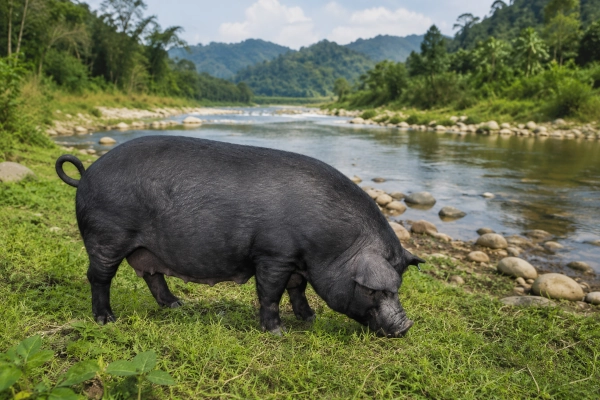
Nagaland has added another important entry to India’s officially recognised livestock heritage with the Nagal pig receiving registration as an indigenous breed under the national animal genetic resources system.
The recognition places the Nagal pig alongside the Tenyi Vo pig and Nagami Mithun, making it the third indigenous animal breed from Nagaland to receive formal national recognition. The latest registration also highlights the role played by local communities in preserving distinct livestock populations through generations of traditional farming and selective breeding.
The Nagal pig is a familiar part of rural life in many parts of the state, where pig rearing remains closely linked with household livelihoods, food traditions and local agriculture. Until now, however, the breed existed largely as a locally maintained population without a separate national identity.
Its registration changes that status by formally documenting the breed’s distinct characteristics and genetic importance.
A Distinct Pig Breed Shaped by Local Farming
The Nagal pig is generally identified by its predominantly black coat, relatively long and deep body, short slightly upturned snout and large drooping ears.
Research carried out by scientists and academic institutions has also highlighted several production traits valued by farmers. These include comparatively rapid growth, good reproductive performance and pork characteristics that are preferred in local markets.
Reported litter sizes commonly range from around seven to 20 piglets, while exceptionally large litters have also been documented. Such reproductive performance, together with adaptability to local farming conditions, has contributed to the breed’s continued popularity among rural households.
Unlike highly specialised commercial pig populations, indigenous breeds such as Nagal have evolved under local climatic conditions, traditional feeding systems and relatively low-input management. Their continued survival therefore represents not only an agricultural resource but also a reservoir of genetic traits that may prove valuable for future livestock improvement.
Nagaland Now Has Three Registered Indigenous Breeds
The addition of the Nagal pig marks another stage in Nagaland’s growing representation in India’s registered indigenous livestock database.
The Tenyi Vo pig, recognised in 2016, became the state’s first officially registered pig breed. It was developed over generations within local farming communities and is valued primarily for pork production. At the time of its recognition, its population was estimated at roughly 60,000 to 70,000 animals.
Nagaland achieved another milestone in February 2025, when Nagami Mithun was formally recognised as a distinct mithun breed. Mithun holds exceptional cultural and economic importance across the state and has long been associated with traditional ceremonies, social status and rural livelihoods.
With the Nagal pig now joining the national register, Nagaland has two recognised indigenous pig breeds in addition to its recognised mithun population.
Why Register Indigenous Breed
The national registration of an animal breed is not simply an administrative exercise.
India’s livestock diversity contains genetic traits accumulated over generations of adaptation to different landscapes, climates, diseases, feeding conditions and farming practices. When a local population is scientifically characterised and registered, it becomes easier to study, conserve and include it in structured breeding and development programmes.
Formal recognition can therefore help support genetic conservation, research, breed improvement, population monitoring and livelihood programmes.
This is especially important for indigenous breeds maintained in smallholder and backyard production systems. Such populations can gradually lose their distinct identity when uncontrolled crossbreeding becomes widespread or when farmers shift entirely toward commercial breeds.
Once genetic diversity disappears, recreating it is extremely difficult.
Registration provides a scientific baseline from which conservation programmes can be developed before such losses become irreversible.
Northeast India Holds Valuable Livestock Diversity
The recognition of the Nagal pig also draws attention to the wider livestock diversity of Northeast India.
The region’s mountainous terrain, varied climate, tribal farming traditions and relative geographical isolation have helped produce animal populations with distinctive characteristics. Many remain closely connected with local food systems and cultural practices.
Unlike industrial livestock farming, much of the region still depends on small-scale household production. Animals are selected over generations according to characteristics important to individual communities, including adaptability, reproductive ability, meat quality and resilience under locally available feeding systems.
Such traditional selection can produce genetic resources that may not always be visible in national production statistics but can be highly valuable from a conservation perspective.
Recognition of Farmers as Much as the Breed
The national recognition of the Nagal pig also represents acknowledgement of the farmers who maintained the population long before it received a scientific name and official registration.
Indigenous livestock breeds rarely emerge from formal laboratories. They are shaped over decades or centuries through repeated choices made by farming communities regarding which animals to breed, retain and exchange.
In Nagaland, these practices have preserved livestock populations adapted to the state’s environment and food culture.
Scientific registration now gives one of those populations a formal identity within India’s animal genetic resource framework.
For Nagaland, the Nagal pig’s recognition therefore represents more than the addition of another breed to a national database. It reinforces the value of community-maintained biodiversity and the importance of conserving indigenous livestock before their unique genetic characteristics are lost.
With the Tenyi Vo pig, Nagami Mithun and now the Nagal pig formally recognised, three livestock populations nurtured by generations of Naga communities have secured a distinct place within India’s documented animal heritage.
You may also like
-
Indian Researcher Surveys Over 3,000 Western Ghats Frogs to Track Deadly Amphibian Fungus
-
Zoological Survey of India Discovers Three New Centipede Species in Western Ghats of Kerala and Karnataka
-
Scientists Document 3,261 Flowering Plant Species in Agasthyamalai Biosphere Reserve, Including 1,018 Indian Endemics
-
Scientists Discover Two Rare Blind Fish Species in Assam’s Underground Waters, Revealing Hidden Biodiversity
-
India Begins National Red List Assessment of 1,211 Bird Species to Strengthen Wildlife Conservation
