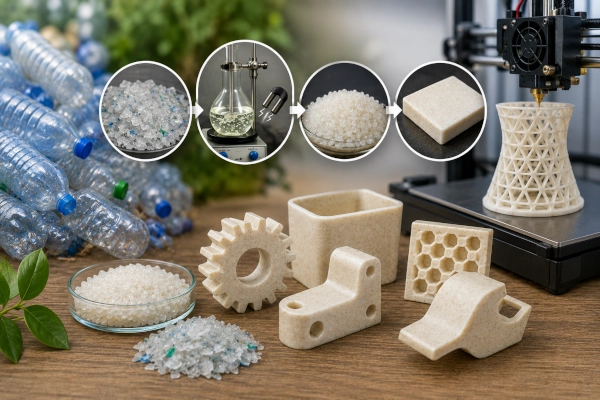
Researchers at the Indian Institute of Technology Bhilai have developed a new process that converts discarded PET plastic bottles into a durable engineering material that can be repaired, reshaped and repeatedly reprocessed. The indigenous technology could open a new route for turning common plastic waste into higher-value materials for advanced manufacturing, including future 3D-printing applications.
The research was led by Dr. Sanjib Banerjee of IIT Bhilai’s Department of Chemistry, along with Priyank Sinha, Bharatbhushan Meshram and Onkarnath Verma. The findings have been published in Materials Today Catalysis, while the researchers have also filed an Indian patent application covering the technology.
PET, or polyethylene terephthalate, is widely used in beverage bottles, food packaging and textiles. Although it can be recycled, repeated conventional recycling generally reduces material quality. This often means that recycled PET eventually moves into lower-value applications rather than remaining part of a continuous high-quality manufacturing cycle.
The IIT Bhilai team approached the problem through chemical recycling. Researchers developed a green, magnetically recoverable catalyst using waste eucalyptus leaves. The catalyst breaks discarded PET into a useful chemical building block and can then be separated using a magnet and reused, helping make the process cleaner and potentially more economical.
Researchers subsequently converted the recovered chemical material into a high-performance dynamic polymer that combines mechanical strength with reprocessability. Unlike conventional thermoset plastics, which permanently retain their structure after curing and are difficult to recycle, the new material can soften when heated, be formed into another shape and retain that shape after cooling.
Tests showed that the material could undergo repeated reshaping into different objects without a significant reduction in performance. It can also be repaired and remoulded rather than discarded when damaged, potentially extending the useful life of products manufactured from it.
This combination of strength and reprocessability gives the material potential for 3D printing and additive manufacturing, where products are often produced in customised shapes and relatively small quantities. IIT Bhilai says possible applications could include customised components, reusable consumer products, educational models and engineering prototypes.
The work builds on IIT Bhilai’s wider research into improved PET recycling. An earlier project from the same Department of Chemistry developed a magnetically recyclable nano zero-valent iron catalyst capable of selectively breaking PET down into bis(2-hydroxyethyl) terephthalate, or BHET, a useful chemical building block. That research focused on recovering high-value material from plastic waste under relatively mild processing conditions.
The latest development takes the concept further by using recovered PET-derived material to create a new polymer designed for repeated use rather than simply recovering the original chemical feedstock.
The technology could also reduce dependence on fresh petroleum-derived raw materials. Instead of treating discarded bottles as low-value waste, the process seeks to return their carbon-containing components to manufacturing as a new engineering material. This creates a more circular system in which plastic remains useful for longer before ultimately becoming waste.
The research is particularly relevant as India expands both its recycling infrastructure and advanced-manufacturing capabilities. IIT Bhilai already operates additive-manufacturing facilities that include polymer 3D printers, laser powder-bed fusion equipment and robotic wire-arc additive manufacturing systems.
The technology will still require further development before large-scale commercial deployment. Researchers will need to establish manufacturing economics, long-term material performance, scalability and compatibility with different 3D-printing processes.
Nevertheless, the breakthrough demonstrates a potentially valuable shift in plastic recycling. Rather than merely converting discarded bottles into lower-grade products, the IIT Bhilai approach aims to upcycle PET into a repairable and repeatedly reprocessable engineering material.
Once successfully scaled, the technology could link plastic-waste management with India’s growing advanced-manufacturing sector, turning one of the country’s most common waste materials into feedstock for a new generation of reusable products.
Reference
- Press Information Bureau (PIB), Government of India
IIT Bhilai Researchers Develop Innovative Material from Waste PET Bottles
https://www.pib.gov.in/PressReleasePage.aspx?PRID=2293973 - Indian Institute of Technology Bhilai
Research on Depolymerisation of Mixed Plastic Using Recyclable Catalyst
https://www.iitbhilai.ac.in/index.php?pid=Depolymerization_mixed_plastic_catalyst - Indian Institute of Technology Bhilai
Department of Mechanical Engineering – Additive Manufacturing and Research Facilities
https://www.iitbhilai.ac.in/index.php?pid=dept_me_facility - Materials Today Catalysis
Research publication by IIT Bhilai team on PET-derived dynamic polymer materials.
Journal: Materials Today Catalysis
Publisher: Elsevier
https://www.sciencedirect.com/journal/materials-today-catalysis
You may also like
-
Indian Scientists Discover How Rapidly Spinning Black Holes Produce High-Frequency X-Ray Oscillations
-
ISRO Completes Historic SPADEX Mission as Both Satellites Re-enter Earth’s Atmosphere After Successful Space Docking Experiments
-
Indian Scientists Discover Rare Accretion Disk Around Neutron Star 24,000 Light-Years Away
-
BARC Scientists Develop Indigenous Technology to Recover 90% of Lithium from Seawater
-
How Indigenous Indian Technologies Are Helping Aircraft and Trains Navigate Safely Through Dense Fog
