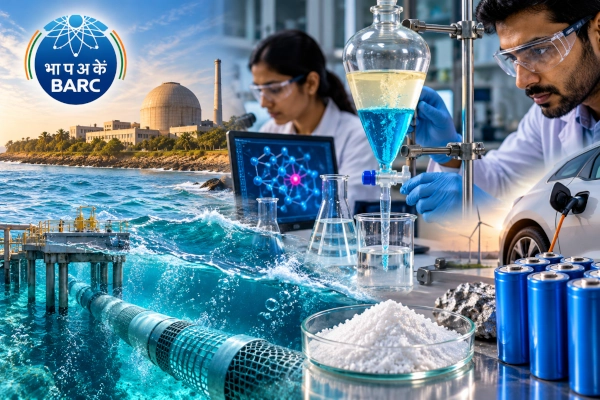
Scientists at India’s Bhabha Atomic Research Centre (BARC) have developed an indigenous chemical extraction technology capable of recovering approximately 90% of dissolved lithium from natural seawater under laboratory conditions. The breakthrough could contribute to India’s long-term efforts to diversify critical mineral supplies for electric vehicles, rechargeable batteries and renewable energy storage systems.
The research was conducted at BARC’s National Centre for Compositional Characterization of Materials (NCCCM) in Hyderabad. Led by researchers Vatsal Trivedi, Sai Krishna Devulapally, R. Shekhar and G. Venkateswarlu, the study introduces a simplified solvent-extraction process that substantially reduces the quantity of organic solvent required to separate lithium from seawater.
The findings were published online on September 4, 2026, in the international scientific journal Talanta. The research attracted wider attention in October because of its potential applications in critical mineral recovery, particularly as India expands domestic battery manufacturing and energy storage capabilities.
Seawater Contains One of the World’s Largest Lithium Resources
Lithium is an essential material used in rechargeable batteries for electric vehicles, mobile phones, laptops and large-scale electricity storage systems. Its importance has increased considerably as countries invest in electric mobility and renewable energy infrastructure.
Conventional lithium production relies primarily on hard-rock mineral deposits and concentrated saltwater brines. These resources are geographically concentrated, making global supply chains sensitive to changes in production, investment and international trade.
Seawater represents an alternative resource because the world’s oceans contain an estimated 230 billion tonnes of dissolved lithium. However, the mineral occurs at an extremely low concentration of approximately 0.17 milligrams per litre, making its recovery technically challenging.
The problem becomes more complicated because seawater contains much larger quantities of sodium, magnesium, calcium and other dissolved minerals. Magnesium is particularly difficult to separate because its chemical behaviour can interfere with conventional lithium extraction processes.
The BARC research addresses these challenges by developing a selective chemical system capable of separating lithium while using considerably smaller volumes of organic solvent than many conventional extraction approaches.
BARC Develops a New Solvent-Extraction Process
The Indian research team developed a chemical extraction system using dibenzoylmethane (DBM) and methyl isobutyl ketone (MIBK). The process separates lithium ions from other dissolved minerals through controlled chemical interactions.
In conventional solvent-extraction methods, researchers often use additional chemical agents to improve the transfer of lithium from an aqueous solution into an organic solvent. These additives can increase chemical consumption, complicate processing and create difficulties when the method is scaled up.
The BARC scientists developed a different approach in which MIBK performs two functions simultaneously. It serves as the organic extraction medium while also stabilising the lithium-containing chemical complex formed during extraction.
This dual functionality eliminates the need for certain additional chemical agents used in comparable extraction systems. By simplifying the chemical formulation, the researchers reduced the required solvent volume and improved the efficiency of lithium separation under their experimental conditions.
The method also incorporates carefully controlled mixing conditions to maintain stability between the aqueous and organic phases. This is important because excessive mixing can create emulsions that complicate the separation and recovery of extracted materials.
Alkaline Treatment Removes Interfering Minerals
Before extracting lithium, the researchers treated seawater through a process known as sequential alkaline preconditioning. This preparation stage removes minerals that would otherwise interfere with the selective recovery of lithium.
The scientists adjusted the chemical conditions using sodium hydroxide and sodium carbonate. Raising the pH caused much of the dissolved magnesium and calcium to separate from the seawater through precipitation.
The process removed more than 99% of these interfering multivalent ions while retaining most of the lithium in the remaining solution. This substantially reduced the chemical competition encountered during the subsequent extraction stage.
The treated seawater was then brought into contact with the DBM–MIBK extraction mixture. Under the selected alkaline conditions, dibenzoylmethane forms an active chemical species capable of binding lithium ions.
MIBK stabilises the resulting lithium-containing complex and facilitates its transfer into the organic phase. The process selectively removes lithium from the treated seawater while limiting interference from other dissolved minerals.
The researchers found that this combination of preconditioning and solvent chemistry was essential to achieving high lithium extraction efficiency.
Indigenous Technology Achieves Approximately 90% Lithium Extraction
Under optimised laboratory conditions, the BARC-developed system extracted approximately 90% of the lithium present in natural seawater.
The researchers achieved this performance at an organic-to-aqueous phase ratio of just 0.1. This means the experimental system used approximately 100 millilitres of organic phase for every litre of treated seawater during the extraction stage.
Comparable conventional solvent-extraction methods often require organic-to-aqueous ratios approaching or exceeding 1.0. The BARC approach therefore demonstrated an approximately tenfold reduction in the organic solvent volume required for this stage of the process.
Reducing solvent consumption is particularly important for seawater processing because enormous volumes of water would need to be treated to recover commercially meaningful quantities of lithium.
The researchers also demonstrated that the extracted lithium could be transferred from the organic phase into a separate solution using dilute nitric acid. This recovery step enables the organic extraction mixture to be reused.
The findings establish a laboratory-scale method for selectively separating lithium from natural seawater using a simplified chemical system.
Solvent Reuse Demonstrates Potential for More Efficient Processing
The BARC team conducted additional experiments to evaluate whether the extraction solvent could be reused without significantly reducing lithium recovery performance.
The researchers tested the system through five extraction and recovery cycles. Under the optimised conditions, lithium extraction remained close to 90%, while the lithium concentration in the recovery solution progressively increased.
This demonstrated that the organic phase could participate in repeated extraction cycles rather than requiring complete replacement after every operation.
Repeated solvent use could become important in future process development because chemical consumption contributes to operating costs, material requirements and waste generation.
However, the experiments also identified practical limitations. The organic phase experienced physical losses during repeated processing, and maintaining stable separation required careful control of mixing and contact times.
Further research will be necessary to determine how the process performs during extended continuous operation and whether solvent losses can be reduced sufficiently for industrial applications.
Natural Seawater from Kerala Used in Scientific Validation
An important aspect of the research was its use of natural seawater rather than relying exclusively on artificially prepared laboratory solutions.
The scientists collected seawater samples from the Arabian Sea near Kasaragod in Kerala. The samples were filtered and prepared for chemical analysis before undergoing the extraction process.
Using natural seawater allowed the researchers to examine the method’s performance in the presence of the complex mixture of dissolved minerals found in actual marine environments.
The research team also evaluated the method using other lithium-containing resources, including coal fly ash and spent lithium-ion battery samples.
These additional experiments indicate that the chemical extraction approach may have applications beyond seawater. Recovering lithium from industrial residues and discarded batteries is particularly relevant to developing circular material supply chains.
The study therefore contributes to two related areas of critical mineral research: identifying alternative lithium resources and recovering valuable materials from secondary sources.
Lithium Recovery Could Support India’s Battery Manufacturing Industry
India’s expanding electric vehicle and renewable energy sectors are increasing demand for lithium-based battery technologies. Lithium is used in several rechargeable battery chemistries because of its favourable electrochemical characteristics and high energy-storage potential.
The country has been pursuing multiple approaches to strengthen access to critical minerals. These include domestic mineral exploration, overseas resource partnerships, battery recycling and the development of alternative material recovery technologies.
The BARC research introduces another potential pathway by investigating whether lithium dissolved in seawater can be recovered efficiently.
If further research establishes technical and economic feasibility at larger scales, seawater extraction could complement conventional mineral production and recycling. It could also contribute to the development of specialised chemical separation technologies within India’s domestic research and manufacturing ecosystem.
However, the present findings do not establish commercial viability. The concentration of lithium in seawater remains extremely low, and processing large quantities of water would require careful evaluation of energy consumption, chemical use, operational costs and environmental effects.
The laboratory achievement nevertheless provides valuable scientific evidence for developing more resource-efficient extraction methods.
Indigenous Research Strengthens India’s Critical Mineral Technologies
The lithium extraction study demonstrates the contribution of India’s public sector research institutions to advanced chemical separation technologies.
BARC operates under the Department of Atomic Energy and undertakes research across nuclear science, materials engineering, chemistry and industrial technologies. Its scientific capabilities include the development of analytical techniques and processes for separating valuable elements from complex materials.
At NCCCM Hyderabad, researchers specialise in the characterisation and analysis of materials, including methods for identifying and measuring elements present at extremely low concentrations.
The newly developed extraction system combines this analytical expertise with chemical process design. By demonstrating selective lithium recovery from a highly dilute resource, the researchers have addressed an important scientific challenge.
The work also reflects the potential of indigenous research to generate technologies relevant to strategic industrial requirements beyond the nuclear sector.
Such advances can support India’s broader efforts to strengthen domestic expertise in critical minerals, advanced materials and energy-related technologies.
Further Research Required Before Commercial Production
Although the laboratory results are promising, industrial lithium recovery from seawater presents several challenges that require further investigation.
The exceptionally low concentration of lithium means that large quantities of seawater must be processed to obtain relatively small amounts of the metal. Even when extraction efficiency is high, the total quantity recovered depends on the volume of water treated.
Researchers must therefore evaluate the energy requirements, chemical consumption, solvent recovery, equipment performance and operating costs of a larger system.
The environmental implications of processing seawater and managing the resulting chemical streams will also require assessment. These considerations are particularly important when developing technologies intended for deployment in coastal environments.
Future research may focus on continuous extraction systems, improved solvent recovery, process integration and methods for increasing the concentration of lithium in the final product.
The current study establishes an effective laboratory separation process. It does not demonstrate that battery-grade lithium compounds can already be manufactured economically from seawater using the technology.
Towards Greater Self-Reliance in Critical Mineral Recovery
The development of a lithium extraction system by BARC represents a significant contribution to India’s research capabilities in critical mineral recovery.
The achievement is particularly notable because the researchers demonstrated approximately 90% lithium extraction from natural seawater while substantially reducing the organic solvent required during processing.
The technology also performed across repeated extraction cycles and showed potential applications involving secondary lithium resources, including industrial residues and spent batteries.
These findings provide a foundation for further research into more efficient mineral separation processes and alternative sources of lithium.
As India expands its electric mobility, renewable energy and battery manufacturing industries, advances in indigenous chemical technologies will play an increasingly important role in strengthening domestic technical capabilities.
The BARC study marks progress towards that objective by demonstrating how Indian scientific research can address complex material recovery challenges and contribute to the development of future critical mineral technologies.
References
- Trivedi, V., Devulapally, S. K., Shekhar, R. and Venkateswarlu, G. (2026). Development of a Novel Selective Extraction System for Lithium and Application to Its Secondary Resources. Talanta, Volume 312, Part C, Article 130545. Published online September 4, 2026.
https://doi.org/10.1016/j.talanta.2026.130545 - National Library of Medicine – PubMed: Scientific publication record for the BARC lithium extraction research, including author affiliations, methodology and experimental findings.
https://pubmed.ncbi.nlm.nih.gov/42710137/ - Research Matters, October 17, 2026: BARC Scientists Develop an Efficient and Green Extraction Method to Harvest Lithium from the Ocean.
https://researchmatters.in/news/barc-scientists-develop-an-efficient-and-green-extraction-method-to-harvest-lithium-from-the-ocean - Bhabha Atomic Research Centre, Department of Atomic Energy: Official institutional information on research capabilities and scientific programmes.
https://www.barc.gov.in/ - Ministry of Mines, Government of India: National Critical Mineral Mission and India’s critical mineral exploration and supply-chain development initiatives.
https://mines.gov.in/
You may also like
-
Russia Ratifies Temporary Employment Agreement with India, Expanding Opportunities for Skilled Workers
-
Indian Scientists Discover Rare Accretion Disk Around Neutron Star 24,000 Light-Years Away
-
Rosatom Completes Supply of Nuclear Safety Control Systems for Kudankulam Units 3 and 4
-
Pine Labs Partners with Sri Lanka’s WEBXPAY to Expand UPI and Indian Digital Payment Acceptance
-
SRF Limited Announces ₹600 Crore Battery-Grade Aluminium Foil Plant in Madhya Pradesh
