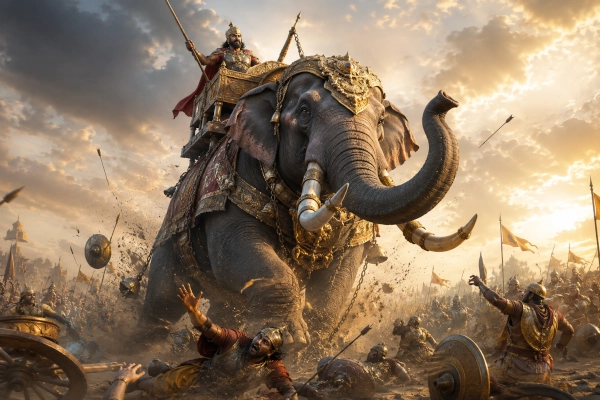
Among the many terrifying sights witnessed on the battlefield of Kurukshetra, few could have matched the arrival of King Bhagadatta of Pragjyotisha mounted upon his enormous war elephant Supratika. Bhagadatta was already an elderly king when he entered the great war, but age had not diminished his courage or skill. He was regarded as one of the finest elephant warriors of his generation, and Supratika was no ordinary mount. The enormous animal had been trained for war and could smash chariots, scatter infantry and terrify cavalry simply by charging into a formation.
Together, Bhagadatta and Supratika moved across Kurukshetra almost like a living fortress. Bhagadatta fought from the elephant’s elevated back while Supratika used its weight, tusks, trunk and momentum against the Pandava ranks below. Their assault became so destructive that experienced warriors struggled to contain them. Eventually, the situation became dangerous enough for Arjuna and Krishna to turn away from another battle and confront the king of Pragjyotisha directly.
What followed became one of the most dramatic episodes of the Drona Parva. It brought together Bhima’s extraordinary encounter beneath Supratika, the destruction of Pandava chariots, Arjuna’s duel with Bhagadatta, the release of the terrible Vaishnavastra and Krishna’s intervention to save Arjuna.
The King of Pragjyotisha
Bhagadatta ruled Pragjyotisha, an important kingdom associated in the Mahabharata with the eastern and northeastern regions of the subcontinent. He had earned fame long before the Kurukshetra War as a warrior who possessed exceptional mastery over elephants. Arjuna himself acknowledged Bhagadatta’s skill and regarded him as one of the most dangerous fighters in the world when mounted upon a war elephant.
Elephant warfare demanded abilities very different from those required of a chariot warrior. A king fighting from an elephant had to control an enormous animal while simultaneously watching enemy movements, handling weapons and maintaining his balance amid violent charges and sudden turns. The elephant itself needed extraordinary discipline because the battlefield was filled with screaming men, clashing weapons, drums, arrows, terrified horses and other elephants.
Bhagadatta had mastered this demanding form of warfare, while Supratika provided him with the strength and mobility needed to exploit it. The bond between warrior and elephant made the pair considerably more dangerous than either would have been alone.
Bhima Breaks the Kaurava Elephant Corps
The great confrontation occurred during the twelfth day of the Kurukshetra War. Duryodhana advanced against Bhima with a large force of elephants, hoping that their sheer weight could overwhelm the powerful Pandava warrior. Bhima, however, attacked the formation with tremendous force and began striking down the animals and their riders until confusion spread through the Kaurava elephant corps.
As the elephant formation began to collapse, Bhagadatta entered the battle upon Supratika. He drove the huge animal directly toward Bhima, determined to reverse the situation. Supratika charged with extraordinary speed for an animal of its size and smashed into Bhima’s chariot. The impact destroyed the vehicle and left Bhima on foot directly beneath the shadow of the advancing elephant.
For most warriors, this would have meant almost certain death. Bhima, however, possessed both tremendous physical strength and specialised knowledge of elephant combat. Instead of attempting to flee across open ground, he moved beneath Supratika itself.
Bhima Beneath the Great Elephant
The Mahabharata describes Bhima using a specialised technique known as Anjalikabedha, which allowed a warrior familiar with elephants to move beneath the animal while avoiding its crushing feet. Bhima entered the dangerous space beneath Supratika and began striking the elephant with his powerful arms while constantly shifting his position.
Supratika reacted violently. The elephant turned again and again, trying to reach the warrior beneath its body. At one stage, Bhima emerged from underneath and Supratika seized him with its trunk. The elephant attempted to pull him toward its knees, where the enormous weight of its body could have crushed him.
Bhima twisted himself free and once again moved beneath Supratika before eventually escaping. From a distance, however, the Pandava soldiers could not clearly see what had happened amid the dust, elephant and surrounding warriors. A rumour quickly spread through their ranks that Bhima had been killed.
The possibility that one of the Pandavas’ greatest warriors had fallen immediately caused alarm throughout the army.
Yudhishthira Surrounds Bhagadatta
When Yudhishthira heard that Bhima might have been slain, he advanced with warriors from the Panchala forces and attempted to surround Bhagadatta. Chariots closed around Supratika and arrows began falling upon both the king and the elephant from several directions.
Bhagadatta did not panic. Even while surrounded, he continued directing Supratika through the attacking formation with remarkable control. From the elephant’s back, he returned the Pandavas’ arrows while the great animal forced enemy chariots to move aside or risk being crushed beneath its feet.
Another elephant warrior soon challenged Bhagadatta directly. The king of the Dasarnas charged Supratika on his own massive elephant, creating one of the most dramatic clashes of elephant warfare described in the battle. The two animals collided with tremendous force, appearing almost like mountains crashing against one another.
Supratika proved superior. Bhagadatta’s elephant overcame its opponent, while Bhagadatta killed the rival king and continued his advance.
Supratika Attacks Satyaki
The great Yadava warrior Satyaki soon found himself directly in Supratika’s path. Bhagadatta drove the elephant toward his chariot, and the enormous animal reached the vehicle before Satyaki could stop it. Supratika seized and hurled the chariot with tremendous force, forcing Satyaki to abandon it in order to survive.
Bhagadatta then broke through the ring of warriors attempting to surround him. Supratika moved so rapidly from one part of the formation to another that terrified soldiers began imagining that several elephants were attacking them rather than one. Dust covered the battlefield while horses bolted from the approaching animal and infantrymen scattered in every direction.
The Pandavas continued sending warriors against Bhagadatta, but his assault remained difficult to stop. Ruchiparvan fell while confronting him, while Abhimanyu, the sons of Draupadi, Dhrishtaketu, Yuyutsu and other fighters tried to check Supratika with showers of arrows.
At one point, the elephant trampled Yuyutsu’s horses and killed his charioteer, forcing him to abandon his vehicle. Bhima also attempted to return to the battle, but Supratika sprayed water from its trunk toward his horses. The frightened animals fled, temporarily carrying Bhima away from the fighting.
The Pandava formation was beginning to break under the pressure.
Arjuna Hears the Battle From Afar
Arjuna was fighting on another part of Kurukshetra when the crisis developed. The Samsaptakas, warriors who had sworn either to kill him or die fighting him, had deliberately drawn him away from Yudhishthira and the main Pandava army.
As Krishna drove Arjuna’s chariot across the battlefield, the two heard the distant roar of men, elephants and frightened horses. A great cloud of dust rose over the fighting. Arjuna immediately understood that something serious was happening among the Pandava ranks.
He told Krishna that Bhagadatta must have entered battle upon his elephant. Arjuna knew the king’s reputation and understood how dangerous Supratika could become if allowed to continue moving freely through the army. He believed that very few warriors could successfully confront Bhagadatta while he fought from such a powerful elephant.
Arjuna still had to deal with the Samsaptakas before he could return. Once he had broken their immediate attack, however, he turned to Krishna and directed him toward Bhagadatta.
Arjuna and Krishna Face Supratika
When Arjuna finally reached the battlefield where Bhagadatta was fighting, Supratika turned toward Krishna’s chariot. The confrontation brought together two completely different forms of warfare. Bhagadatta relied on the mass and power of a huge elephant, while Arjuna and Krishna depended on the speed and manoeuvrability of a chariot.
Bhagadatta began releasing arrows from Supratika’s back while the elephant charged toward Arjuna. Krishna manoeuvred the horses with extraordinary skill, repeatedly moving the chariot away from Supratika’s attacks and bringing Arjuna into positions from which he could shoot.
At one point, Krishna’s manoeuvre placed Arjuna behind Bhagadatta, giving him an opportunity to attack the king from the rear. Arjuna refused to take advantage of the position because he considered such an attack contrary to the rules of fair combat.
Supratika turned again, and the battle resumed from the front.
Arjuna Strips Away Supratika’s Protection
Bhagadatta attacked Krishna and Arjuna with arrows, darts and other weapons while continuing to direct Supratika toward their chariot. Arjuna answered with Gandiva and began cutting down the weapons coming toward him.
He then turned his attention toward the elephant’s protection. Supratika had entered battle wearing armour, but Arjuna’s arrows gradually cut through it until pieces fell away. He struck Bhagadatta repeatedly, destroyed his standard and damaged the protective equipment surrounding him.
Bhagadatta refused to retreat. Despite his wounds, the old king continued throwing weapons toward Arjuna and Krishna. One of his attacks struck Arjuna’s famous diadem with enough force to disturb it. Arjuna calmly adjusted the crown and continued fighting.
Bhagadatta now realised that ordinary weapons were unlikely to defeat his opponent. He therefore turned to the most dangerous weapon in his possession.
Bhagadatta Releases the Vaishnavastra
Bhagadatta took the elephant hook used to control Supratika and empowered it through sacred mantras, transforming it into the terrible Vaishnavastra. He then hurled the divine weapon directly toward Arjuna.
The weapon carried extraordinary destructive power. According to Krishna’s explanation in the Mahabharata, it had a divine origin connected with Vishnu and had once been given for the protection of Naraka before eventually coming into Bhagadatta’s possession.
Arjuna watched the weapon approach, but before he could counter it, Krishna intervened.
Although Krishna had entered the war as Arjuna’s charioteer and had promised not to take up weapons, he placed himself between Arjuna and the approaching missile. The Vaishnavastra struck Krishna directly upon the chest.
Instead of destroying him, its terrible energy disappeared and the weapon transformed into a garland upon Krishna.
Krishna Explains His Intervention
Arjuna was surprised and disturbed by Krishna’s action. He reminded Krishna that he had promised only to guide the chariot and argued that he was still capable of defending himself.
Krishna then explained that the weapon was unlike an ordinary missile. Its divine power made it extraordinarily difficult for any mortal warrior to withstand. Krishna had therefore accepted the weapon upon himself because its power ultimately belonged to him in his divine nature.
With the Vaishnavastra neutralised, Bhagadatta had lost his greatest weapon.
The balance of the battle immediately changed.
The Fall of Supratika
Krishna told Arjuna that the time had come to end the threat. Arjuna raised Gandiva and turned his attention toward Supratika, the enormous elephant that had spent much of the day breaking through the Pandava formations.
Arjuna released a powerful arrow that struck the elephant in a vulnerable region of its head and penetrated deeply. Bhagadatta attempted to urge Supratika forward once more, but the great animal could no longer continue.
The elephant’s strength began to leave it. Its legs weakened beneath its immense body, and the creature that had crushed chariots and scattered entire formations finally collapsed upon the battlefield.
Supratika was dead.
For Bhagadatta, the loss was devastating. The elephant had been more than a mount. It had been the foundation of his entire method of warfare and the companion through which his mastery of elephant combat had become so formidable.
The Death of Bhagadatta
With Supratika fallen, Bhagadatta was exposed. The elderly king had already fought Bhima, broken Pandava formations, defeated other elephant warriors and confronted Arjuna himself. He had continued fighting even after being struck repeatedly and had finally released his most powerful divine weapon.
Arjuna now brought the duel to an end. He released a crescent-shaped arrow that struck Bhagadatta. The old king’s bow slipped from his hands, his headcloth loosened and he fell from the body of the great elephant upon which he had entered the battle.
The king of Pragjyotisha had fallen beside Supratika.
Their deaths ended one of the most destructive attacks launched against the Pandava army during the twelfth day of the war.
Supratika Was a Warrior in His Own Right
One of the most striking features of this episode is the way the Mahabharata presents Supratika. The elephant is not described merely as a platform carrying Bhagadatta into battle. It actively shapes the course of the fighting.
Supratika smashes chariots, attacks other elephants, terrifies horses, attempts to crush Bhima and repeatedly breaks through the Pandava formations. Its speed and aggression become so overwhelming that soldiers momentarily believe several elephants are attacking them.
Bhagadatta’s greatness as an elephant warrior depended upon his ability to control and direct such an animal. Supratika’s destructive power, in turn, became far more dangerous because it was guided by a warrior of Bhagadatta’s experience.
The two therefore function almost as a single fighting unit throughout the episode.
The Power of the Ancient War Elephant
The story of Bhagadatta and Supratika also provides one of the Mahabharata’s clearest pictures of how dangerous war elephants could be in ancient battle.
An elephant possessed enormous physical power. It could break infantry formations, overturn chariots and frighten horses that had not been trained to withstand its presence. A warrior seated high upon its back gained an elevated view of the battlefield and could attack opponents below with arrows, spears and other weapons.
Yet elephant warfare also required tremendous control. A wounded or frightened elephant could become dangerous to its own army, while experienced enemies could target its rider or vulnerable areas of the animal itself.
This is what makes the confrontation between Supratika and Krishna’s chariot so fascinating. Bhagadatta represents mass, height and crushing force, while Krishna and Arjuna rely upon speed, manoeuvre and precise archery.
Bhagadatta’s Final Great Battle
The Mahabharata does not treat Bhagadatta as an insignificant opponent. Arjuna respected him before they fought and openly acknowledged his mastery of elephant warfare. That respect gives Bhagadatta’s final stand much of its power.
Despite his advanced age, Bhagadatta spends a considerable part of the day overwhelming younger warriors. He survives repeated attacks, continues fighting while wounded and drives Supratika through formations that contain some of the greatest fighters in the Pandava army.
Only the combined presence of Arjuna and Krishna finally stops him.
Bhagadatta therefore falls not as a weak old king, but as one of the most formidable warriors fighting for the Kaurava side.
The Image Kurukshetra Never Forgot
Kurukshetra contained thousands of warriors, horses, chariots and elephants, yet the sight of Bhagadatta upon Supratika remained one of the day’s unforgettable images. An elderly king sat high above the battlefield while an enormous elephant carried him through men and chariots like a moving fortress.
Bhima disappeared beneath its body. Satyaki lost his chariot. Pandava soldiers scattered from its path. Dust rose so high that Arjuna understood the seriousness of the battle from a distant part of the field.
Then Krishna’s chariot arrived.
The confrontation that followed brought together Bhagadatta’s mastery of elephant warfare, Supratika’s enormous strength, Arjuna’s precision with Gandiva and Krishna’s divine intervention against the Vaishnavastra.
When Supratika finally collapsed and Bhagadatta fell beside him, one of Kurukshetra’s most powerful warrior-and-elephant partnerships came to an end.
Their story remains one of the Mahabharata’s most vivid reminders that the great war was not fought only by famous chariot warriors. On the twelfth day of Kurukshetra, an old king and his extraordinary elephant came close to breaking an entire section of the Pandava army, leaving behind one of the epic’s greatest stories of courage, destruction and battlefield skill.
Mahabharata Source
The principal account of Bhagadatta and Supratika’s assault, Bhima’s encounter with the elephant, the destruction among the Pandava forces, Arjuna’s arrival, the Vaishnavastra and the deaths of Bhagadatta and Supratika appears in the Drona Parva, particularly Sections XXIV–XXVII in the Kisari Mohan Ganguli English translation.
You may also like
-
Canada Raises Proof-of-Funds Requirement for International Students to C$23,448
-
Government Extends National Means-cum-Merit Scholarship Applications to September 30
-
NCERT Expands Multilingual Education With Textbooks in 22 Scheduled Languages and 93 Tribal-Language Primers
-
Girls from 108 Countries Build ShakthiSAT in India as Global All-Girls Space Mission Enters Hands-On Phase
-
Ekalavya and the Barking Dog: The Archer the Forest Had Trained
