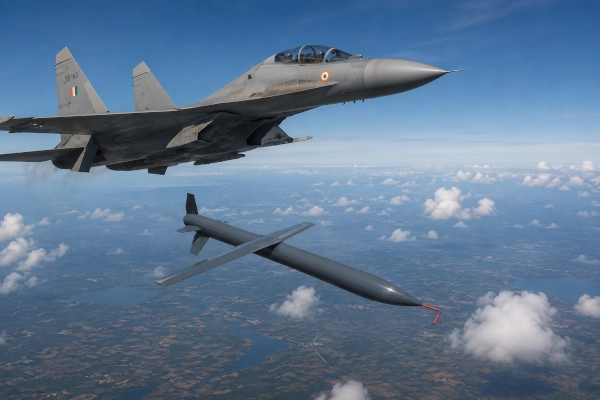
India has achieved an important milestone in indigenous precision-strike weapons with the Indian Air Force successfully conducting a drop trial of the Khagantak-243 Long Range Glide Bomb, an Indian-developed stand-off weapon associated with defence PSU Bharat Electronics Limited and Nagpur-based private defence company JSR Dynamics.
The Indian Air Force officially announced the achievement on September 2, 2026, describing the trial as a significant milestone for both the service and Indian industry. According to the IAF, the indigenously designed and developed Khagantak-243 successfully completed its drop trial and met all the objectives established for the test. The Air Force linked the achievement to the expanding contribution of Atmanirbhar Bharat, Make in India and domestic defence innovation to India’s combat capability.
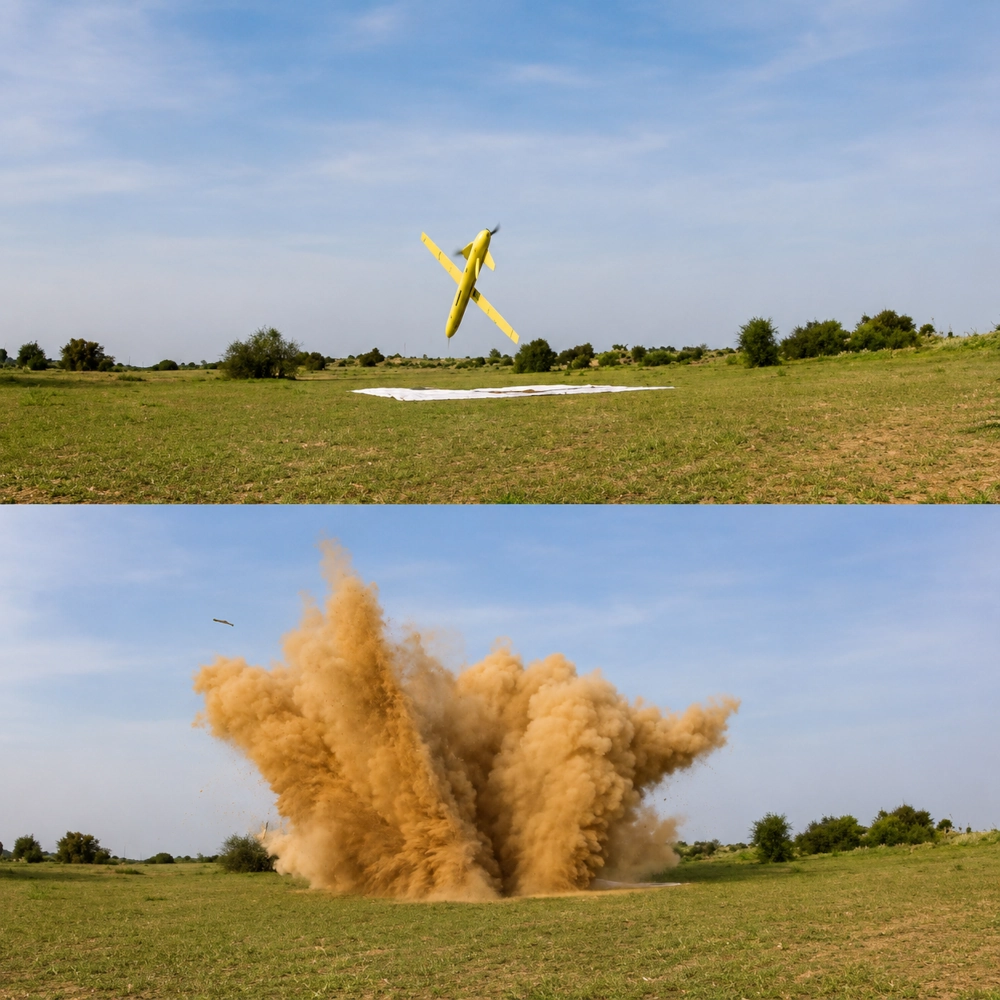
The successful test is particularly significant because Khagantak-243 belongs to a category of weapons intended to allow combat aircraft to accurately attack targets from substantial stand-off distances. Rather than falling almost directly beneath the launching aircraft like a conventional unguided bomb, the weapon deploys aerodynamic surfaces after release and glides towards its target using an onboard navigation and flight-control system.
This allows the launching fighter to release the weapon well before reaching the target itself. Stand-off capability is increasingly important in modern air operations because targets of strategic importance are frequently protected by surface-to-air missiles, radar networks, electronic warfare systems and other air-defence assets.
Khagantak-243 is the 300-kg-class member of JSR Dynamics’ Long Range Glide Bomb family. The company’s official specifications list the K-243 with a length of up to four metres, a diameter of approximately 290 mm and a wingspan of up to three metres. The broader LRGB architecture is designed around the widely used Mk 80 family of conventional warheads, allowing different bomb bodies and payload classes to be incorporated into the same basic stand-off weapon concept.
JSR Dynamics states that its LRGB uses a multi-constellation Global Navigation Satellite System coupled with an Inertial Navigation System for mid-course guidance. An electro-optical/infrared terminal seeker can also be incorporated as an optional precision-guidance system. According to the company’s published specifications, accuracy is intended to remain below 10 metres CEP without a terminal seeker and can improve to below five metres when terminal guidance is incorporated.
The company also says a jamming-resistant satellite-navigation capability can be incorporated, an increasingly important feature as electronic warfare becomes a central component of modern air defence. The ability to combine inertial navigation with multiple satellite constellations reduces dependence on any single navigation source, while an electro-optical or infrared terminal seeker could provide an additional means of acquiring the target during the final portion of flight.
The precise maximum range demonstrated during the latest IAF trial has not been disclosed by the Air Force. JSR Dynamics’ public information describes the LRGB architecture as capable of 120-plus kilometres when released from approximately 12 km altitude at Mach 0.85, with range capable of being optimised according to customer requirements. Earlier reporting by Janes, based on information provided by BEL during Aero India 2025, placed the Khagantak-243’s specific maximum range at more than 140 km when released from around 12,000 metres. The 140-km figure should therefore be treated as previously reported performance rather than a figure officially announced as part of the September 2 trial.
The weapon is the product of a long-running partnership between India’s public and private defence sectors. Bharat Electronics officially announced in February 2019 that it had signed a memorandum of understanding with JSR Dynamics at Aero India 2019 to combine the design and manufacturing capabilities of the two companies for the development of glide weapons and lightweight cruise missiles. BEL described JSR Dynamics as an Indian defence startup specialising in ground- and air-launched weapon systems.
The partnership subsequently progressed from conceptual weapons displayed at defence exhibitions towards an actual Indian Air Force programme. At Aero India 2025, BEL officials told Janes that the company had secured an IAF order for an unspecified number of Khagantak-243 munitions, encompassing prototype and production requirements. According to the same disclosure, JSR Dynamics provides the weapon body and control systems while BEL supplies its electronics and guidance subsystems.
That division of work makes the programme an interesting example of India’s evolving defence-industrial model. Instead of a weapon being developed entirely by a traditional government research establishment and subsequently transferred to a production agency, Khagantak combines the specialised guided-weapons expertise of a relatively young private company with the electronics and manufacturing capabilities of one of India’s largest defence PSUs.
The Su-30MKI has been closely associated with the Khagantak programme. BEL had previously identified the Su-30MKI as the initial aircraft intended for K-243 flight testing. An official DRDO airworthiness document also lists Khagantak-243 among weapons associated with software modification of the Su-30MKI, alongside systems including Astra, BrahMos, Rudram and the indigenous Gaurav Long Range Glide Bomb.
The IAF’s September 2 announcement, however, did not publicly specify all parameters of the successful drop, including the release altitude, exact distance covered, impact accuracy or complete weapon configuration. Those details should therefore not be assumed from previously published design specifications.
The successful trial nevertheless represents a substantial step for the programme because an air-launched glide weapon must demonstrate much more than aerodynamic range. Safe separation from the aircraft, deployment of its wings, navigation-system operation, flight-control response, trajectory management and accurate arrival in the designated target area all form critical parts of the development process.
Khagantak also differs fundamentally from a powered cruise missile. Once released, a conventional glide bomb does not rely on a continuously operating propulsion system. Instead, it converts the altitude and forward speed supplied by the launching aircraft into range, using aerodynamic lift and flight controls to travel towards its target. This can make glide weapons less complex and potentially less expensive than powered stand-off missiles while still allowing fighters to attack from significant distances.
Their range, however, is strongly influenced by launch conditions. A weapon released from a fighter flying high and fast can travel considerably farther than the same weapon released at lower altitude or speed. This makes the stated release conditions particularly important when evaluating maximum-range figures.
For the Indian Air Force, domestically produced glide weapons could become useful complements to more expensive cruise missiles and powered precision weapons. High-value missiles can be reserved for targets requiring exceptional range, speed or penetration capability, while comparatively simpler guided glide weapons can be employed against a much wider range of fixed and semi-fixed targets.
An indigenous weapon also provides advantages beyond acquisition cost. Local design and production can allow India to manufacture larger stocks, modify guidance packages, introduce new seekers and integrate additional warheads without remaining dependent on a foreign supplier for every change. That becomes particularly important during sustained operations, when the rate at which precision munitions can be replenished can be as important as their individual performance.
Khagantak-243 is also only one member of a broader family being developed by JSR Dynamics. The company’s LRGB architecture includes weapons in several weight classes, allowing the same general design philosophy to be adapted to different warheads and aircraft requirements. JSR is separately developing powered precision weapons, including a jet-powered evolution of its glide-bomb concept intended to achieve substantially greater ranges.
The September 2 trial therefore represents more than the testing of a single bomb. It marks tangible progress in an Indian industrial ecosystem capable of developing the aerodynamics, actuators, navigation systems, guidance electronics, flight-control software and integration expertise required for increasingly sophisticated air-launched weapons.
It also expands a rapidly growing indigenous IAF precision-strike portfolio. India is simultaneously developing several classes of stand-off weapons, ranging from glide bombs to anti-radiation missiles, air-launched cruise missiles and longer-range powered precision munitions. Khagantak occupies a potentially important position in that spectrum as a comparatively compact weapon capable of delivering a substantial conventional payload from well outside the immediate target area.
Further trials and qualification milestones may still be required before large-scale operational deployment, and the IAF has not announced the number of Khagantak-243 weapons ultimately intended for service. The successful drop should therefore not automatically be interpreted as confirmation that the weapon has completed every stage of operational induction.
What is now beyond doubt, however, is the progress of the programme. The Indian Air Force itself has confirmed that the indigenous Khagantak-243 was successfully dropped and that the trial achieved all its stated objectives.
From a BEL-JSR Dynamics partnership established at Aero India in 2019 to an IAF-backed prototype and production programme and now a successful flight trial, Khagantak-243 has progressed from an Indian defence-industry concept towards a credible indigenous stand-off precision-strike capability.
You may also like
-
India and Russia Hold Seventh Strategic Security Dialogue on Pakistan and Afghanistan
-
Rolls-Royce and Reliance Advance Indigenous 120 kN AMCA Engine Plans with Focus on Indian Design and Manufacturing
-
Indian Coast Guard and Korea Coast Guard Strengthen Maritime Cooperation at 14th High-Level Meeting in Incheon
-
Ministry of Defence Signs ₹4,106 Crore Contracts for GSAT-7C Satellite and Varunastra Torpedoes
-
AVNL, Indian Army and Russian Delegation Explore Modernisation of Armoured Vehicles
