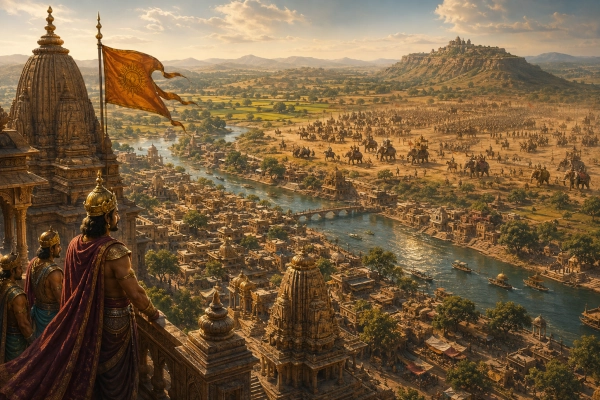
Avanti was one of the important kingdoms of central Bharat described in the Mahabharata. Its territory is broadly associated with the Malwa region of present-day Madhya Pradesh, while its best-known historical capital was Ujjayini, modern Ujjain. Situated on the Kshipra River, the region occupied a strategic position between northern India, western India, the Narmada valley and the routes leading into the Deccan.
The Mahabharata remembers Avanti principally through its two warrior rulers, Vinda and Anuvinda. They first appear when Sahadeva marches south during the campaigns undertaken before Yudhishthira’s Rajasuya sacrifice. Although Sahadeva defeated them and obtained tribute, the brothers retained their kingdom. Years later, when the dispute between the Pandavas and Kauravas developed into war, Vinda and Anuvinda chose Duryodhana and became prominent commanders in the Kaurava army.
Their story connects the Malwa plateau directly with the great political struggle centred on Hastinapura. Avanti was therefore not merely a distant kingdom mentioned in geographical lists. Its rulers participated in the imperial politics preceding the Rajasuya and later fought some of the most powerful warriors of the Pandava coalition on the battlefield of Kurukshetra.
The Land of Avanti
Ancient Avanti occupied a strategically important portion of central India. Its northern heartland broadly corresponds with the Malwa plateau, especially the country around Ujjain and adjoining parts of western Madhya Pradesh. The region was fertile, elevated and well connected with neighbouring political zones.
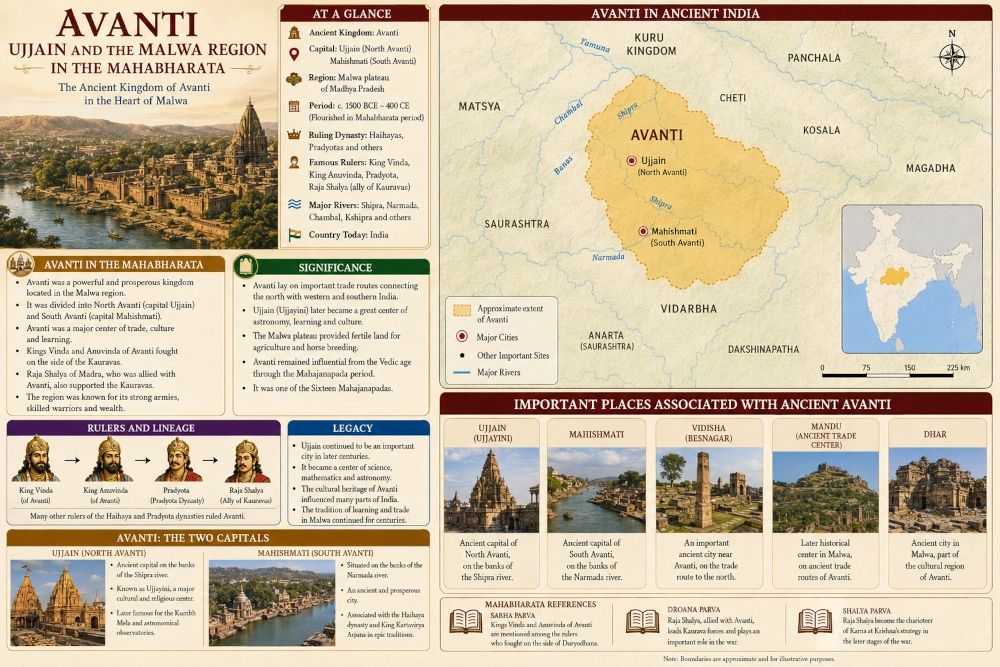
To the north lay the approaches toward Rajasthan and the Yamuna basin. To the west were routes leading toward Gujarat and the Arabian Sea. To the south, the plateau descended toward the Narmada valley and the gateways into the Deccan. To the east lay routes toward Vidisha and the central Indian plains.
This geographical position gave Avanti considerable political and commercial importance. The official historical account maintained by the Ujjain district administration describes Ujjain as lying on an ancient route that linked Mathura with Ujjain, Mahishmati on the Narmada and regions farther south. Such routes allowed goods, armies, pilgrims and political influence to move through the Malwa plateau.
For a modern geographical reconstruction, the strongest Avanti core may be placed approximately around Ujjain, Dewas, Indore, Dhar, Ratlam and adjoining parts of Malwa. The wider historical sphere of Avanti also extended toward the Narmada valley. However, ancient kingdoms did not possess surveyed borders comparable to modern states, so any map of Avanti should clearly mark its boundaries as approximate.
Avanti at a Glance
| Feature | Description |
|---|---|
| Ancient Kingdom | Avanti |
| Epic Rulers | Vinda and Anuvinda |
| Historical Capital | Ujjayini, modern Ujjain |
| Modern Core Region | Malwa, western Madhya Pradesh |
| Important River | Kshipra |
| Wider Southern Connection | Narmada corridor |
| Rajasuya Campaign | Defeated by Sahadeva |
| Kurukshetra Alignment | Kauravas |
| Major Opponents | Iravat, Kuntibhoja, Virata, Bhima and Arjuna |
| Fate of Rulers | Vinda and Anuvinda were killed during the Kurukshetra War |
| Later Historical Status | One of the sixteen Mahajanapadas |
| Modern State | Madhya Pradesh |
| Country Today | India |
Ujjayini: The Historical Capital of Avanti
Modern Ujjain preserves the clearest surviving geographical identity of ancient Avanti. Known in antiquity as Ujjayini and also associated with the name Avantika, the city stands on the banks of the Kshipra River in the heart of the Malwa plateau.
The Ujjain district administration identifies the city as the ancient capital of the Avanti Janapada. Its location helped it develop into an important political, commercial and religious centre. Roads from northern India passed through the region toward the Narmada valley, while western routes connected Malwa with Gujarat and the maritime world.
The Mahabharata generally refers to the kingdom of Avanti and its rulers rather than repeatedly naming Ujjayini itself. This distinction is important. Ujjain can confidently be identified as the historical capital of the later Avanti state, while the epic primarily preserves the political identity of Avanti through Vinda and Anuvinda.
Vinda and Anuvinda: The Warrior Rulers of Avanti
The two rulers most strongly associated with Avanti in the Mahabharata are Vinda and Anuvinda. They almost always appear together and are repeatedly described as powerful warriors commanding the forces of their kingdom.
Their importance becomes clear from the opponents they faced. During the Kurukshetra War, the brothers fought or confronted warriors connected with Iravat, Kuntibhoja, Virata, Bhima, Dhrishtadyumna and Arjuna. They were therefore not minor provincial chiefs placed on the edge of Duryodhana’s army. The epic consistently treats them as important royal warriors.
The brothers also appear to have fought in close coordination. Several battlefield passages describe them acting together, supporting one another after the destruction of chariots or horses and continuing to resist even when facing some of the strongest fighters in the Pandava army.
Sahadeva’s Southern Campaign and the Conquest of Avanti
Avanti first enters the political story surrounding Yudhishthira’s imperial ambitions before the Rajasuya sacrifice. The four Pandava brothers undertook campaigns in different directions to obtain tribute and recognition from neighbouring rulers. Sahadeva was assigned the southern expedition.
During this campaign, the Sabha Parva records that Sahadeva encountered the two heroic rulers of Avanti, Vinda and Anuvinda. The brothers were supported by a substantial army and resisted his advance. Sahadeva defeated them in battle, obtained tribute and then continued his expedition toward other southern kingdoms.
This passage is one of the clearest references to Avanti in the Mahabharata. It establishes Avanti as a recognised territorial kingdom, identifies Vinda and Anuvinda as its rulers and confirms that the kingdom possessed sufficient military strength to oppose a major Pandava campaign.
Sahadeva’s victory did not destroy the Avanti royal house. The objective of the Rajasuya campaigns was primarily to secure acknowledgement of Yudhishthira’s imperial status. Defeated kings could retain their thrones after paying tribute. Vinda and Anuvinda therefore continued ruling Avanti after their defeat.
From Rajasuya Submission to Kaurava Alliance
The later decision of Vinda and Anuvinda to support Duryodhana shows how fluid political alliances could be in the Mahabharata. Their earlier submission to Sahadeva did not create permanent loyalty to the Pandavas. When the succession dispute eventually became a war, the Avanti rulers chose the Kaurava side.
This change should not be treated as a contradiction. The Rajasuya campaign established Yudhishthira’s ceremonial supremacy at a particular moment, but it did not erase the independence or interests of the conquered kings. As circumstances changed, rulers could form new alliances according to family ties, political calculations and personal relationships.
Avanti therefore provides an excellent example of the complex political world described in the epic. A kingdom that had once paid tribute to Yudhishthira later became one of Duryodhana’s significant military allies.
Avanti Joins Duryodhana
By the beginning of the Kurukshetra War, Vinda and Anuvinda were firmly positioned within the Kaurava coalition. The Bhishma Parva names the princes of Avanti among the important kings fighting for Duryodhana, alongside rulers from several other regions of Bharat.
Their presence demonstrates the enormous geographical reach of the conflict. Duryodhana’s army drew contingents from the northwest, the Gangetic plain, central India and regions farther south. Avanti represented one of the important central Indian powers participating in this coalition.
The Mahabharata repeatedly assigns Vinda and Anuvinda significant positions within Kaurava battle formations. They were trusted with guarding vulnerable sectors and supporting major commanders. Such assignments suggest that the Avanti rulers possessed both capable troops and a strong reputation as battlefield leaders.
The Avanti Princes in Kaurava Battle Formations
The war narrative repeatedly places Vinda and Anuvinda in carefully organised Kaurava formations. In one arrangement they are described as helping protect a flank of the army. In another, the Avanti contingent appears alongside warriors from regions such as Kamboja, Saka and Surasena.
Protecting the side of a large battle formation was an important responsibility. A successful attack against a flank could cause disorder across an entire army. Commanders placed there therefore needed disciplined troops capable of resisting cavalry, chariots, infantry and elephants.
The repeated deployment of the Avanti rulers in such positions indicates that Duryodhana and his commanders regarded them as reliable warriors. Avanti was contributing more than numerical strength to the Kaurava coalition; its kings were actively involved in the tactical structure of the army.
Vinda and Anuvinda Against Kuntibhoja
One of the battles involving the Avanti rulers brought them against Kuntibhoja, an important royal supporter of the Pandavas. The Bhishma Parva records Vinda and Anuvinda advancing against him at the head of their troops.
Kuntibhoja was connected with the larger family and alliance network surrounding the Pandavas. The decision to deploy the Avanti rulers against him shows that they were being used against important royal opponents rather than merely participating in minor clashes.
As the war continued, their opponents became increasingly formidable. The brothers would eventually fight warriors belonging to some of the most powerful military houses in the Pandava coalition.
The Battle with Iravat
A particularly memorable encounter involved Iravat, the son of Arjuna and the Naga princess Ulupi. The Bhishma Parva describes Vinda and Anuvinda advancing against Iravat and engaging him in intense combat.
The brothers fought together and showered their opponent with arrows. During the clash, Iravat damaged their chariot and horses, but the two rulers continued supporting one another. When one brother’s chariot became unusable, he joined the other rather than withdrawing from battle.
The episode demonstrates the close battlefield partnership between the Avanti princes. Their ability to continue fighting despite setbacks helped establish them as persistent opponents throughout the early stages of the war.
Avanti Against Dhrishtadyumna
The Avanti brothers were also sent against Dhrishtadyumna, commander of the Pandava army. Dhrishtadyumna was one of the most important military leaders on Yudhishthira’s side and carried the destiny of eventually killing Drona.
The Mahabharata records Vinda and Anuvinda moving against him during the fighting. Their presence in such an engagement again shows the confidence that the Kaurava leadership placed in them.
Dhrishtadyumna commanded enormous forces and stood at the centre of Pandava military planning. Warriors assigned to confront him faced one of the most dangerous responsibilities on the battlefield.
The Avanti Forces Under Bhishma
The Mahabharata sometimes refers not only to Vinda and Anuvinda but also collectively to the Avantis. This indicates that the kingdom had sent an organised regional contingent to Kurukshetra rather than merely its two rulers and their personal retainers.
The Avanti warriors fought as part of Bhishma’s enormous Kaurava army during the opening phase of the war. Their presence alongside contingents from many different kingdoms illustrates the scale of the conflict.
Kurukshetra was not simply a struggle between two groups of Kuru princes. It became a war involving political powers from across ancient Bharat, and the Malwa region was represented directly through the armies of Avanti.
The Avanti Rulers Confront Bhima
Vinda and Anuvinda also fought Bhimasena, one of the most feared warriors in the Pandava army. During a major engagement, the brothers attacked Bhima with arrows while other Kaurava commanders joined the assault.
Bhima was dangerous at every range of combat. His strength made him devastating with the mace, while he was also an accomplished chariot warrior and archer. Facing him required considerable courage and coordination.
The Mahabharata continues to mention the Avanti brothers even when the fighting became increasingly destructive. Their refusal to abandon the battlefield, despite the devastation caused by Bhima and Arjuna, reinforces the image of determined allies committed to Duryodhana’s cause.
Vinda and Anuvinda Fight King Virata
During the period when Drona commanded the Kaurava army, Vinda and Anuvinda encountered Virata, king of Matsya. The Drona Parva describes the Avanti rulers and their troops confronting Virata’s forces.
Virata was one of the most important political allies of the Pandavas. His kingdom had sheltered them during their thirteenth year of exile, and his daughter Uttara later married Abhimanyu. Matsya consequently became closely tied to the Pandava cause.
The confrontation between the rulers of Avanti and Virata therefore brought together two important regional kingdoms standing on opposite sides of the Kuru conflict. One represented the Malwa plateau of central India, while the other represented the Matsya country farther northwest.
The Avanti Princes Stand Against Arjuna
The most dramatic stage of the Avanti story came when Vinda and Anuvinda faced Arjuna. During the Drona Parva, Arjuna was attempting to penetrate the Kaurava formations while Krishna drove his chariot.
The Avanti brothers moved with their troops to stop him. Arjuna at this stage of the war represented one of the greatest threats to the Kaurava army. He possessed celestial weapons, exceptional archery and the advantage of Krishna as his charioteer.
Despite the danger, Vinda and Anuvinda accepted the challenge. Their decision to confront Arjuna shows how deeply they had committed themselves to Duryodhana’s cause.
The Death of Vinda and Anuvinda
The final battle of the Avanti rulers unfolded during Arjuna’s advance through the Kaurava army. The brothers attacked him when his horses had become exhausted from prolonged fighting and attempted to prevent his progress.
Arjuna responded with overwhelming force. The battle intensified rapidly as arrows struck chariots, horses and warriors. Vinda was killed during the fighting, but the surviving brother continued resisting rather than abandoning the field.
The struggle eventually moved into close combat after the destruction of chariot equipment. Arjuna finally overcame the remaining Avanti prince and ended their resistance.
The deaths of Vinda and Anuvinda brought the principal Mahabharata story of Avanti’s ruling house to an end. The same brothers whom Sahadeva had defeated during the Rajasuya campaign ultimately died opposing Sahadeva’s elder brother Arjuna on the battlefield of Kurukshetra.
Avanti’s Remarkable Political Journey
The political journey of Avanti is one of the more interesting regional stories within the Mahabharata. Vinda and Anuvinda first appear as independent rulers capable of resisting Sahadeva. After their defeat, they acknowledge Yudhishthira’s imperial position but continue ruling their kingdom.
When the conflict between the Pandavas and Kauravas later becomes unavoidable, the brothers support Duryodhana. They bring the forces of Avanti into the Kaurava coalition, command important sections of the army and repeatedly face leading Pandava warriors.
Their story culminates in their confrontation with Arjuna. Avanti therefore participates in both major phases of Pandava political history: the rise of Yudhishthira before the Rajasuya and the destructive war that followed the exile of the Pandavas.
Avanti and the Geography of Central Bharat
The geographical position of Avanti explains much of its importance. The Malwa plateau lies in the centre of routes connecting northern India, Rajasthan, Gujarat, the Narmada valley and the Deccan.
This made the region valuable for trade, military movement and political expansion. An army attempting to move between northern and southern Bharat could hardly ignore the kingdoms controlling this corridor.
The location also helps explain why Sahadeva encountered Avanti during his southern Digvijaya. A Pandava force advancing from the northern political sphere toward the Narmada and the southern kingdoms naturally entered the zone influenced by Avanti.
The ancient kingdom was therefore important not simply because of its rulers, but because it controlled a geographical crossroads.
The Kshipra River and the Landscape of Ujjain
The Kshipra River remains one of the most recognisable geographical features of ancient Ujjain. The city developed along its banks and became one of the principal settlements of the Malwa plateau.
The river later acquired immense religious importance, but even geographically it helps explain the development of Ujjain. Settlements in ancient India often flourished where dependable water, fertile land and communication routes came together.
For a map of Avanti, the Kshipra should be displayed prominently alongside the broader Chambal river system to the north and the Narmada farther south. These waterways help readers understand the physical environment in which the kingdom developed.
Avanti and Mahishmati
The wider historical tradition of Avanti eventually came to recognise two important political zones. Ujjayini dominated northern Avanti, while Mahishmati became associated with the southern region near the Narmada.
This division belongs more clearly to the later historical geography of the Avanti Mahajanapada than to every episode involving Vinda and Anuvinda in the Mahabharata. It should therefore not be projected backward without caution.
Nevertheless, the connection is geographically logical. Ujjain commanded the Malwa plateau, while Mahishmati controlled an important position along the Narmada corridor. Together, the two centres represented the northern and southern gateways of one of central India’s most strategically important regions.
Mahishmati is commonly associated with the area around modern Maheshwar in Madhya Pradesh. For the purpose of an article map, it can be shown as an important southern centre linked to the wider historical Avanti sphere, while Ujjain should remain the principal capital associated with northern Avanti.
From Epic Avanti to the Avanti Mahajanapada
The name Avanti survived long beyond the political world described in the Mahabharata. In later historical tradition, Avanti became one of the sixteen Mahajanapadas, the major territorial states that dominated northern and central India during the first millennium BCE.
Ujjayini emerged as one of the great cities of the period. The kingdom later became associated with the Pradyota dynasty, which transformed Avanti into an important competitor in the political struggles involving Vatsa, Kosala and Magadha.
These later rulers should not be confused with Vinda and Anuvinda. The brothers belong to the epic tradition of the Mahabharata, while Pradyota belongs to the more historically visible Mahajanapada period.
The continuity of the name is nevertheless remarkable. The epic remembers Avanti as a powerful central Indian kingdom, and later historical sources continue to identify the same broad region as one of India’s major states.
Ujjain as a Commercial Crossroads
Ujjain’s prosperity was closely connected with trade. Its position on the Malwa plateau allowed routes from Mathura and northern India to pass through the city toward the Narmada valley and farther south into the Deccan.
Other routes moved westward toward Gujarat and the commercial centres connected with Arabian Sea trade. Ujjain therefore developed into a meeting point between northern, western and southern India.
This commercial geography helps explain why the city remained important even after political dynasties changed. Kingdoms could rise and fall, but the routes crossing Malwa continued to make Ujjain valuable.
The economic importance of the region also provides a broader context for the strength attributed to Avanti in the Mahabharata. A kingdom controlling such a strategic plateau could support armies, attract wealth and maintain influence far beyond its immediate territory.
Ujjain and the Sacred Geography of India
Over later centuries, Ujjain became one of India’s great sacred cities. The city is home to Mahakaleshwar, one of the twelve Jyotirlingas of Shiva, and the Kshipra River became central to its pilgrimage traditions.
Ujjain also preserves the traditional association of Krishna and Balarama with the ashram of Sage Sandipani, where they are believed to have received their education. This tradition belongs to the wider sacred memory of the city rather than to the principal political narrative of Avanti’s rulers in the Mahabharata.
These traditions demonstrate how an ancient political capital gradually acquired additional religious and cultural identities. Ujjain survived the disappearance of the Avanti monarchy and continued to shape Indian civilisation in new ways.
Avanti on the Modern Map
The clearest modern identification for the ancient kingdoms series is Avanti centred on Ujjain and the Malwa region of Madhya Pradesh, India. The principal shaded area should focus on the western Madhya Pradesh plateau around Ujjain, Dewas, Indore, Dhar and Ratlam.
The map should mark Ujjayini/Ujjain as the principal historical capital and show the Kshipra River passing through the region. The Chambal system should appear to the north, while the Narmada should form an important southern geographical reference.
Mahishmati, commonly associated with modern Maheshwar, may be shown as a major southern centre of the wider historical Avanti sphere. The Vindhyan transition between Malwa and the Narmada valley should also be visible because it helps explain the physical geography connecting northern and southern Avanti.
Any territorial outline should be labelled “Approximate Extent of Ancient Avanti.” This is important because the surviving texts provide geographical clues rather than precisely surveyed political boundaries.
Avanti’s Place in the Mahabharata
Avanti deserves a prominent position on any reconstruction of Mahabharata-era Bharat. Its rulers were involved in the political story long before the first arrows were fired at Kurukshetra.
Sahadeva defeated Vinda and Anuvinda during the campaigns preceding Yudhishthira’s Rajasuya, demonstrating that Avanti was already an important regional power. The brothers survived that defeat, retained their kingdom and later made an independent political decision to support Duryodhana.
At Kurukshetra, they became prominent Kaurava warriors. They fought against important Pandava allies, confronted Bhima and other leading fighters, and repeatedly held dangerous positions within Duryodhana’s army.
Their story ended only when they stood against Arjuna and were killed in battle.
Through Vinda and Anuvinda, the Mahabharata links the distant Malwa plateau directly with the fate of the Kuru dynasty. Avanti was therefore far more than a geographical name. It was a powerful central Indian kingdom whose rulers participated in the imperial politics of the Rajasuya, chose sides in the greatest war of the epic and ultimately died defending the Kaurava cause.
Today, the political boundaries of that ancient kingdom have disappeared, but its landscape remains recognisable. Ujjain still stands beside the Kshipra, the Malwa plateau still dominates western Madhya Pradesh, and the Narmada continues to flow south of the ancient Avanti heartland.
The continuity between the epic name and the surviving geography makes Avanti one of the most fascinating kingdoms through which the landscape of the Mahabharata can still be explored in modern India.
References
The Sabha Parva records Sahadeva’s southern Digvijaya and his defeat of Vinda and Anuvinda of Avanti during the campaign undertaken before Yudhishthira’s Rajasuya. The Bhishma Parva repeatedly places the two Avanti rulers within the Kaurava army and records their encounters with warriors including Kuntibhoja, Iravat, Dhrishtadyumna and Bhima.
The Drona Parva describes further fighting involving the Avanti princes, including their confrontation with King Virata and their final attempt to stop Arjuna. Their deaths form the conclusion of their major battlefield role in the epic.
The District Ujjain, Government of Madhya Pradesh, identifies Ujjain with ancient Ujjayini and Avantika, describes its position on the Kshipra River and Malwa plateau, and records its historical status as the capital of the Avanti Janapada.
You may also like
-
Shaka in the Mahabharata: Central Asia’s Steppe Peoples, Nakula’s Campaign and the Alliance with Duryodhana
-
Yavana in the Mahabharata: Greek Connections, Pandava Campaigns and the Warriors of Kurukshetra
-
India and Sri Lanka Launch SAMHiTA Manuscript Digitisation Project to Preserve Ancient Buddhist Heritage
-
ASI Uses Ground-Penetrating Radar to Investigate Ancient Buddhist Stupa at Ujjain After Nearly 90 Years
-
Pahlava: The Parthian World Beyond India’s Northwestern Frontiers in the Mahabharata
