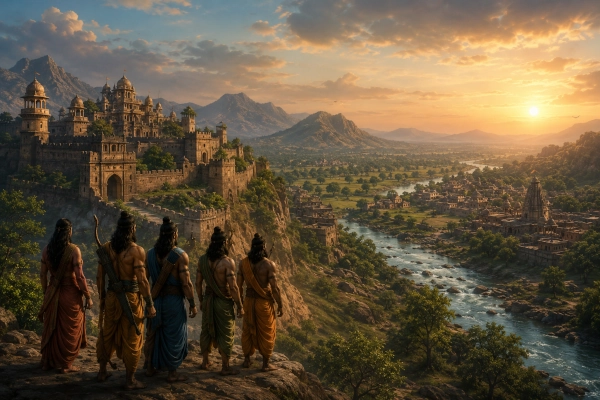
The ancient Matsya kingdom, or Matsyadesa, occupies an unusually important place in the Mahabharata. It was here that the Pandavas spent the thirteenth and final year of their exile. They entered the kingdom under assumed identities, served in the court of King Virata and remained concealed until the conditions of their exile had been fulfilled.
The Matsya country is traditionally identified with eastern and north-eastern Rajasthan, particularly the present-day regions of Jaipur, Alwar and Bharatpur. Rajasthan’s official educational material similarly states that the Matsya kingdom mentioned in the Mahabharata extended over parts of Jaipur, Alwar and Bharatpur, with Viratanagar as its capital.
Modern Viratnagar, historically known as Bairat, therefore provides the strongest geographical anchor for locating ancient Matsya on the present-day map of India. The Rajasthan government’s own institutions preserve the tradition that Viratnagar was the capital of Matsya during the Mahabharata period.
Matsya at a Glance
| Feature | Identification |
|---|---|
| Ancient Kingdom | Matsya / Matsyadesa |
| Mahabharata Ruler | King Virata |
| Capital | Viratanagara |
| Modern Identification of Capital | Viratnagar / Bairat, Rajasthan |
| Approximate Modern Region | Alwar, Jaipur and parts of Bharatpur |
| Modern State | Rajasthan |
| Country Today | India |
| Queen | Sudeshna |
| Princess | Uttaraa |
| Prince | Uttara |
| Important Commander | Kichaka |
| Major Mahabharata Event | Pandavas’ thirteenth year of exile in disguise |
| Important Matsya City | Upaplavya |
| Major Alliance | Matsya-Pandava alliance |
| Dynastic Connection | Uttaraa married Abhimanyu, son of Arjuna |
Where Was Ancient Matsya?
The most useful modern geographical reconstruction places Matsya across the Jaipur-Alwar-Bharatpur belt of Rajasthan. Rajasthan Board of Secondary Education material explicitly associates Matsya with portions of these three regions and names Viratanagar as its capital.
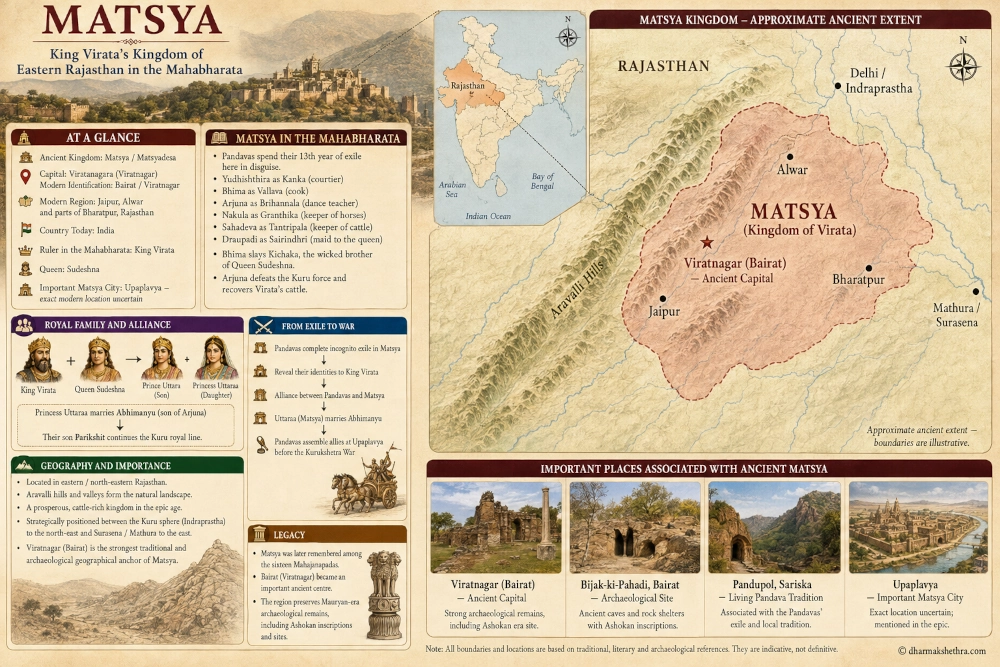
The boundaries should not be drawn as though Matsya followed modern district lines. Ancient kingdoms changed with political circumstances, and the Mahabharata does not provide a surveyed frontier. A historical map should therefore show an approximate Matsya zone, centred on Viratnagar and extending through the Alwar and Jaipur region towards Bharatpur.
Rajasthan Tourism continues to describe Alwar as part of the old Matsya Desh tradition. Its official account links the area with the kingdom of Viratnagar and with the Pandavas’ period of concealment.
Geographically, this placed Matsya in an important position between the Aravalli country and the plains leading towards the Yamuna. The kingdom stood near the wider political spheres of the Kurus, Panchalas and Surasenas that repeatedly appear in the Mahabharata.
Viratanagara: Capital of King Virata
The political centre of Matsya in the Mahabharata was the city of Virata, or Viratanagara.
When the Pandavas discussed where they could safely complete their final year of exile, Arjuna listed several possible kingdoms surrounding the Kuru country. These included Panchala, Chedi, Matsya, Surasena, Dasarna and Avanti. Yudhishthira ultimately chose Matsya because he regarded King Virata as powerful, virtuous and favourably disposed towards the Pandavas.
Modern tradition identifies this Viratanagara with Bairat, now Viratnagar, situated between Jaipur and Alwar. The Government PG College at Viratnagar, under Rajasthan’s Department of College Education, describes the town as the capital of Matsya Janapada during the Mahabharata period.
This identification makes Viratnagar the central location for any modern map of Matsya.
The Pandavas Enter Matsya in Disguise
The Pandavas had completed twelve years of forest exile. The condition imposed upon them required a thirteenth year during which they could not be recognised. Discovery would have endangered the completion of their exile.
They therefore entered the kingdom of Virata and assumed carefully chosen identities. The Virata Parva describes Yudhishthira deciding to appear before the king as Kanka, a courtier skilled in dice. Bhima became Vallava, serving as a cook while concealing his immense physical strength.
Arjuna entered the royal household as Vrihannala or Brihannala, teaching music and dance to the women of the palace, including Virata’s daughter. Nakula worked with the king’s horses, while Sahadeva took responsibility for cattle. Draupadi entered the household of Queen Sudeshna as Sairindhri, presenting herself as a woman skilled in personal service and hairdressing.
For nearly a year, some of the greatest warriors of the Mahabharata lived inside Matsya’s royal establishment without publicly revealing who they were.
Matsya as a Prosperous Cattle Kingdom
The Virata Parva repeatedly places cattle at the centre of Matsya’s economy and military affairs.
Virata possessed great herds, and control of those cattle became a strategic objective for his enemies. The importance attached to horses, cattle keepers, royal herds and livestock raids suggests a kingdom in which animal wealth formed a significant part of royal power.
This feature also explains why both Nakula’s knowledge of horses and Sahadeva’s expertise with cattle allowed them to enter Virata’s service naturally.
Later in the story, the cattle wealth of Matsya becomes the target of a coordinated military assault.
Kichaka and Draupadi
One of the most dramatic episodes of the Pandavas’ stay in Matsya concerns Kichaka, commander of Virata’s forces and brother of Queen Sudeshna.
The Mahabharata describes Kichaka as a powerful figure within the kingdom. While Draupadi was living as Sairindhri, he became obsessed with her and repeatedly attempted to force his attention upon her.
Draupadi could not openly call upon the Pandavas without risking their discovery. She therefore secretly approached Bhima. The two devised a plan in which Kichaka was drawn to the dancing hall at night.
Bhima waited there in concealment and confronted him. A fierce struggle followed, ending with Bhima killing Kichaka. The epic presents the death of Virata’s commander as a major event inside the Matsya kingdom.
The episode is important politically as well as personally. Kichaka had been one of Matsya’s strongest military figures. His death contributed to the perception among neighbouring powers that Virata’s kingdom had become vulnerable.
The Trigarta Attack on Matsya
The first major assault came from the Trigartas under King Susarman.
Their forces attacked Matsya and seized cattle, forcing King Virata to lead his army against them. Several disguised Pandavas accompanied the Matsya force. During the fighting, Virata was captured by the Trigartas before the Pandavas intervened and changed the course of the battle.
Virata was ultimately freed, and the Matsya forces recovered from the attack.
But the Trigarta invasion was only one part of a larger crisis.
While Virata and much of his army were engaged elsewhere, the Kauravas entered Matsya from another direction and seized the kingdom’s cattle. The Virata Parva describes Duryodhana’s forces driving away enormous royal herds while many of Matsya’s principal warriors were absent.
Arjuna and the Great Cattle Battle
The Kaurava raid created the circumstances in which Arjuna’s concealed identity could no longer remain merely a private matter.
Prince Uttara, Virata’s son, initially set out to recover the cattle. Brihannala accompanied him as his charioteer.
When Uttara saw the strength of the opposing army, he realised that the force before him included some of the greatest Kuru warriors. The opposition included Bhishma, Drona, Karna, Kripa, Ashvatthama and Duryodhana.
Arjuna then revealed himself to the prince and assumed command.
The battle that followed became one of the climactic episodes of the Virata Parva. Arjuna confronted the Kuru force and succeeded in securing the return of Matsya’s cattle. The episode marked the effective end of his life as Brihannala and the return of Arjuna the warrior.
Matsya thus became the landscape where the Pandavas moved from concealment back into open political and military life.
The Pandavas Reveal Their Identities
Once the prescribed period had ended, the Pandavas could finally reveal themselves.
King Virata discovered that the people who had spent the previous year serving inside his court were actually Yudhishthira, Bhima, Arjuna, Nakula, Sahadeva and Draupadi.
Their relationship with Matsya immediately changed. They were no longer disguised retainers living under Virata’s protection. They were royal allies whose dispute with the Kauravas was moving steadily towards war.
Virata’s kingdom consequently became one of the first major political bases available to the restored Pandavas.
Princess Uttaraa and Abhimanyu
The alliance between the two royal houses was strengthened through marriage.
Virata initially wished to give his daughter Uttaraa to Arjuna. Arjuna declined to marry her himself because he had lived in the palace as her teacher and regarded their relationship accordingly. Instead, he proposed that she marry his son Abhimanyu.
Virata accepted the proposal, and the marriage joined the house of Matsya with the Pandava family. The Mahabharata describes rulers and allies arriving for the wedding celebrations.
This marriage would eventually acquire immense dynastic significance. Uttaraa and Abhimanyu became the parents of Parikshit, who continued the Kuru-Pandava royal line after the catastrophic losses of the Kurukshetra War.
Upaplavya: The Pandava Base in Matsya
Matsya remained important even after the Pandavas completed their incognito exile.
The Mahabharata states that after the thirteenth year ended, the five brothers established themselves in Upaplavya, one of the towns belonging to Virata.
Allies began to gather there. Abhimanyu and Krishna arrived, as did the King of Kasi, Drupada, Dhrishtadyumna, Shikhandi and other rulers supporting the Pandavas.
Upaplavya consequently became an important political and military assembly point during the period immediately before the Kurukshetra conflict.
Its precise modern location remains uncertain. For that reason, a responsible map of ancient Matsya should label Upaplavya as an important Matsya city whose exact modern identification is unresolved, rather than attach it confidently to a particular present-day settlement.
Matsya and the Sixteen Mahajanapadas
Matsya’s importance extends beyond the Mahabharata narrative.
Rajasthan’s official educational history identifies Matsya among the ancient political regions associated with the state and places it in the Jaipur-Alwar-Bharatpur area.
Matsya is also traditionally counted among the sixteen Mahajanapadas, the prominent territorial states of northern India during the early historic period.
The Matsya of early historical texts should not automatically be treated as having exactly the same boundaries as the Matsya described in the Mahabharata. Political geography could change significantly across centuries.
Nevertheless, the continuity of the name Matsya and its repeated connection with north-eastern Rajasthan make the region an important meeting point between epic geography and later historical tradition.
Alwar and the Living Memory of Matsyadesa
The association has not disappeared from Rajasthan’s regional identity.
Rajasthan Tourism still describes Alwar through the tradition of Matsya Desh and connects the wider area with Viratnagar and the Pandavas.
The state also celebrates the Matsya Festival at Alwar, demonstrating how the ancient regional name continues to survive in the cultural vocabulary of modern Rajasthan.
This continuity is significant. Across India, memories of the Mahabharata have survived not only in manuscripts but also through place names, pilgrimage traditions, temples, regional identities and local narratives.
Few regions illustrate this as clearly as the old Matsya country.
Viratnagar and the Archaeological Landscape
Modern Viratnagar is valuable not only because of Mahabharata tradition. It also belongs to a substantial archaeological landscape.
Bairat became an important centre during later historical periods, particularly under the Mauryas. Archaeological remains around the settlement demonstrate that the area possessed importance well into documented ancient Indian history.
These later remains should not be described as direct archaeological proof of King Virata or the Pandavas. The distinction between epic tradition and securely dated archaeological evidence is important.
What archaeology does establish is that the geographical location traditionally associated with Viratanagara belonged to a genuinely significant ancient settlement zone. That makes Bairat an especially important site for studying how epic memory became attached to historical landscapes.
Matsya on the Modern Map of India
For a geographical reconstruction of Mahabharata India, Matsya can be represented approximately as:
Matsya / Matsyadesa → Viratanagara → Viratnagar/Bairat → Alwar-Jaipur-Bharatpur region → Rajasthan → India.
The strongest shaded zone should extend through the north-eastern Rajasthan corridor encompassing Viratnagar, Alwar, Jaipur and portions of Bharatpur. This follows the geographical identification given in Rajasthan’s official educational material.
Viratnagar should be marked prominently as the traditional capital. Alwar and Jaipur should appear as major modern reference points, while Bharatpur should mark the kingdom’s eastern geographical association.
A wider map can also show Indraprastha/Delhi towards the north-east and Mathura/Surasena towards the east. This helps place Matsya within the larger political geography surrounding the Kuru heartland.
Ancient Matsya and Modern Geography
| Ancient Location or Region | Modern Identification |
|---|---|
| Matsya / Matsyadesa | Eastern and north-eastern Rajasthan |
| Viratanagara | Viratnagar / Bairat |
| Core modern region | Jaipur-Alwar belt |
| Eastern extent | Parts of Bharatpur |
| Upaplavya | Exact modern location uncertain |
| Modern State | Rajasthan |
| Modern Country | India |
Matsya’s Importance in the Mahabharata
Matsya is not simply one kingdom among dozens named in the Mahabharata.
It is the kingdom where the Pandavas successfully complete the most dangerous condition of their exile.
It is where Yudhishthira becomes Kanka and Bhima becomes Vallava. It is where Arjuna lives as Brihannala, while Nakula and Sahadeva care for Virata’s horses and cattle. It is where Draupadi lives as Sairindhri.
It is where Bhima kills Kichaka.
It is where Matsya’s cattle become the object of major military raids and where Arjuna once again takes up arms against the foremost Kuru warriors.
It is where the Pandavas finally reveal themselves.
It is the kingdom whose princess Uttaraa marries Abhimanyu, joining the Matsya and Pandava royal houses.
And it is within Matsya, at Upaplavya, that many of the Pandavas’ allies gather as the political dispute with Hastinapura moves towards the Kurukshetra War.
Seen through modern geography, these events lead us to the Alwar, Jaipur and Bharatpur regions of Rajasthan, with Viratnagar or Bairat standing at the centre of the traditional identification.
Matsya therefore represents a crucial turning point in the Mahabharata. The Pandavas entered Virata’s kingdom as dispossessed princes who could not reveal their names. They emerged from it openly, surrounded by allies and ready to reclaim their political place in Bharat.
Sources and Further Reading
Mahabharata, Virata Parva — The fourth book of the epic provides the principal narrative for the Pandavas’ life in Matsya, their disguises, the Kichaka episode, the cattle raids, Arjuna’s battle and their alliance with King Virata.
Rajasthan Board of Secondary Education — History and Culture of Rajasthan — Identifies the Mahabharata kingdom of Matsya with parts of Jaipur, Alwar and Bharatpur and gives Viratanagar as its capital.
Government PG College Viratnagar, Department of College Education, Rajasthan — Preserves the official regional tradition identifying Viratnagar as the capital of Matsya Janapada and connecting Uttaraa with Abhimanyu.
Rajasthan Tourism — Alwar — Describes the region as ancient Matsya Desh and records its continuing association with Viratnagar and the Pandavas.
You may also like
-
Yavana in the Mahabharata: Greek Connections, Pandava Campaigns and the Warriors of Kurukshetra
-
India and Sri Lanka Launch SAMHiTA Manuscript Digitisation Project to Preserve Ancient Buddhist Heritage
-
ASI Uses Ground-Penetrating Radar to Investigate Ancient Buddhist Stupa at Ujjain After Nearly 90 Years
-
Pahlava: The Parthian World Beyond India’s Northwestern Frontiers in the Mahabharata
-
Namami Gange in 2026: 368 Projects Completed, 4,339 MLD Sewage Treatment Capacity Created as Ganga Rejuvenation Advances
