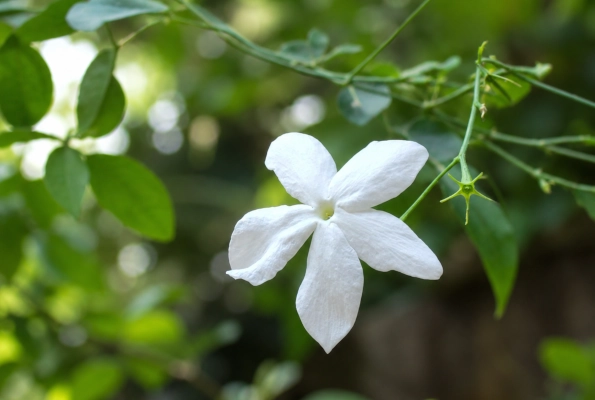
The fragrance of jasmine is deeply woven into Indian life. Its white flowers appear in worship, gardens, garlands, hair adornments and traditional perfumery. Ayurveda, however, looks beyond the flower’s celebrated fragrance.
Jati, identified in much Ayurvedic literature with Jasminum grandiflorum L., is valued especially for its leaves. Traditional practice associates the plant with wound care, oral health and several skin conditions. Modern research has also begun examining some of these applications.
Jasminum grandiflorum belongs to the Oleaceae family. Modern botanical taxonomy accepts it as a distinct species within the genus Jasminum. Older botanical classifications sometimes treated it as a variety or form of Jasminum officinale. This explains some of the variation in names found in medicinal literature.
Botanical Identity
Sanskrit name: Jati
Common name: Jasmine, Spanish Jasmine, Royal Jasmine
Botanical name: Jasminum grandiflorum L.
Family: Oleaceae
Genus: Jasminum
Plant type: Perennial scrambling or climbing shrub
Principal medicinal part: Leaves
Other traditionally used parts: Flowers and roots
Kew’s Plants of the World Online recognises Jasminum grandiflorum as an accepted species. Its natural range extends across parts of Africa, Arabia and Asia. The plant is also widely cultivated for its intensely fragrant flowers.
Identifying Jati
Jati grows as a climbing or scrambling shrub with long, flexible branches.
Its leaves are opposite and compound, usually carrying several leaflets. The flowers are white, strongly aromatic and borne in clusters.
The flower buds may show a faint pinkish tint before opening. Once fully expanded, the flowers develop the characteristic jasmine fragrance for which the plant is famous.
The medicinal leaves are quite different in purpose from jasmine absolute or essential oils used in perfumery. Correct botanical identification therefore becomes important when Jati is intended for therapeutic preparation.
Jati in Ayurveda
Ayurvedic literature places particular importance on Jati Patra, or the leaf of jasmine.
Traditional descriptions associate the leaves with Vrana, or wounds, and Mukhapaka, which broadly refers to inflammatory and ulcerative conditions of the mouth. Jati also appears in discussions of certain skin disorders.
Ayurvedic pharmacognostic literature describes Jasminum grandiflorum leaves as bitter and astringent, with heating potency and a pungent post-digestive effect.
Ayurvedic Properties of Jati
| Ayurvedic Parameter | Traditional Description |
|---|---|
| Rasa — Taste | Tikta, Kashaya — Bitter and astringent |
| Guna — Qualities | Laghu, Snigdha, Mridu — Light, unctuous and soft |
| Virya — Potency | Ushna — Heating |
| Vipaka — Post-digestive effect | Katu — Pungent |
| Important Karma | Traditionally associated with wound healing and cleansing |
| Principal traditional areas | Wounds, oral conditions and skin disorders |
These attributes explain why Jati became particularly important in external Ayurvedic preparations.
Jati and Vrana — Traditional Wound Care
Perhaps the most important Ayurvedic association of Jati is with Vrana, or wounds.
Ayurveda approaches wound management through several stages. These include cleansing the wound, controlling unhealthy discharge and supporting healthy tissue formation.
Jati leaves became valued within this tradition.
This use also survives in preparations carrying the plant’s name, most notably Jatyadi Taila.
Modern experimental research provides some support for this traditional direction.
An animal study examining Jasminum grandiflorum leaf extract found faster wound contraction and increased collagen synthesis in treated wounds. Researchers also observed improvements in antioxidant status within healing tissue.
Another experimental study involving diabetic wounds reported improved contraction and granulation tissue formation following treatment with an ethanolic leaf extract.
These results are encouraging. However, they do not mean raw jasmine leaves should be placed on serious wounds at home.
Deep wounds, infected wounds, diabetic ulcers and burns require professional medical assessment.
Jatyadi Taila — A Formulation Carrying the Name of Jati
The importance of Jati in Ayurvedic wound care can be seen in the classical preparation Jatyadi Taila.
The formulation combines Jati with other medicinal substances in an oil base. It has traditionally been used externally in wound-management practices.
Jatyadi Taila continues to attract scientific interest. Clinical and experimental studies have investigated Ayurvedic wound-management protocols containing the formulation, particularly for difficult or chronic wounds.
The name itself reflects the prominence given to Jati within this therapeutic tradition.
Jati is also mentioned in formulations such as Jatyadi Ghrita and related external preparations in Ayurvedic literature.
Jati for Mouth Ulcers and Oral Health
Another important Ayurvedic application involves the mouth.
Jati leaf preparations have traditionally been used for Mukhapaka, including conditions characterised by oral irritation and ulceration.
This traditional application has now received some direct clinical investigation.
A 2024 study examined Jasminum grandiflorum oral gel as an additional treatment for patients experiencing grade-2 oral mucositis following radiation therapy.
The prospective pilot study included 20 patients. The group receiving Jati gel alongside standard care showed improvements in pain and the affected mucosal area compared with standard care alone.
The study was small, open-label and non-randomised. Its findings should therefore be considered preliminary rather than definitive.
Nevertheless, it represents an interesting example of a traditional Ayurvedic indication moving into structured clinical investigation.
Jati Mouthwash and Mukhapaka
Researchers have also investigated Jati leaf preparations specifically for aphthous stomatitis.
Ayurvedic practice traditionally uses leaf decoctions for Kavala, or therapeutic holding and rinsing of liquids in the mouth.
Clinical research has compared Jati-based mouth preparations with conventional decoctions for oral ulcers. The results have encouraged further investigation into jasmine leaf preparations for oral care.
This is particularly noteworthy because oral use represents one of Jati’s most consistent traditional applications.
It also illustrates an important principle in Ayurveda. The medicinal value of jasmine does not rest primarily in its perfume.
For Jati, the leaf has a major therapeutic role.
Jati and Skin Health
Ayurvedic descriptions also associate Jati with Kushta, a broad classical category covering numerous skin disorders.
Its bitter and astringent qualities help explain this traditional placement.
Modern laboratory work has examined extracts of Jasminum grandiflorum for antimicrobial, antioxidant and inflammatory pathways. However, much of this research remains experimental.
This distinction is important.
Evidence that a plant extract affects microorganisms in a laboratory does not establish that homemade preparations can safely treat bacterial or fungal skin infections.
Persistent rashes, infected lesions or unexplained skin changes need proper diagnosis.
The Fragrant Flowers of Jati
While Ayurveda places considerable medicinal emphasis on the leaves, the flowers give Jati its cultural identity.
The intensely fragrant blossoms have long been prized for:
- Garlands and temple offerings
- Traditional hair adornment
- Natural perfumery
- Jasmine oils and aromatic preparations
- Gardens and household cultivation
Their aroma has also made jasmine important in traditional aromatic practices.
However, concentrated jasmine absolute or essential oil should not be considered equivalent to an Ayurvedic leaf preparation. Extraction methods create products with very different concentrations and chemical profiles.
Jati and the Mind
The fragrance of jasmine is traditionally associated with pleasantness, emotional warmth and relaxation.
Modern aromatherapy research has explored jasmine fragrance in relation to mood, alertness and nervous-system responses. Evidence remains much less developed than the popular claims surrounding jasmine fragrance.
Ayurveda also recognises the sensory influence of pleasant aromas. Yet medicinal use should remain distinct from general aromatherapy.
Smelling a jasmine flower and consuming a concentrated jasmine preparation are entirely different exposures.
Important Phytochemicals
Research into Jasminum grandiflorum has identified several classes of plant compounds.
These include:
- Iridoid and secoiridoid compounds
- Flavonoids
- Terpenoid compounds
- Phenolic constituents
- Tannins
These groups may contribute to the biological effects observed in experimental studies.
However, identifying phytochemicals does not automatically establish clinical effectiveness.
Their concentration also varies according to the plant part, cultivation conditions and extraction method.
Modern Scientific Perspective
Among Jati’s traditional uses, wound healing and oral care currently have some of the more interesting scientific support.
Animal studies have reported improved wound contraction, collagen formation and tissue repair with leaf extracts.
Human research is more limited.
The 2024 pilot trial involving radiation-induced oral mucositis offers preliminary clinical evidence for a Jati leaf gel used alongside standard treatment.
This does not establish Jati as a replacement for conventional treatment.
Instead, it provides a useful research direction for studying a traditional Ayurvedic application using modern clinical methods.
An Important Botanical Note: Jati and Jasmine Species
Jasmine presents an identification challenge because several closely related species appear in Indian medicinal and horticultural usage.
Jasminum grandiflorum, Jasminum officinale and Jasminum sambac should not automatically be treated as interchangeable.
Modern botanical authorities recognise Jasminum grandiflorum as its own accepted species. Earlier botanical systems sometimes placed it under Jasminum officinale, including as Jasminum officinale var. grandiflorum.
This historical overlap helps explain why different Ayurvedic publications may assign slightly different botanical identities to Jati.
For medicinal use, correctly authenticated plant material is therefore preferable.
Cultivation and Collection
Jati is widely cultivated in warm regions for its flowers.
The plant prefers good sunlight and well-drained soil. Its climbing growth benefits from physical support.
Flowers are normally collected when fragrance and freshness are desired. Medicinal leaf material requires greater attention to plant identification and contamination.
Plants exposed to heavy pesticide treatment should not automatically be assumed suitable for medicinal preparation.
Ornamental jasmine obtained from florists may have been cultivated specifically for decorative use.
Traditional Ayurvedic Significance
Jati offers an excellent example of how Ayurveda viewed plants beyond their most obvious qualities.
To most people, jasmine means fragrance.
To Ayurveda, Jati was also a useful medicinal plant.
Its leaves became associated with wounds, oral ulcers and skin care. That knowledge eventually influenced formulations such as Jatyadi Taila.
Modern research is now beginning to investigate several of those same traditional applications.
The most interesting aspect is not that ancient and modern terminology are identical. They are not.
Rather, traditional observations have provided specific questions that researchers can now test scientifically.
Jati — Fragrance with a Medicinal Heritage
Few plants combine beauty, fragrance, ritual importance and medicinal history as naturally as jasmine.
Jasminum grandiflorum occupies a distinctive place within this tradition.
Its white flowers represent one side of Jati: fragrance, beauty and cultural familiarity.
Its leaves reveal another.
Ayurveda valued them in preparations associated with wound healing, oral care and skin disorders. Early laboratory and clinical studies now provide scientific reasons to examine several of these uses more closely.
Jati therefore deserves recognition not merely as one of India’s most beloved fragrant flowers, but also as a plant with a substantial Ayurvedic medicinal heritage.
References
- Royal Botanic Gardens, Kew — Plants of the World Online: Jasminum grandiflorum L.
- Ministry of Ayush, Government of India — e-Charak medicinal plant resources.
- Pharmacognostical and phytochemical study of Jati Patra (Jasminum grandiflorum).
- Chaturvedi et al. — Research on Jasminum grandiflorum leaf extract and dermal wound healing.
- Anuja et al., 2024 — Jati oral gel in radiation-induced oral mucositis.
Health Disclaimer
This article is intended for educational and informational purposes only. Ayurvedic descriptions represent traditional knowledge and should not be interpreted as medical advice.
Do not use raw Jati leaves, concentrated extracts, jasmine oils or homemade preparations to treat serious wounds, burns, infections or oral lesions without qualified guidance. Deep wounds, diabetic ulcers, persistent mouth ulcers and unexplained skin conditions require professional medical assessment.
Pregnant or breastfeeding women, children, people taking regular medicines, and those with chronic illnesses should consult a qualified healthcare professional before medicinal use.
Concentrated jasmine essential oil or absolute is not the same as a traditional Ayurvedic Jati preparation and should not be ingested unless specifically prescribed by an appropriately qualified professional.
Ayurvedic treatment should be individualised according to the person’s constitution, condition and clinical circumstances. It should complement appropriate medical care rather than replace necessary diagnosis or treatment.
You may also like
-
Bharat Biotech’s Nucelion and VeGen Bio Partner to Manufacture Advanced Dual-Target CAR-T Cancer Therapy in India
-
Ayurveda and Anger: How Emotional Excess Affects Physical and Mental Health
-
Ayurveda and Stress: Daily Practices for Mental Balance and Emotional Well-Being
-
Ayurveda and Bowel Routine: Why Regularity Matters for Digestive Health
-
Why Ayurveda Warns Against Suppressing Hunger, Thirst and Sleep
