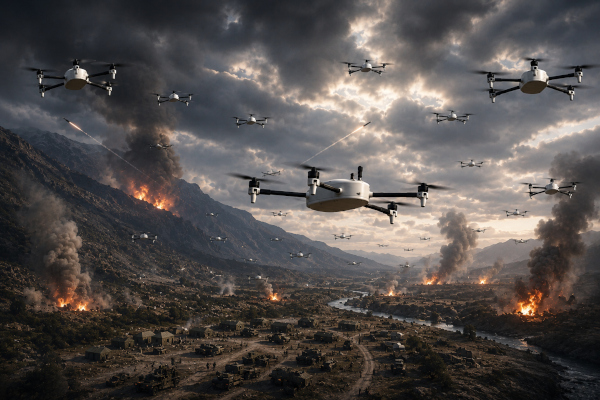
India’s defence-drone revolution is moving beyond remotely piloted aircraft towards something substantially more complex: machines that can coordinate with one another, redistribute tasks, communicate as a network and continue operating with progressively less human intervention. Bengaluru-based NewSpace Research & Technologies (NRT) is one of the Indian companies working at this frontier.
Rather than concentrating on a single class of UAV, NewSpace is developing an ecosystem spanning autonomous drone swarms, long-endurance unmanned aircraft, tethered surveillance drones, loitering systems and persistent high-altitude platforms. The company describes its objective as developing unmanned aerospace systems for global markets from India, with programmes intended for organisations including the Ministry of Defence, Ministry of Home Affairs, National Disaster Response Force and Department of Telecommunications.
At the centre of this effort is autonomy — turning individual drones into cooperating members of a larger aerial network.
From Individual Drones to an Intelligent Swarm
A conventional military UAV is generally treated as an individual aircraft. A drone swarm changes that model.
Instead of every aircraft depending upon a human operator to continuously direct it, multiple UAVs can exchange information, divide tasks and coordinate their movement. One vehicle may perform surveillance, another may act as a communications relay, while others investigate different targets or carry mission-specific payloads.
NewSpace describes its architecture as a heterogeneous UAV system, meaning different types of aircraft can operate together rather than requiring every drone in the swarm to be identical. Its disclosed capabilities include dynamic retasking, intelligent mesh networking and what the company calls “self-healing swarms” — architectures intended to reorganise when individual members are lost or become unavailable. The company’s published material gives its swarm architecture a stated operating radius of up to 50 km and service ceiling of 20,000 ft for the relevant system configuration.
This is an important distinction. The real military value of swarming does not simply come from putting large numbers of drones into the air. It comes from allowing those drones to behave as a coordinated distributed system.
India’s 75-Drone Swarm Demonstration
One of the early public demonstrations of India’s progress came during the Indian Army Day Parade on January 15, 2021, when 75 indigenously designed and developed drones conducted an AI-enabled swarm demonstration at Delhi Cantonment.
The aircraft simulated offensive missions and close-support tasks. The Ministry of Defence described the programme as part of the Army’s effort to integrate artificial intelligence, autonomous weapon systems, robotics, cloud computing and algorithmic warfare into future operations. PIB stated that the AI Offensive Drone Operations programme had been incubated with an Indian start-up; contemporary reporting identified NewSpace Research & Technologies as the company working with the Army on the swarm capability.
It was an early indication that Indian drone development was progressing from assembling remotely controlled quadcopters towards creating indigenous autonomy and swarm-control architectures.
Indian Army Places Its First Swarm Order
The programme subsequently moved beyond demonstration.
The Indian Army awarded NewSpace a roughly $15-million fast-track contract in 2021 for 100 swarming UAVs, according to Janes. NewSpace completed deliveries by March 2023. The system is identified as the Autonomous Surveillance and Armed Drone Swarm, or A-SADS, and uses multiple UAV types working cooperatively.
The system reportedly combines NewSpace’s Beluga and Nimbus UAV families and is intended for missions including intelligence, surveillance and reconnaissance, communications relay and kinetic applications.
This makes the programme particularly significant for Make in India. India was not merely purchasing individual indigenous drones; it was beginning to induct an Indian-developed architecture for cooperative unmanned operations.
Beluga — Long-Endurance Hybrid UAV
Among NewSpace’s publicly listed systems is BELUGA, described by the company as a hybrid multirotor long-endurance UAV.
Hybrid propulsion can be useful where a mission requires greater persistence than conventional battery-powered multirotors can normally provide while retaining vertical take-off and landing characteristics.
Within a heterogeneous swarm, such an aircraft could provide persistence while smaller electric platforms undertake missions requiring greater agility.
The importance therefore lies not simply in Beluga as an individual drone but in how differently configured UAVs can be integrated into a common autonomous network.
Nimbus — The Electric Workhorse
NIMBUS is listed by NewSpace as a multipurpose electric UAV.
An electric multirotor can provide the swarm with a relatively compact platform for reconnaissance, observation and other mission payloads. Multiple Nimbus-type aircraft operating together could distribute themselves across an area rather than forcing a single reconnaissance platform to observe everything.
This distributed architecture creates another advantage: redundancy.
Losing one aircraft need not necessarily result in the loss of the entire mission if other swarm members can take over its task.
Mackerel — Loitering Capability Inside the UAV Family
NewSpace also lists MACKEREL, described as a multirotor loitering-munition UAV.
The presence of surveillance, communications and loitering platforms within the same broader technological family illustrates where autonomous warfare is heading.
The ultimate objective is not necessarily a swarm composed of dozens of identical aircraft. It can instead become a mixed formation of specialised autonomous machines.
One group searches.
Another maintains communications.
Another identifies or tracks targets.
Other platforms can then be allocated to appropriate tasks.
This resembles a distributed aerial combat network more than a conventional fleet of remotely controlled drones.
Nimbus-Scope — A Persistent Eye in the Sky
The company’s portfolio also includes NIMBUS-SCOPE, a tethered electric UAV.
Tethered drones occupy an interesting position in military surveillance because they can remain over a fixed position while receiving power through their tether rather than relying entirely upon onboard batteries.
Such aircraft can potentially act as persistent observation or communications nodes above bases, forward posts and other protected locations.
When connected conceptually with mobile drone swarms, the result could be a layered system in which persistent nodes support highly mobile autonomous aircraft operating farther away.
Autonomous Operations Without GPS
One of the most important challenges facing military drones is that the battlefield cannot be assumed to provide uncontested satellite navigation or communications.
Electronic warfare systems can jam or deceive navigation signals, while terrain, buildings and forests can make autonomous flight much more difficult.
NewSpace has publicly discussed experimentation with drone swarms capable of operating in foliage and forest environments, incorporating technologies including edge computing, artificial intelligence, human-machine teaming, GNSS-denied operations and resilient mesh networking.
This is where autonomy becomes strategically more important than the airframe itself.
A drone that cannot operate after losing its communication link or navigation signal remains vulnerable. An aircraft capable of estimating its own position, avoiding obstacles and continuing a pre-assigned mission becomes considerably more useful in a contested environment.
DRDO-Backed Autonomous Indoor Drone
NewSpace’s autonomy work extends into environments where satellite navigation may be unavailable altogether.
Under DRDO’s Technology Development Fund, the Bengaluru company developed an “Autonomous Drone as First Responder for Search and Report Operations in Enclosed/Indoor Environments.”
The project incorporated an autonomous navigation stack, onboard object detection, localisation fallback mechanisms, 3D mapping, exploration algorithms and an AI/ML engine. The system was designed to navigate indoor environments even under zero-light conditions.
DRDO formally transferred the technology developed under the programme to the end user in October 2024.
Although developed for first-responder operations, the underlying technologies — autonomous navigation, mapping and object recognition without normal GPS availability — have much wider relevance to unmanned warfare.
Beyond Line of Sight Swarms
NewSpace has also demonstrated another important capability: controlling and receiving information from a swarm over very long distances.
The company reported testing a satellite-communications link for drone-swarm C4I functions in Ladakh at an altitude of around 4,200 metres, while the mission was planned, monitored and controlled from the company’s Bengaluru headquarters more than 3,000 km away.
According to NewSpace, telemetry and payload information continued to pass through the satellite network during the mission.
Such connectivity could eventually allow unmanned formations to operate far beyond the direct radio horizon of their operators.
From Swarms to Persistent Solar Aircraft
NewSpace is simultaneously working at the opposite end of the UAV spectrum — extremely long-endurance solar aircraft.
The company has been developing a High-Altitude Pseudo-Satellite, or HAPS, a solar-powered unmanned aircraft intended to remain in the stratosphere for extremely long periods.
A HAPS occupies the technological space between a conventional UAV and a satellite.
Unlike an orbiting satellite, it can remain over a relatively defined geographical area. Unlike a conventional aircraft, it is designed for persistence measured potentially in weeks or months rather than hours.
NewSpace has stated an ambition for its HAPS system to remain airborne for more than 90 days at approximately 65,000–70,000 feet. HAL has participated as a prototype development partner, and scale-model flight testing was reported as early as 2022.
Potential applications include persistent surveillance, communications relay and earth observation.
MAPSS — Bringing Solar Persistence Lower
NewSpace’s solar-aircraft work is also producing a medium-altitude system.
The company has secured an approximately ₹1.68-billion contract to supply its solar-powered Medium Altitude Persistent Surveillance System, or MAPSS, to the Indian Army, according to Janes. The aircraft is intended for ISR, electronic-intelligence and communications-relay missions.
The reported configuration is designed for operations around 28,000–30,000 feet with endurance measured in multiple days rather than the few hours typical of many tactical UAVs.
This suggests a broader NewSpace strategy based on persistence at different levels of the atmosphere:
tactical drones close to soldiers,
long-endurance UAVs above the battlefield,
and solar HAPS aircraft far into the stratosphere.
NewSpace UAVs Become Missile Carriers
Another important development is NewSpace’s integration with indigenous Indian weapons.
DRDO successfully tested its ULPGM-V3 precision-guided missile from an indigenously developed NewSpace UAV. The Ministry of Defence confirmed the company’s platform was used during the trials.
Further trials announced in 2026 again used UAVs developed by NewSpace, with DRDO demonstrating ULPGM-V3 configurations against ground and aerial targets.
This is significant because India’s unmanned-aircraft ecosystem is beginning to evolve from isolated products into integrated systems:
Indian UAV + Indian sensors + Indian communications + Indian autonomous software + Indian precision weapon.
That is a much deeper form of defence indigenisation than simply manufacturing an airframe locally.
The HAPS Opportunity Is Becoming Much Larger
The strategic relevance of NewSpace’s early investment in high-altitude aircraft has also increased.
On July 3, 2026, India’s Defence Acquisition Council approved procurement of a Fixed-Wing High Altitude Pseudo Satellite for the Indian Air Force. The Ministry of Defence said the aircraft would support persistent ISR, telecommunications and remote sensing.
The approval does not by itself mean that NewSpace has won this procurement, but it demonstrates that the category in which the Bengaluru company has invested for years is moving towards an operational requirement for the Indian military.
A Different Kind of Make in India Company
NewSpace illustrates how India’s defence-industrial transformation is changing the meaning of Make in India.
In earlier decades, indigenisation often meant manufacturing an imported design under licence.
Companies such as NewSpace are pursuing a different model. Their most valuable products may not be individual pieces of hardware at all.
The critical intellectual property increasingly lies in:
autonomy algorithms, swarm logic, distributed mission planning, onboard artificial intelligence, mesh communications, navigation, sensor fusion and human-machine interaction.
These are technologies that determine how unmanned systems behave rather than merely how they fly.
That distinction will become increasingly important.
One Operator, Many Aircraft
The eventual objective of swarm autonomy is to reverse the current manpower equation.
Today, sophisticated UAV operations may require multiple personnel to operate one aircraft and interpret the information it collects.
A mature autonomous swarm aims ultimately to allow one human commander to supervise many machines.
The operator would increasingly specify the objective rather than manually controlling every flight movement.
The swarm could then determine how to allocate aircraft, maintain formations, navigate obstacles, distribute sensor coverage and reorganise itself if members become unavailable.
The human remains responsible for command and decisions requiring human authority, while the machines increasingly handle the enormous computational burden involved in coordinating the formation.
Swarms – A credible Deterrent
For India, the technology has particular geographical relevance.
In the Himalayas, numerous small UAVs could provide surveillance over valleys and mountain approaches that are difficult for ground forces to continuously observe.
Across deserts, they could disperse across large areas and locate moving formations.
Along the coastline, autonomous systems could supplement conventional maritime surveillance.
During disasters, swarms could rapidly map large areas while individual aircraft search different sectors.
For communications, UAVs can form temporary airborne networks when terrestrial infrastructure is unavailable.
The same fundamental technologies can therefore serve military, border-security and civil applications.
Building the Software Layer of Indian Air Power
Aircraft such as Tejas, helicopters such as the Prachand and missiles such as BrahMos remain highly visible symbols of India’s defence-industrial growth.
The next transformation may be much less visible.
It will take place inside processors, algorithms and communications networks.
Autonomous systems will increasingly determine which platform detects a threat, which machine follows it, how information is distributed and which asset is assigned to respond.
NewSpace Research & Technologies is attempting to build part of this emerging software-defined layer of Indian air power.
Its journey from small autonomous UAVs to heterogeneous swarms, long-endurance surveillance aircraft and solar-powered pseudo-satellites illustrates the direction India’s unmanned aerospace industry is taking.
The future battlefield may contain thousands of unmanned systems, but their effectiveness will depend on something more important than numbers: whether those machines can think, communicate and cooperate as one system.
That is the technological space in which NewSpace Research & Technologies is positioning itself — and it makes the Bengaluru company one of the more interesting examples of India’s transition from Make in India to Design, Develop and Innovate in India
References
NewSpace Research & Technologies — Official Website
https://newspace.co.in/
Press Information Bureau — DRDO Technology Development Fund: Autonomous Drone as First Responder, NewSpace Research & Technologies
https://www.pib.gov.in/PressReleseDetailm.aspx?PRID=2030445&lang=2®=3
Press Information Bureau — Technology developed by NewSpace Research handed over under DRDO TDF programme
https://www.pib.gov.in/PressReleseDetailm.aspx?PRID=2066036
Press Information Bureau — DRDO flight trials of ULPGM-V3 using NewSpace Research UAV, July 2025
https://www.pib.gov.in/PressReleaseIframePage.aspx?PRID=2148320&lang=2®=48
Press Information Bureau — DRDO completes ULPGM-V3 development trials using NewSpace Research UAVs, May 2026
https://www.pib.gov.in/PressReleasePage.aspx?PRID=2263045&lang=2®=3
Janes — Indian Army Receives Swarming UAVs from NewSpace Research & Technologies
https://www.janes.com/defence-intelligence-insights/defence-news/defence/indian-army-receives-swarming-uavs
Janes — India Points to Gains in Swarm Technologies
https://www.janes.com/defence-intelligence-insights/defence-news/india-points-to-gains-in-swarm-technologies
Janes — DefExpo 2022: NewSpace-HAL High-Altitude Pseudo-Satellite Conducts Test Flights
https://www.janes.com/defence-intelligence-insights/defence-news/defence/defexpo-2022-indias-haps-conducts-test-flights
Janes — Indian Army to Procure NewSpace Solar-Powered MAPSS Surveillance UAV
https://www.janes.com/defence-intelligence-insights/defence-news/defence/indian-army-to-procure-solar-powered-surveillance-uav
You may also like
-
ICAR Scientists Develop Indigenous Protective Gloves for Cotton Farmers, Sign Commercial Manufacturing Agreement
-
India Moves Towards Five-Year Assured Orders for Defence Startups Under New Procurement Reforms
-
BHEL–Coal India Joint Venture Begins Construction of ₹25,016 Crore Indigenous Coal Gasification Project in Odisha
-
Zen Technologies Introduces Indigenous Hyper-Strike Falcon AI-Guided Counter-Drone Interceptor
-
L&T and Germany’s SCHOTTEL Expand Partnership for Controllable Pitch Propeller Systems in Indian Shipbuilding
