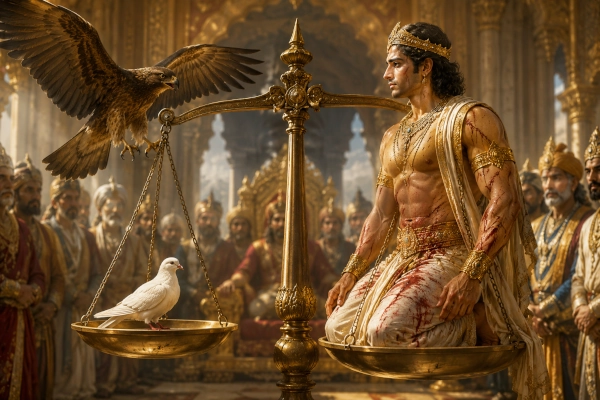
The royal court of King Shibi was calm when a small dove suddenly came racing through the air. Its wings beat frantically, its breath was nearly spent, and terror drove it towards the one place where it believed it might still find safety. Behind it came a powerful hawk, swift and relentless, its eyes fixed upon the fleeing bird as it closed the distance between them.
The dove flew directly towards King Shibi and collapsed into his lap. Trembling uncontrollably, it pressed itself against him as though the king’s body itself had become a fortress. Shibi immediately understood what had happened. A helpless creature had deliberately sought refuge with him, and from that moment the king believed that its life had become his responsibility.
What seemed at first to be a simple act of protection soon became one of the Mahabharata’s most profound examinations of Dharma. The dove had the right to seek safety, yet the pursuing hawk also had a claim that could not easily be dismissed. It was a predator living according to its nature, and the dove was its food. By protecting one creature, Shibi risked condemning another to hunger.
King Shibi and the Reputation of a Righteous Ruler
Shibi, son of Ushinara, was renowned as a ruler of extraordinary generosity and righteousness. His fame rested not merely upon military strength or royal wealth, but upon the confidence that anyone who approached him for protection would not be abandoned. His commitment to Dharma had become so celebrated that even the gods wished to discover whether his virtue would endure when the cost became unbearable.
According to the Mahabharata tradition, Indra and Agni decided to test him. Agni assumed the form of the terrified dove, while Indra appeared as the pursuing hawk. They did not choose an easy test, because a simple contest between good and evil would reveal little. Instead, they created a situation in which two legitimate duties stood against one another and forced the king to decide how far he was willing to go to honour both.
The Dove Finds Refuge
The dove remained hidden in the king’s lap while the hawk descended into the court. The frightened bird had no weapon, no strength and no argument except the ancient appeal of one who had sought refuge. Shibi placed a protective hand around it and made it clear that he would not simply hand the creature back to death.
For a king, protecting one who had sincerely sought shelter was not merely an act of kindness. It was part of the moral obligation of rulership. If those who came to the king in fear could be surrendered whenever circumstances became inconvenient, the king’s promise of protection would be meaningless. Shibi therefore regarded the dove’s arrival as a sacred responsibility.
The hawk, however, was not prepared to accept that answer.
The Hawk Speaks of Its Own Dharma
Standing before the king, the hawk demanded that the dove be returned. It argued that the bird was its natural prey and that preventing it from eating would place its own life in danger. The hawk had not attacked the dove out of hatred or cruelty. It hunted because that was the way nature had provided for its survival.
The hawk therefore challenged Shibi directly. If the king considered himself righteous for saving the dove, what righteousness was there in forcing another creature to starve? If the hawk had young depending upon it, their lives might also be endangered. The king could not protect one being by ignoring the suffering imposed upon another and then simply call the result Dharma.
Shibi listened carefully. The hawk’s argument could not be dismissed as selfishness alone, because it rested upon the fundamental need of every living creature to survive. The problem before the king had suddenly become far more difficult than defending the weak against the strong.
When Two Dharmas Collide
The dove represented the duty to protect one who had sought refuge. The hawk represented the equally real necessity of sustaining life according to the order of nature. Both claims possessed moral weight, and Shibi found himself standing between them.
This is what makes the story so powerful. The Mahabharata does not reduce Dharma to a simple command that can be applied without thought. Instead, it presents situations in which righteous duties can collide, forcing an individual to search for a path that causes the least injustice. Shibi could not simply save the dove and ignore the hawk, nor could he surrender the dove without betraying the trust placed in him.
The king therefore began searching for another solution.
Shibi Offers Another Meal
Shibi first offered the hawk other food. If hunger was the problem, the king was willing to provide meat from his stores so that the predator would not suffer. The wealth of the kingdom was available to him, and feeding a single hawk would have been easy.
The hawk refused. It argued that the dove was the food assigned to it by nature and that another meal could not simply replace its lawful prey. The king’s attempt to solve the dilemma through wealth had failed, and the moral conflict returned with even greater force.
Shibi then proposed something far more serious. If the hawk required flesh, the king would provide flesh from his own body. The dove would remain under his protection, while the hawk would receive food without another innocent creature being sacrificed in its place.
The Hawk Names the Price
The hawk accepted the proposal but placed a condition upon it. The king would have to give flesh from his own body equal in weight to the dove. The demand transformed what had been a philosophical debate into a test of flesh and blood.
Shibi agreed without hesitation. He did not summon a prisoner, servant or soldier and command someone else to suffer for his promise. The obligation belonged to him, and therefore the cost would also be his. If the king’s word had created the responsibility, then the king’s own body would bear its burden.
A balance was brought into the court. The little dove was placed carefully upon one side while Shibi prepared himself for the sacrifice.
Flesh Upon the Balance
The king cut flesh from his thigh and placed it upon the empty pan. Blood flowed from the wound, and those gathered in the court watched in horror as the scale began to move. Yet the balance did not become equal. The dove remained heavier.
Shibi cut away more flesh and placed it beside the first piece. Again the scale shifted, but once more the dove outweighed everything that had been offered. The king continued, each sacrifice weakening him further, while the tiny bird remained astonishingly heavy upon the other side.
Pain spread through Shibi’s body, but he did not withdraw his promise. He had told the dove that it was safe, and he refused to make that assurance meaningless simply because the cost had become greater than he had imagined. More flesh was added, yet the balance still refused to level.
The court could now see that something extraordinary was taking place. No ordinary dove could outweigh so much human flesh, but Shibi did not use the impossibility as an excuse to abandon the creature.
The King Refuses to Turn Away
Shibi had already suffered more than anyone could reasonably have demanded. He could have declared that the bargain had become impossible and surrendered the dove. No one in the court could have denied that he had tried to fulfil his promise.
Yet the king understood Dharma differently. The value of a promise was revealed precisely when keeping it became difficult. If he abandoned the dove now, then every wound he had already endured would become meaningless, because the creature that trusted him would still be returned to death.
Looking at the stubborn balance, Shibi realised that pieces of flesh would never satisfy the demand. If portions of his body were not enough, then he would offer the whole of himself.
Shibi Climbs Onto the Scale
Weak from blood loss, Shibi approached the balance and climbed onto the pan himself. The dove remained upon the opposite side, small and apparently helpless, while the king placed his entire life against its safety. In that moment, the meaning of his vow became complete.
Shibi was no longer merely saying that a ruler should protect those who seek refuge. He was demonstrating that the promise of protection must remain meaningful even when fulfilling it threatens the protector himself. A king who expected his subjects to trust him could not make his word conditional upon personal comfort.
The balance became more than an instrument for measuring weight. It became a visible measure of responsibility. On one side sat a tiny bird, while on the other rested the king who had accepted responsibility for its life.
The Gods Reveal the Truth
The test had reached its highest point. Shibi had shown that he was prepared to sacrifice not merely wealth or comfort, but his own life rather than betray the creature that had sought safety with him. There was nothing more the disguised visitors needed to learn.
The hawk and dove then revealed their true identities. The frightened bird was Agni, the divine embodiment of fire, while the hawk was Indra, king of the Devas. They had come not to destroy Shibi but to test whether his celebrated righteousness was genuine.
The king had answered them without speeches or proclamations. His answer had been written in his own blood and confirmed when he placed himself upon the balance.
The gods praised Shibi for his extraordinary commitment to Dharma. The terrible ordeal came to an end, and the king’s wounds were restored. What had appeared to be a cruel conflict between predator and prey was revealed as a divine examination of the deepest meaning of kingship and responsibility.
Why the Hawk Was Not the Villain
An important feature of the story is that the hawk is never reduced to a simple symbol of evil. Its argument is rational and powerful. Predators must eat, and denying them food can also cause suffering.
The hawk therefore forces Shibi to confront the danger of selective compassion. It is easy to protect the creature that appears helpless while ignoring the needs of another being. True Dharma requires looking beyond immediate emotion and considering the consequences of one’s actions.
Shibi does not answer the hawk by declaring its hunger unimportant. Instead, he accepts the validity of its need and chooses to bear the cost himself. That decision transforms the story from a simple rescue into a profound exploration of moral responsibility.
The Meaning of Refuge
The dove’s decision to fly into Shibi’s lap carries enormous significance. It arrives with nothing to offer the king. It possesses no wealth, army or political importance. Its only possession is trust.
Shibi understands that this very helplessness strengthens his obligation. Protection is most meaningful when given to someone who has no other means of defending themselves. A refuge that disappears when danger arrives is not a refuge at all.
The story therefore places enormous weight upon the principle of protecting those who sincerely seek shelter. Once Shibi accepted the dove, its small life became inseparable from his own honour.
The Balance as a Symbol of Dharma
The mysterious weight of the dove is one of the most memorable images in the episode. Physically, the bird should have weighed very little compared with the flesh of a grown man. Yet no amount of flesh seemed sufficient.
Symbolically, the balance was measuring something greater than physical mass. It was measuring the burden created when one life becomes dependent upon another person’s promise.
The dove remained heavier because responsibility cannot always be satisfied through partial sacrifice. Shibi could not fulfil his Dharma by giving something while still holding himself apart from the consequences. Only when he placed his entire being upon the scale did his commitment become complete.
The balance therefore becomes a symbol of justice itself. It asks whether the protector values his own promise as highly as the life entrusted to him.
Leadership Means Bearing the Burden
The story also presents a demanding vision of leadership. Shibi possessed enough authority to make others pay for his decisions, yet he refused to do so. He could have ordered another animal killed or commanded one of his subjects to provide flesh, but he understood that transferring his moral burden to someone weaker would itself be unjust.
His kingship therefore becomes inseparable from personal responsibility. The throne does not merely give the king power over others. It makes him responsible for protecting them, and sometimes that responsibility requires him to stand between danger and those who trust him.
Shibi’s greatness lies not in asking his subjects to sacrifice for the kingdom, but in showing that the ruler must be prepared to sacrifice for those who depend upon the kingdom.
Compassion and Courage Together
Shibi’s compassion is not weakness. He does not protect the dove because he is unable to face unpleasant realities. He listens to the hawk, accepts the legitimacy of its hunger and then deliberately chooses a solution that brings suffering upon himself.
His kindness therefore requires immense courage. It is easy to speak gently when nothing is at stake, but compassion becomes meaningful when maintaining it demands pain, endurance and personal loss.
The story unites Daya, compassion, with courage and determination. Shibi’s strength is demonstrated not by defeating the hawk, but by refusing to abandon the vulnerable creature in his care.
Dharma Is Tested When It Becomes Painful
Before the dove entered his court, Shibi already possessed a reputation for righteousness. Yet reputation alone proves very little. Virtue becomes meaningful when circumstances place pressure upon it.
The gods therefore created a situation in which every possible choice carried consequences. Shibi had to decide whether his commitment to Dharma would survive hunger, argument, physical agony and the possibility of death.
The answer was found when he climbed onto the scale.
This theme appears repeatedly throughout the Mahabharata. Dharma is rarely difficult when duty is convenient. Its true complexity emerges when honour conflicts with safety, compassion conflicts with necessity, or a promise demands more than anyone expected to give.
A Tiny Bird Becomes the Measure of a King
The dove had no importance in the political affairs of Shibi’s kingdom. Protecting it could bring him no wealth, territory or military advantage. From the perspective of worldly power, its life was almost insignificant.
Yet that is precisely why the story is so powerful. The moral greatness of a kingdom is not revealed only by how it treats the powerful. It is revealed by what happens when the weakest creature arrives at the throne seeking help.
Shibi’s willingness to sacrifice himself demonstrates that Dharma does not measure the value of life according to status. The frightened bird mattered because it was alive and because it had trusted him.
In that moment, the king’s entire reputation was measured against the life of a creature that had nothing to offer him except faith.
The King Who Became the Refuge
At first, Shibi merely offered the dove shelter. Then he offered his flesh. Finally, he offered his entire body. With each step, the distinction between the protector and the refuge became smaller.
By climbing onto the scale, Shibi himself became the price of the safety he had promised. He would not allow the dove to pay for the hawk’s hunger, and he would not allow the hawk to be dismissed as unworthy of consideration. If Dharma demanded a sacrifice to reconcile those two claims, the king would provide it himself.
That final act explains why the story survived across centuries. Shibi did not merely discuss righteousness. He embodied it.
What the Story of Shibi Teaches
The tale of King Shibi, the dove and the hawk teaches that Dharma cannot always be reduced to one simple rule. Protecting the weak is righteous, but so is respecting the needs of another living being. Keeping a promise is righteous, but every promise can produce consequences that must also be considered.
Shibi’s greatness lies in refusing to solve the problem by sacrificing someone weaker than himself. Instead, he asks what he personally must give so that his promise can remain honourable without denying the hawk’s right to survive.
The story also teaches that words create responsibilities. When Shibi assures the dove that it is safe, his statement becomes more than comforting language. It becomes a vow for which he is prepared to pay with his body.
For rulers, leaders and ordinary people alike, the principle remains powerful. Responsibility means more than making decisions. It means accepting the consequences of the promises we make and refusing to force the vulnerable to bear the price of our own commitments.
The King Who Placed Himself Against a Dove
A terrified dove entered the court seeking life. A hungry hawk arrived demanding its rightful prey. Between them stood a king who recognised the truth in both claims.
Shibi refused to surrender the dove, yet he did not dismiss the hawk’s hunger. Instead, he placed his own flesh upon a balance and tried to satisfy both duties without sacrificing another innocent creature. When piece after piece of his body failed to equal the dove’s mysterious weight, he understood that only one offering remained.
He placed himself upon the scale.
Only then did the divine visitors reveal themselves and end the test. Agni and Indra had come to discover whether Shibi’s celebrated Dharma would survive when righteousness demanded everything from him.
They received their answer.
Long after the royal court disappeared and Shibi’s kingdom passed into memory, one image endured: a wounded king seated upon the scales, willing to offer his entire life rather than betray a creature that had trusted him.
The dove was small, but the promise made to it was not.
That is why King Shibi and the balance of Dharma remain among the Mahabharata’s most powerful images of sacrifice, refuge and righteous leadership.
Mahabharata Source
The story of King Shibi appears in the Vana Parva of the Mahabharata, where the sage Markandeya narrates the testing of Shibi, son of Ushinara. Agni takes the form of the dove, while Indra assumes the form of the hawk. The confrontation leads to Shibi offering his own flesh and ultimately placing himself upon the balance rather than abandoning the creature that has sought refuge with him.
A related version also appears within the wider Mahabharata tradition in the Anushasana Parva, further reinforcing Shibi’s association with generosity, protection and unwavering commitment to Dharma.
You may also like
-
Indian Physicist Ashoke Sen Becomes First Indian to Receive Prestigious Oskar Klein Medal
-
Indian Army’s Northern Command Opens 75-Day Defence Technology Internship Programme for Young Innovators
-
Ayush Patent Filings Rise Eightfold as India Records 4,077 Applications and 711 Grants in 12 Years
-
DRDO Announces Paid Research Internships at Gwalior for Science and Engineering Students
-
PM-SETU: Government Approves ₹1,194.92 Crore to Modernise 25 ITIs Across Maharashtra, Odisha and Jammu & Kashmir
