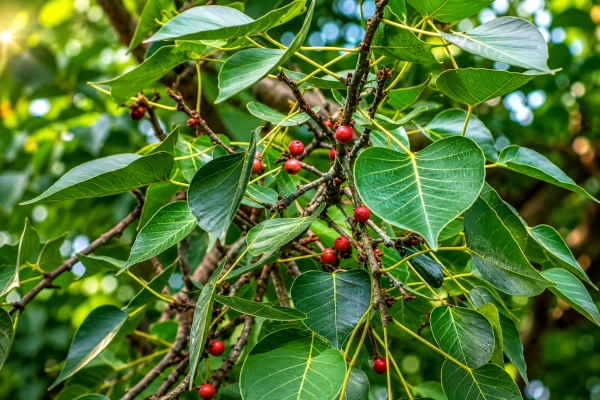
Few trees occupy a place in Indian civilisation as profound as the Peepal tree.
Known in Sanskrit as Ashvattha, Ficus religiosa is revered in Hindu, Buddhist and Jain traditions. It grows beside temples, ancient water bodies, village pathways and sacred spaces across the Indian subcontinent.
Ayurveda, however, regards Ashvattha as more than a sacred tree.
Its bark, leaves, fruits, roots and latex have a long history of medicinal use. Classical Ayurvedic literature particularly values its astringent and cooling qualities. Traditional applications include wounds, excessive bleeding, inflammatory conditions, disorders of the mouth and certain gastrointestinal and skin conditions. Ayurvedic literature also places Ashvattha among plants used for controlling excessive bodily secretions.
Modern research has investigated Ficus religiosa for wound healing, anti-inflammatory, antioxidant, antimicrobial, glucose-lowering and gastroprotective effects. Much of this evidence, however, remains preclinical rather than established human clinical evidence.
Botanical Identity
Sanskrit name: Ashvattha — अश्वत्थ
Common names: Peepal, Pipal, Sacred Fig, Bodhi Tree
Botanical name: Ficus religiosa L.
Family: Moraceae
Genus: Ficus
Plant type: Large perennial tree
Principal Ayurvedic part: Bark
Other traditionally used parts: Leaves, fruit, tender shoots, roots and latex
The Royal Botanic Gardens, Kew recognises Ficus religiosa L. as an accepted species. Its native range extends from southeastern Pakistan across the Indian subcontinent towards Myanmar.
The tree belongs to the same botanical family as banyan and other fig species, but each has a distinct botanical identity.
How to Identify the Peepal Tree
Ashvattha can become a massive and long-lived tree.
Its most distinctive feature is its heart-shaped leaf. The leaf ends in a long, narrow and pointed tip. This extended tip often moves even in a light breeze, giving the Peepal canopy its characteristic fluttering appearance.
Young leaves may emerge with a coppery or reddish tint before turning green.
The trunk develops grey to brown bark as the tree matures. Like many members of the Ficus genus, the plant produces a milky latex when its tissues are injured.
The fruits are small figs. They usually appear green when immature and darken as they ripen.
Correct botanical identification is important because several Ficus species occur in Ayurvedic medicine.
Ashvattha in Ayurveda
Ayurvedic texts describe Ashvattha primarily as a Kashaya Rasa, or astringent-tasting drug.
Its drying and cooling nature explains many of its traditional applications.
A review of Ayurvedic literature describes Ashvattha as possessing Kashaya Rasa, Guru and Ruksha Guna, Sheeta Virya and Madhura Vipaka, with an overall tendency to pacify Pitta and Kapha.
Ayurvedic Properties of Ashvattha
| Ayurvedic Parameter | Traditional Description |
|---|---|
| Rasa — Taste | Kashaya — Astringent |
| Guna — Qualities | Guru, Ruksha — Heavy and dry |
| Virya — Potency | Sheeta — Cooling |
| Vipaka — Post-digestive effect | Madhura — Sweet, according to several Ayurvedic literary reviews |
| Dosha action | Traditionally described as Pitta-Kapha Shamaka |
| Important Karma | Vrana Ropana, Stambhana and actions associated with cooling and controlling excessive secretions |
Different Nighantus and later Ayurvedic references may vary slightly in their description of individual properties. The dominant themes remain its astringent, cooling and drying character.
Kashaya Rasa — The Importance of Its Astringency
The astringent taste of Ashvattha is central to understanding its Ayurvedic use.
Kashaya Rasa is traditionally associated with drying, contracting and absorbing actions.
Ayurveda therefore employs astringent substances when there is excessive moisture, discharge or bleeding.
This helps explain Ashvattha’s traditional association with:
- Vrana — wounds
- Raktasrava — excessive bleeding
- Atisara — diarrhoeal conditions
- Mukhapaka — inflammatory and ulcerative disorders of the mouth
- Certain skin disorders
- Conditions involving excessive secretions
Its cooling nature further supports its traditional use where Pitta-related heat, burning or inflammation is prominent.
Ashvattha and Vrana — Traditional Wound Care
Wound management is one of the important traditional uses of Ashvattha.
Ayurvedic literature describes applications of different parts of the plant in Vrana, or wounds. Its astringent nature was traditionally valued for controlling discharge and supporting tissue healing. Reviews of classical Ayurvedic texts also document external applications in wounds, swelling, burning sensations and other inflammatory conditions.
Modern researchers have explored this traditional indication.
Experimental studies using Ficus religiosa leaf extracts have reported increased wound contraction, shorter epithelialisation periods and improved tissue strength in animal models.
These findings provide a scientific reason to continue researching the plant.
They do not, however, establish raw Peepal leaves or bark as substitutes for modern wound treatment.
Deep wounds, burns, diabetic ulcers and infected wounds require professional medical care.
Bark — The Principal Ayurvedic Drug
Although almost every part of the Peepal has entered traditional medicine, the stem bark holds particular importance in Ayurveda.
Its strong astringency makes it suitable for preparations intended to reduce excessive secretions.
Traditional bark preparations have been associated with:
- Bleeding conditions
- Diarrhoeal disorders
- Oral problems
- Wounds
- Certain skin disorders
- Excessive vaginal discharge
- Inflammatory conditions
The bark is generally used after appropriate cleaning, drying and pharmaceutical preparation rather than simply consumed from the tree.
Medicinal bark should never be indiscriminately stripped from living Peepal trees. Ring-barking can seriously damage or kill a mature tree.
Ashvattha for Oral Health
Ashvattha has a long traditional association with the mouth and gums.
Its astringent character makes the bark particularly suitable for Ayurvedic oral preparations.
Traditional applications include conditions corresponding broadly to:
- Mouth ulcers
- Inflamed gums
- Bleeding gums
- Unhealthy oral secretions
- Local irritation
Astringent plant compounds can create a contracting sensation over mucous membranes. This helps explain the historical use of Ashvattha and related Ficus species in oral hygiene.
However, persistent mouth ulcers or recurrent gum bleeding should not simply be treated at home. They can have several causes and may require dental or medical evaluation.
Ashvattha and Atisara
The drying action of Kashaya Rasa also explains the traditional use of Ashvattha in Atisara, a broad Ayurvedic category that includes diarrhoeal conditions.
Bark preparations have historically been used when stools are frequent or excessively watery.
This is a classical example of Ayurvedic reasoning.
A condition involving excessive fluid loss is approached with a medicine possessing Grahi or Stambhana-like astringent qualities.
However, acute diarrhoea can rapidly cause dehydration. Children, older adults and people with severe symptoms require prompt medical attention.
Blood in the stool, persistent fever or signs of dehydration should always be medically assessed.
Ashvattha and Rakta Disorders
The combination of Kashaya Rasa and Sheeta Virya also explains Ashvattha’s association with certain conditions involving Rakta and Pitta.
Ayurveda traditionally uses cooling and astringent substances when excessive heat and bleeding occur together.
Ashvattha therefore appears in traditional discussions of bleeding conditions.
The term should not be interpreted as proof that Peepal bark can treat an unexplained bleeding disorder.
Repeated or heavy bleeding may indicate a serious underlying condition and requires medical diagnosis.
Ashvattha in Skin Conditions
Ayurvedic literature includes Ashvattha among plants used externally in certain Kushta and inflammatory skin disorders.
Traditional practice uses its bark or other plant parts in carefully prepared formulations.
Experimental research has identified antimicrobial and anti-inflammatory activity in various Ficus religiosa extracts.
These findings are interesting but remain largely laboratory or animal evidence.
A plant extract inhibiting bacteria in a laboratory does not mean homemade Peepal preparations can safely treat skin infections.
Persistent rashes, fungal infections and infected wounds require proper diagnosis.
Anti-inflammatory Potential
Inflammation is another area where modern pharmacology has investigated Ashvattha.
Animal studies involving leaf extracts and fractions have demonstrated analgesic and anti-inflammatory activity. Researchers have linked some of these effects to tannins, polyphenols and other plant constituents.
This direction corresponds broadly with traditional applications involving Shotha, or swelling, and inflammatory discomfort.
Human clinical evidence remains limited.
Ashvattha should therefore not replace prescribed anti-inflammatory medicines where these are medically necessary.
Ashvattha and Digestive Protection
Traditional medicine also associates the Peepal with several gastrointestinal conditions.
Modern animal experiments have investigated leaf extracts for potential anti-ulcer activity.
One study found that an ethanolic Ficus religiosa leaf extract reduced experimentally induced gastric ulcer parameters in animals. Researchers suggested that flavonoids and antioxidant mechanisms may have contributed to the observed effect.
This remains preclinical evidence.
People with persistent acidity, severe abdominal pain, black stools or suspected gastric ulcers require medical evaluation.
Research into Blood Glucose
One of the more frequently studied modern areas involving Ficus religiosa is glucose metabolism.
Laboratory and animal studies have reported hypoglycaemic or antidiabetic activity from extracts of various parts of the plant. Reviews of the available evidence list glucose-lowering effects among the plant’s experimental pharmacological activities.
This does not establish Peepal as a clinically proven treatment for diabetes.
Replacing diabetes medicines with plant preparations can be dangerous.
Combining herbal preparations with glucose-lowering drugs may also increase the risk of excessively low blood sugar.
Anyone with diabetes should use Ashvattha medicinally only under qualified supervision.
Antioxidant Activity
Researchers have identified several antioxidant compounds in Ficus religiosa.
Experimental extracts have shown free-radical-scavenging activity in laboratory tests.
Antioxidant activity in a test tube, however, should not be translated directly into broad claims that a plant can prevent or cure disease.
Such studies primarily help researchers identify promising chemical pathways for further investigation.
Important Phytochemicals in Peepal
Research into Ficus religiosa has identified several classes of natural plant compounds.
These include:
- Tannins
- Flavonoids
- Phenolic compounds
- Sterols
- Terpenoids
- Lupeol-related compounds
- Other bioactive phytochemicals
The concentration and composition vary according to the plant part and extraction method.
Tannins are especially relevant when considering the plant’s strong traditional astringent properties.
Leaves of Ashvattha
The familiar heart-shaped leaves have several traditional applications.
Ayurvedic and folk traditions have used leaf preparations in wound care, swelling, inflammatory conditions and other disorders.
Research on leaf extracts has examined:
- Wound healing
- Anti-inflammatory activity
- Antioxidant activity
- Anti-ulcer potential
- Glucose metabolism
- Antimicrobial effects
Most studies remain experimental.
Using dried, authenticated medicinal material also differs greatly from casually picking leaves from roadside trees.
Roadside leaves may carry dust, exhaust residue, microbes, pesticides or other contaminants.
Fruit of the Peepal
The small figs produced by Ashvattha are less prominent than its leaves but also appear in traditional practice.
Ayurvedic sources attribute nutritive and medicinal qualities to different stages of the fruit.
Research has found amino acids and several naturally occurring compounds in the fruits and seeds.
The medicinal properties of the fruit should not automatically be assumed to match those of the bark or leaves.
Different plant parts contain different concentrations of active compounds.
Latex — A Potent Substance Requiring Caution
Ashvattha produces a white milky latex when the bark, leaves or young branches are injured.
This latex appears in several traditional practices.
It should nevertheless be regarded as a potent plant secretion, not as an everyday food.
Fresh Ficus latex can irritate sensitive skin and mucous membranes.
It should never be placed in the eyes or used internally without qualified guidance.
People with allergies to figs or latex-containing plants should exercise particular caution.
Roots and Tender Shoots
Roots and young shoots also appear in traditional formulations.
Their use varies depending on the disorder and the classical preparation.
Ayurveda rarely treats all parts of a medicinal plant as interchangeable.
The bark, fruit, latex and leaves may have different therapeutic roles.
Correct plant part, dose, method of preparation and Anupana — the accompanying substance — can substantially influence an Ayurvedic formulation.
Ashvattha and the Doshas
Ashvattha is generally associated with Pitta-Kapha Shamaka action in Ayurvedic literature.
Effect on Pitta
Its Sheeta Virya, or cooling potency, supports traditional applications involving:
- Burning
- Heat
- Inflammatory conditions
- Certain bleeding disorders
Effect on Kapha
Its Kashaya Rasa and Ruksha Guna help counter excessive moisture and secretions.
This can explain its use where Kapha and Kleda are prominent.
Effect on Vata
The strong drying and astringent qualities of Ashvattha mean that excessive or inappropriate use may aggravate dryness and Vata in susceptible individuals.
This is one reason Ayurveda does not recommend using medicinal plants solely because they are described as beneficial.
Dosage and constitution matter.
Ashvattha as Part of the Panchavalkala Tradition
The medicinal importance of fig trees in Ayurveda extends beyond Ashvattha alone.
Several related trees belonging largely to the Ficus group appear together in classical bark combinations used externally.
These astringent barks became particularly useful in traditional preparations for cleansing wounds, bathing affected areas and managing excessive discharge.
The concept illustrates Ayurveda’s detailed understanding of medicinal tree bark as a separate pharmaceutical category.
Ashvattha therefore belongs to a broader tradition of using India’s great fig trees medicinally.
Sacred Tree of Indian Civilisation
The medicinal identity of Ashvattha cannot be completely separated from its civilisational importance.
The tree appears repeatedly in Indian religious and philosophical traditions.
In Hindu thought, the Ashvattha became a symbol of continuity, life and the cosmic order.
The Bhagavad Gita famously uses the image of an Ashvattha tree with its roots above and branches below as a philosophical metaphor for worldly existence.
The tree also occupies a central place in Buddhism. Gautama Buddha attained enlightenment beneath a sacred fig at Bodh Gaya, giving rise to the name Bodhi Tree.
Its reverence across generations also helped protect large Peepal trees within settlements.
Sacred status therefore served, in practice, as a form of ecological conservation.
Ecological Importance of Peepal
Large Ficus religiosa trees provide shade and habitat within tropical landscapes.
Their figs are consumed by birds and other animals, while mature crowns create nesting and resting spaces.
Kew records Ficus religiosa as having environmental, social, medicinal and food-related uses.
Its ecological value adds another dimension to the Ayurvedic principle that medicinal plants should be protected rather than exploited.
Harvesting should therefore be sustainable.
Removing large quantities of bark from a mature Peepal can seriously injure the tree.
What Modern Science Currently Tells Us
Ficus religiosa is scientifically interesting because traditional medicine has attributed a remarkably broad range of applications to the tree.
Modern studies have reported experimental:
- Wound-healing activity
- Anti-inflammatory activity
- Analgesic activity
- Antioxidant activity
- Antimicrobial activity
- Glucose-lowering effects
- Gastroprotective effects
- Anticonvulsant activity
A major review published in the Journal of Ethnopharmacology concluded that many traditional uses had received some experimental support. It also highlighted an important weakness: many studies relied on uncharacterised crude extracts, making their findings difficult to reproduce or translate into medicines.
This remains an important limitation.
Laboratory activity is not the same as proven clinical effectiveness.
Traditional Knowledge and Scientific Evidence
Ashvattha illustrates how traditional knowledge and modern pharmacology can complement each other without being confused with one another.
Ayurveda provides centuries of observations about:
- Which part of the plant was used
- How it was prepared
- What qualities were attributed to it
- Which clinical patterns were considered appropriate
Modern science can then investigate:
- Chemical constituents
- Biological mechanisms
- Toxicity
- Effective dosage
- Drug interactions
- Human clinical outcomes
The strongest approach is not to dismiss traditional knowledge or exaggerate preliminary science.
It is to investigate the traditional claims carefully.
An Important Conservation Principle
Ashvattha is not merely a source of medicinal raw material.
A mature Peepal can represent decades or centuries of ecological and cultural continuity.
Bark should therefore never be removed indiscriminately from sacred or roadside trees.
Medicinal material should ideally come from authenticated and responsibly sourced Ayurvedic suppliers.
This protects both the patient and the tree.
Correct sourcing also reduces the risk of contamination, adulteration and botanical misidentification.
Ashvattha — Where Ayurveda, Ecology and Sacred Tradition Meet
The Peepal occupies a rare position in Indian civilisation.
It is a medicinal tree, an ecological landmark and a sacred symbol at the same time.
Ayurveda values Ashvattha primarily for its astringent, cooling and drying properties. Its bark and other parts have traditionally been used in wound care, excessive secretions, oral conditions, diarrhoeal disorders, inflammatory states and certain skin problems.
Modern research has provided experimental evidence for several biological activities associated with these traditional applications. Yet most evidence remains laboratory or animal-based, and large, high-quality human clinical trials are still lacking.
Ashvattha therefore deserves neither casual dismissal nor exaggerated medicinal claims.
Its significance lies in something deeper.
For centuries, Indian civilisation recognised that a tree could simultaneously provide medicine, shade, habitat, spiritual meaning and continuity between generations.
In Ashvattha, Ayurveda’s medicinal knowledge and India’s tradition of reverence for nature meet beneath the same spreading canopy.
References
Royal Botanic Gardens, Kew — Plants of the World Online: Botanical identity, accepted taxonomy and geographical distribution of Ficus religiosa.
Singh et al., Journal of Ethnopharmacology: Review of the traditional uses, phytochemistry and pharmacology of Ficus religiosa.
Phytopharmacology of Ficus religiosa: Review of experimental pharmacological activities, including wound healing, antioxidant, antimicrobial and metabolic effects.
A Critical Review on Ashvattha Leaves: Ayurvedic properties, classical uses and modern pharmacological research relating to Ashvattha.
Ayurvedic literary review of Ashvattha: Classical description of Kashaya Rasa, Sheeta Virya, Guru-Ruksha Guna, Madhura Vipaka and Pitta-Kapha action.
Gulecha et al.: Experimental investigation of analgesic and anti-inflammatory activity in Ficus religiosa leaf fractions.
Gregory et al.: Experimental investigation of anti-ulcer activity of Ficus religiosa leaf extract.
Health Disclaimer
This article is intended for educational and informational purposes only. Traditional Ayurvedic uses described here should not be interpreted as medical advice or as proof of clinical effectiveness.
Do not consume Peepal bark, leaves, roots, fruits, latex or concentrated extracts medicinally without guidance from an appropriately qualified practitioner.
Peepal latex should be used with particular caution. It may irritate the skin, eyes and mucous membranes.
People who are pregnant or breastfeeding, children, older adults and people with chronic medical conditions should seek professional advice before medicinal use.
Anyone taking medicines for diabetes, blood pressure, blood clotting or other chronic illnesses should consult a qualified healthcare professional before using Ashvattha preparations because herbal products may alter treatment response or interact with medicines.
Serious wounds, persistent diarrhoea, unexplained bleeding, recurrent mouth ulcers, infected skin lesions and other significant symptoms require proper medical diagnosis.
Ayurvedic treatment should be individualised according to the person’s constitution, condition, medicines and clinical circumstances. Traditional herbal preparations should complement appropriate healthcare rather than replace necessary diagnosis or treatment.
You may also like
-
The Ayurvedic Approach to Work-Life Balance: Restoring Harmony Between Work, Health and Personal Life
-
Ayurveda and Mental Fatigue in the Digital Age: Ancient Wisdom for a Calm and Focused Mind
-
Bharat Biotech’s Nucelion and VeGen Bio Partner to Manufacture Advanced Dual-Target CAR-T Cancer Therapy in India
-
Ayurveda and Anger: How Emotional Excess Affects Physical and Mental Health
-
Ayurveda and Stress: Daily Practices for Mental Balance and Emotional Well-Being
