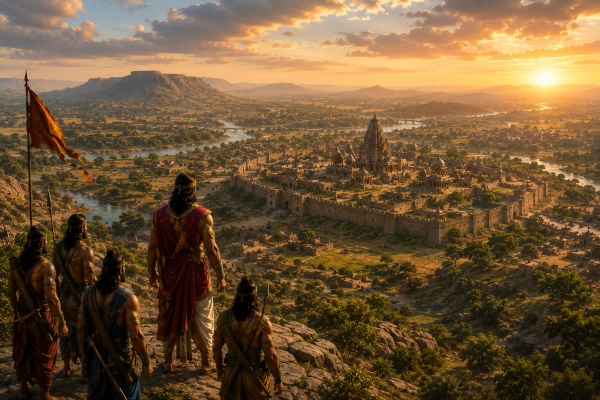
The Malavas were an important ancient Indian people repeatedly mentioned in the Mahabharata. Their name later became permanently associated with Malwa, the great plateau region covering much of western Madhya Pradesh and adjoining southeastern Rajasthan. Modern Malwa includes the wider regions around Ujjain, Indore, Dhar, Ratlam, Mandsaur and Neemuch, while its north-western cultural and geographical zone extends towards Rajasthan.
However, the geographical story of the Malavas requires more caution than kingdoms such as Matsya or Chedi. Historical evidence indicates that the Malavas were originally a mobile warrior people or confederacy rather than a kingdom permanently fixed within the modern Malwa plateau. Ancient geographical studies place earlier Malava groups farther north-west, followed by their movement into Rajasthan and eventually central India. The present-day region called Malwa received its name from the Malavas only in a later period.
The Mahabharata nevertheless clearly knows the Malavas as a distinct political and military people. They appear during the Pandavas’ campaigns, at Yudhishthira’s Rajasuya sacrifice and on the battlefield of Kurukshetra. The epic also names individual Malava chiefs, confirming that they possessed recognised leadership and substantial military strength.
For a modern geographical series, Malava can therefore be broadly associated with the later Malwa cultural region of western Madhya Pradesh and southeastern Rajasthan, while noting that the Malavas’ territory changed over the centuries.
Malava at a Glance
| Feature | Identification |
|---|---|
| Ancient People | Malavas |
| Political Character | Warrior tribe or confederation; later territorial power |
| Mahabharata References | Sabha, Bhishma, Drona and other Parvas |
| Approximate Later Region | Western Madhya Pradesh and southeastern Rajasthan |
| Modern Cultural Region | Malwa |
| Modern States | Madhya Pradesh and Rajasthan |
| Country Today | India |
| Important Later Centre | Malavanagara, traditionally associated with the Rajasthan region |
| Major Epic Event | Subjugated during Nakula’s western campaign |
| Rajasuya Association | Malava rulers attended Yudhishthira’s sacrifice |
| Kurukshetra Role | Malava contingents fought in the great war |
| Named Malava Chief | Sudarsana |
| Important Historical Legacy | The name Malwa derives from the Malavas |
Where Was Ancient Malava?
The modern Malwa region occupies a broad plateau across western Madhya Pradesh and southeastern Rajasthan. It is bounded broadly by Rajasthan to the north-west, Gujarat towards the west and the Vindhyan and Narmada landscapes towards the south.
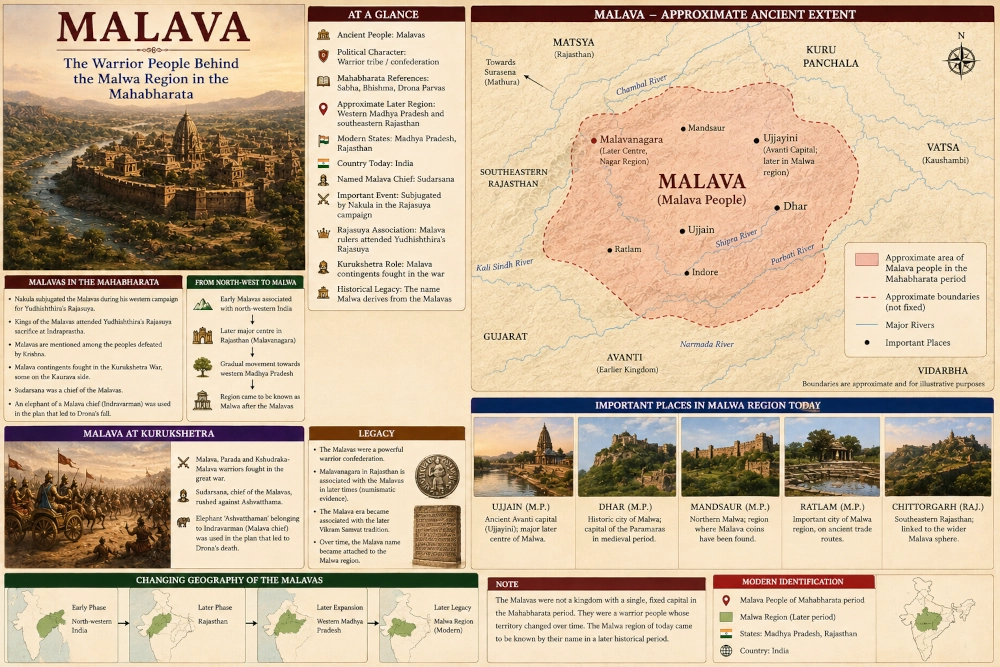
Today, districts commonly associated with Malwa include Ujjain, Indore, Dewas, Dhar, Ratlam, Mandsaur, Neemuch, Shajapur and parts of Rajgarh and Sehore in Madhya Pradesh. The wider historical region also extends towards parts of southeastern Rajasthan.
Yet the Malavas mentioned in the Mahabharata should not automatically be placed within these precise modern boundaries.
Historical geographical research indicates that the Malavas were originally associated with north-western India. They later appear strongly in Rajasthan before their name became associated with the central Indian plateau now called Malwa. Historian D. C. Sircar noted that the well-known central Indian Malwa region came to be named after the Malavas considerably later than the second century CE.
For this reason, the most accurate geographical formula is:
Malavas → north-western origins → Rajasthan → western Madhya Pradesh → later Malwa region.
For a Mahabharata location map, the kingdom can still be represented broadly over western Madhya Pradesh and southeastern Rajasthan, but the boundary should be marked as approximate and historically evolving.
Malava and Avanti: An Important Distinction
A particularly important distinction must be made between Malava and Avanti.
In later Indian history, Ujjain and the surrounding plateau became closely identified with Malwa. However, during the ancient period, Ujjayini was the great centre of Avanti, another kingdom clearly named in the Mahabharata. Ancient Avanti broadly corresponded to much of what later became the Malwa region.
This means that the words Malava, Malwa and Avanti cannot always be used interchangeably.
The Mahabharata sometimes names the Avantis and Malavas separately. For example, a passage describing peoples defeated by Krishna lists the Avantis and Malavas independently. This strongly suggests that the epic regarded them as distinct political or ethnic groups.
Over succeeding centuries, Malava groups moved farther into central India. Their name gradually became attached to the wider plateau, and the geographical term Malwa eventually replaced or absorbed older regional names in common usage.
This historical transformation is one of the most fascinating aspects of Malava geography.
The Malavas in the Mahabharata
The Mahabharata refers to the Malavas on several important occasions.
They were not presented merely as an obscure tribe inhabiting a distant frontier. Instead, they appear alongside prominent peoples such as the Trigartas, Sivis, Madras, Surasenas and other recognised political communities.
These references show that the Malavas belonged to the larger network of warrior states and tribal confederacies that formed the political world of ancient Bharat.
Their position within lists of western peoples is also important for geographical reconstruction.
Nakula’s Western Campaign
One of the clearest references to the Malavas occurs during the preparations for Yudhishthira’s Rajasuya sacrifice.
The Pandavas sent their brothers in different directions to secure recognition and tribute from rulers across Bharat. Nakula was assigned the western regions.
The Sabha Parva describes Nakula setting out from Khandavaprastha with a large army. During his campaign he conquered several western peoples, including the Dasarnas, Sivis, Trigartas, Amvashtas and Malavas.
This passage is particularly useful because it places the Malavas within a western geographical and political grouping.
It also indicates that the Malavas were sufficiently organised and militarily significant to be treated as one of the communities whose submission was required before Yudhishthira could claim imperial status through the Rajasuya.
Nakula’s success brought the Malavas within Yudhishthira’s wider political sphere.
The Malava Kings Attend the Rajasuya
After the Pandava campaigns, rulers from throughout Bharat gathered at Indraprastha for Yudhishthira’s Rajasuya.
The Sabha Parva explicitly mentions the kings of the Malavas among those who came to the ceremony.
The use of the plural is significant.
It may suggest that Malava political organisation included several chiefs or rulers rather than a single highly centralised monarchy. This would fit later historical evidence describing the Malavas as a gana or confederated political community.
Such political structures were not unusual in ancient India. Several powerful warrior peoples operated through assemblies, clans or groups of chiefs rather than through a single hereditary king.
The Malavas may therefore have represented a martial confederation whose leaders collectively exercised authority.
A Warrior Confederation
Later grammatical and historical traditions strengthen this picture.
The Malavas are remembered as a martial community, and later evidence portrays them as a gana, or organised corporate political body. Historical discussions of the Malavas describe them as an ancient confederation whose political traditions differed from those of conventional hereditary monarchies.
This helps explain why Mahabharata passages sometimes refer to Malavas collectively rather than concentrating on a single famous royal dynasty.
Their identity appears to have rested as strongly upon the people and warrior community as upon individual kings.
This also separates Malava from kingdoms such as Magadha, Matsya or Chedi, where specific royal houses dominate the narrative.
Malavas and Krishna
The Drona Parva includes the Malavas in a long description of peoples said to have been defeated by Krishna.
The list contains Avantis, southerners, mountain peoples, Daserakas, Kashmiris, Kambojas, Trigartas, Malavas, Daradas, Sakas and Yavanas.
The passage again demonstrates that Malava and Avanti were treated separately within the epic.
It also places the Malavas among formidable warrior groups encountered in the wider military and political world associated with Krishna.
The exact historical setting behind such epic conquest lists cannot always be reconstructed. Nevertheless, their presence shows that the Malavas were firmly established within the Mahabharata’s geographical imagination.
Malavas at Kurukshetra
The Malavas also fought in the Kurukshetra War.
Several passages in the Bhishma and Drona Parvas place Malava warriors within the armies engaged in the conflict. At least some Malava contingents fought alongside the Kaurava forces. One Bhishma Parva passage describes warriors supported by Malavas, Paradas and Kshudraka-Malavas within the Kaurava battle formation.
Other battle passages mention Malavas confronting Pandava warriors.
These references also reveal something important about the complexity of ancient alliances.
A large people such as the Malavas may not always have acted as a completely unified political bloc. Different chiefs or branches could potentially support different alliances, just as other regional groups were sometimes divided during the Kurukshetra conflict.
Sudarsana, Chief of the Malavas
One of the most important named Malava leaders in the Mahabharata is Sudarsana.
During the fierce fighting described in the Drona Parva, Sudarsana is explicitly called the chief of the Malavas. He rushed against Ashvatthaman during battle.
The reference gives the otherwise collective Malava identity a specific leader.
Sudarsana’s appearance demonstrates that the Malavas possessed recognised commanders capable of leading them during one of the greatest wars described in Indian epic tradition.
The episode also places them among the organised military powers present at Kurukshetra.
The Malavas and the Death of Drona
The Malavas are indirectly connected with one of the most famous episodes of the entire Kurukshetra War: the fall of Dronacharya.
Krishna and the Pandavas knew that Drona would be extremely difficult to defeat while he continued fighting with full determination. A plan was therefore devised to convince him that his son Ashvatthaman had died.
Bhima killed an elephant named Ashvatthaman and then loudly announced that Ashvatthaman was dead.
The Drona Parva identifies the elephant as belonging to Indravarman, chief of the Malavas.
Yudhishthira then confirmed that Ashvatthaman had been killed, while quietly clarifying that he meant the elephant. Drona, overcome by grief and believing his son dead, eventually laid down his weapons.
This remarkable episode gives the Malavas an unexpected connection to one of the decisive turning points of the war.
More Than One Malava Chief?
The appearance of Sudarsana as a Malava chief and Indravarman in connection with the Malava elephant has generated questions about Malava political organisation.
Rather than requiring every Malava to be ruled by one monarch, these references may reflect several chiefs or clan leaders operating within the broader Malava community.
Such a structure would be consistent with the later reputation of the Malavas as a gana or confederation.
This interpretation should remain cautious, because the Mahabharata contains layers of traditions from different periods. Yet it offers a reasonable explanation for the appearance of multiple Malava leaders.
Kshudraka-Malavas
The epic also refers to Kshudraka-Malavas, suggesting a close connection between the Malavas and another warrior community called the Kshudrakas.
A Bhishma Parva passage places Kshudraka-Malavas alongside other western fighting peoples.
The association is historically interesting because classical accounts of Alexander’s campaigns also describe powerful peoples of the north-west whom historians have connected with the Malavas and Kshudrakas.
Ancient geographical research has long associated the Malavas with the Malloi encountered by Alexander’s forces in the Punjab region. Historical geography places these early Malavas far to the north-west of the later Malwa plateau.
This reinforces the idea that Malava geography changed considerably across centuries.
From the North-West to Rajasthan
After their early association with north-western India, Malava groups appear strongly in Rajasthan.
Historical reconstruction places a major Malava centre around Malavanagara, commonly associated with the Nagar region in Rajasthan. Large numbers of Malava coins discovered in Rajasthan indicate an important phase of political activity there.
These coins often carried legends celebrating the Malavas and provide material evidence for their existence as an organised political community.
This Rajasthan phase is essential when connecting the Malavas with modern southeastern Rajasthan.
It creates a geographical bridge between their earlier north-western history and their later association with central India.
The Movement Towards Central India
Over time the Malavas moved or expanded farther south-east towards central India.
By the Gupta period, historical evidence places them broadly in Rajasthan and western Malwa. The Allahabad Pillar inscription of Samudragupta includes the Malavas among political communities brought under imperial authority.
Their association with the plateau gradually became so strong that the region itself acquired their name.
This was the beginning of the geographical identity that survives today as Malwa.
The process was gradual rather than instantaneous. Older texts continued distinguishing Malava territory from Ujjain or Avanti even during later centuries.
Why the Region Became Known as Malwa
The modern name Malwa derives from the Malavas.
D. C. Sircar’s study of the Malava era notes that the central Indian tract known as Malwa was named after the ancient Malava people at a relatively late stage.
This means the people gave their name to the landscape.
It is a pattern found elsewhere in ancient history. Migrating or expanding communities sometimes transferred their ethnic name to the region they eventually dominated.
Over the centuries, Malava changed from primarily describing a people to describing a geographical country.
The Malwa Plateau
Modern Malwa is one of central India’s most recognisable geographical regions.
The plateau consists largely of fertile volcanic soils. Its rivers and tributaries connect the region with both the Chambal system to the north and the Narmada basin farther south.
Madhya Pradesh Tourism associates the region with fertile agriculture and important historical trade routes, factors that helped Malwa develop into a prosperous zone in later centuries.
Its location made it a natural crossroads.
Routes from northern India could pass through the region towards the Narmada valley and the Deccan. Western routes led towards Gujarat, while eastern routes connected the plateau with central and northern India.
Such geography explains why control of Malwa remained strategically important for many later Indian dynasties.
Important Rivers of the Malwa Landscape
Several rivers shape the wider Malwa geographical zone.
The Chambal and its tributaries drain large areas towards the north. The Shipra flows through Ujjain. Other important river systems include the Kali Sindh, Parbati and sections of the Mahi drainage.
These rivers created fertile agricultural corridors within the plateau.
For an article map, the Chambal system is particularly useful because it helps explain the connection between western Madhya Pradesh and southeastern Rajasthan.
The rivers also help distinguish the upland geography of Malwa from the Gangetic plains farther north.
Ujjain and Malava: Important but Not Identical
Modern readers naturally associate Ujjain with Malwa, and today that association is correct.
Historically, however, the Mahabharata identifies the region around Ujjayini primarily with Avanti, not Malava. Later traditions gradually merged these geographical identities.
Ujjain should therefore appear on a Malava map as an important modern and later historical centre of Malwa, rather than being labelled confidently as the Mahabharata capital of the Malavas.
No securely established Malava capital comparable with Viratanagara of Matsya or Girivraja of Magadha can be identified from the Mahabharata.
This distinction is important for maintaining historical accuracy.
Malavanagara and the Rajasthan Connection
For the later historical Malavas, Malavanagara offers a stronger connection with Rajasthan.
Numismatic evidence has led historians to associate an important Malava centre with the Nagar region of Rajasthan. Thousands of coins attributed to the Malavas have been discovered in this broader region.
For a location map, it can therefore be useful to show:
Malavanagara — later Malava centre, Rajasthan; identification based principally on historical and numismatic reconstruction.
This provides a physical anchor while clearly separating later archaeological evidence from the epic narrative.
Malava and Southeastern Rajasthan
The connection with southeastern Rajasthan is particularly significant.
The Malavas occupied parts of Rajasthan before their name became dominant farther east and south across the Malwa plateau. Later inscriptions using the Malava era are also found across Rajasthan, indicating that Malava political and cultural influence extended through the region.
For modern mapping, this supports including parts of the Rajasthan-Madhya Pradesh borderland within the broad Malava geographical sphere.
The area around Chittorgarh, Pratapgarh, Jhalawar and neighbouring regions lies within or beside the wider historical transition zone between Rajasthan and Malwa.
Again, these should be treated as modern reference points rather than exact epic boundaries.
Malava and the Malava Era
The Malavas also left a significant chronological legacy.
An ancient era known as the Malava era became associated with the community. In later historical usage, this chronological tradition became connected with the system widely known as the Vikram Samvat.
The precise development of the era and its later association with Vikramaditya belongs to the complex history of Indian chronology.
Nevertheless, its name demonstrates how strongly the Malavas influenced the historical identity of western and central India.
Their legacy survived not merely through territorial memory but also through systems of dating and inscription.
Malava and Later Malwa
By the early medieval period, the name Malava increasingly referred to rulers and territories within central India.
Eventually the distinction between ancient Avanti and Malava became less important in geographical usage. By around the later first millennium CE, texts increasingly treated Malava and the Ujjain-Malwa country as parts of the same regional identity.
Later dynasties ruling central India inherited this geography.
The Paramaras, whose great centres included Dhar and Ujjain, became deeply associated with Malwa. The medieval region would later produce some of India’s most famous rulers, scholars, temples and cities.
Yet behind that later history remained the name of the ancient Malavas.
Ancient Malava and Modern Geography
| Ancient or Historical Reference | Modern Geographical Association |
|---|---|
| Malavas | Ancient warrior people named in the Mahabharata |
| Early Malava sphere | North-western India |
| Later major Malava region | Rajasthan |
| Later territorial expansion | Western Madhya Pradesh |
| Malavanagara | Traditionally associated with the Nagar region of Rajasthan |
| Modern Malwa | Western Madhya Pradesh and southeastern Rajasthan |
| Ujjain | Major later Malwa centre; anciently associated primarily with Avanti |
| Indore | Central modern Malwa |
| Dhar | Western Malwa |
| Mandsaur-Neemuch | Northern and north-western Malwa |
| Jhalawar region | Southeastern Rajasthan and Malwa cultural zone |
| Modern States | Madhya Pradesh and Rajasthan |
| Country Today | India |
For this geographical series, the most useful modern identification is therefore:
Malava → Malwa → western Madhya Pradesh and southeastern Rajasthan → India.
The map should also contain a note explaining that the Mahabharata-era Malavas were a mobile warrior people whose earliest geographical associations lay farther north-west, while the modern Malwa region acquired their name later.
Malava’s Place Among the Kingdoms of the Mahabharata
Malava occupies a different place in the Mahabharata from kingdoms dominated by a single famous ruler.
There is no Malava equivalent of Jarasandha of Magadha, Virata of Matsya or Shishupala of Chedi who dominates the kingdom’s story.
Instead, the Malavas appear primarily as a people.
Nakula confronts them during his western campaign.
Malava rulers attend Yudhishthira’s Rajasuya.
Krishna’s military accomplishments include victory over the Malavas.
Malava contingents fight at Kurukshetra.
Sudarsana appears as a chief of the Malavas.
And an elephant belonging to a Malava chief becomes central to the strategy that leads to Drona’s fall.
Taken together, these references portray a recognised martial community with considerable geographical reach.
From Malava to Malwa
The most remarkable aspect of Malava history is the survival of its name.
Many ancient peoples mentioned in the Mahabharata disappeared from common geographical vocabulary. The Malavas did not.
Their name travelled with them.
From the north-western regions associated with their earliest history, they moved into Rajasthan. From Rajasthan their political presence expanded into central India. Eventually the plateau itself became Malava-desa, and from that name emerged modern Malwa.
Today, someone travelling through Ujjain, Indore, Dhar, Ratlam, Mandsaur or the adjoining Rajasthan borderlands is moving through a region whose name preserves the memory of this ancient people.
The Legacy of Malava
The Malavas deserve an important place in any geographical study of the Mahabharata.
They demonstrate that the epic’s political landscape consisted of more than territorial monarchies. Ancient Bharat also contained powerful clans, tribal republics and martial confederations whose identities could survive for centuries.
The Malavas participated in Yudhishthira’s imperial world.
They fought during the Kurukshetra War.
Their chiefs appear directly within some of the epic’s decisive episodes.
Later archaeological, numismatic and inscriptional evidence shows that the Malava name survived long after the epic tradition. The community became established in Rajasthan and eventually gave its name to one of central India’s most famous historical regions.
Seen through modern geography, the broad landscape most closely associated with that later legacy lies across western Madhya Pradesh and southeastern Rajasthan.
Malava therefore represents something larger than a vanished ancient kingdom.
It represents the movement of a people across centuries and the extraordinary transformation of an ethnic name into the enduring name of an Indian region.
Malava — Western Madhya Pradesh and southeastern Rajasthan, India.
Sources and Further Reading
Mahabharata — Sabha Parva
Nakula’s western campaign records his subjugation of the Malavas, while later sections list Malava rulers among those attending Yudhishthira’s Rajasuya.
Mahabharata — Bhishma Parva
Contains several references to Malava and Kshudraka-Malava contingents participating in the Kurukshetra War.
Mahabharata — Drona Parva
Names Sudarsana as a chief of the Malavas and connects another Malava chief with the elephant Ashvatthaman used in the strategy against Drona.
D. C. Sircar — “Spread of the Malava Era”
An important historical study noting that the central Indian region now called Malwa acquired its name from the ancient Malavas at a later period.
Historical Geography of Ancient India
Discusses the earlier north-western location of the Malavas and their identification with peoples encountered during Alexander’s campaigns.
Madhya Pradesh Tourism — Malwa Region
Provides modern geographical context for the Malwa region of western Madhya Pradesh.
You may also like
-
GeM’s AABHAR Collection Showcases 294 Indigenous Products, Strengthens Market Access for Indian Artisans
-
Tushara in the Mahabharata: The Lands Beyond the Hindu Kush and the Horsemen Who Faced Arjuna
-
Shaka in the Mahabharata: Central Asia’s Steppe Peoples, Nakula’s Campaign and the Alliance with Duryodhana
-
Yavana in the Mahabharata: Greek Connections, Pandava Campaigns and the Warriors of Kurukshetra
-
India and Sri Lanka Launch SAMHiTA Manuscript Digitisation Project to Preserve Ancient Buddhist Heritage
