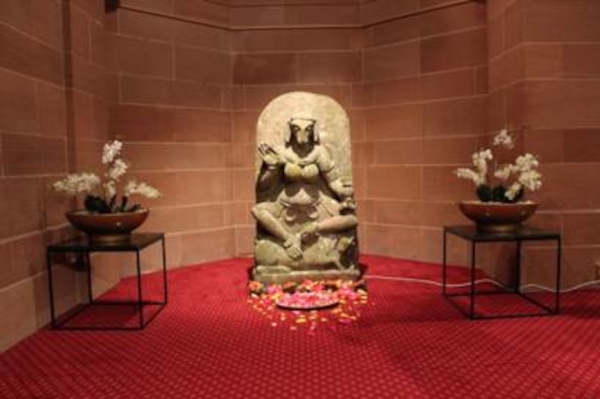
India has retrieved 662 antiquities from the United States, Australia, the United Kingdom and the Netherlands up to June 2026, as part of continuing efforts to bring back cultural objects that were illegally exported or removed from the country.
Union Minister for Culture and Tourism Gajendra Singh Shekhawat provided the figures in a written reply to the Rajya Sabha on August 13.
The United States accounts for the overwhelming majority of the retrieved antiquities, with 589 objects returned to India. Australia has accounted for another 51 antiquities, while 21 have been retrieved from the United Kingdom and one from the Netherlands.
United States Leads in Return of Indian Antiquities
According to the country-wise data placed before Parliament, the antiquities recovered up to June 2026 are:
- United States: 589
- Australia: 51
- United Kingdom: 21
- Netherlands: 1
Together, the four countries account for 662 retrieved antiquities.
The large number of objects returned from the United States reflects growing cooperation between Indian authorities and foreign governments, law-enforcement agencies, museums and cultural institutions in identifying and repatriating antiquities that were illegally taken out of India.
Many Indian antiquities entered foreign collections over several decades through illicit excavation, theft, smuggling or unauthorised export. Others left India during the colonial period under circumstances that are now being examined individually.
India Pursues Colonial-Era Objects Case by Case
The government told Parliament that it continues to raise the issue of retrieving objects taken abroad during the colonial period at appropriate international and bilateral forums.
However, such repatriation is not undertaken through a single blanket mechanism. Each object is examined separately while taking into account relevant Indian laws, the laws of the country where the object is located and applicable international conventions.
Retrieval is therefore dependent on documentation, provenance, legal evidence and cooperation between the governments concerned.
The government said the process is facilitated through mutual understanding and cooperation between countries, allowing individual cases to be pursued through diplomatic and institutional channels.
Indian Missions Help Track Illegally Exported Objects
Indian sculptures, idols, manuscripts and other antiquities are held by museums, galleries and private collectors across the world. However, the government said that no comprehensive inventory exists of all Indian antiquities currently held overseas.
This presents a major challenge because many objects have passed through several dealers, auction houses and private collections before entering museums or being identified by investigators.
Whenever authorities receive information about an illegally exported antiquity of Indian origin on foreign soil, action is initiated through the Indian Embassy or High Commission concerned.
Indian diplomatic missions can then coordinate with local governments, law-enforcement agencies, museums and other institutions to establish the provenance of the object and facilitate its return where appropriate.
Repatriation Becomes Major Cultural Heritage Effort
The recovery of antiquities has become an increasingly important component of India’s cultural diplomacy.
Beyond their monetary value, many of the retrieved objects are connected with temples, archaeological sites and religious or artistic traditions that developed over centuries across the Indian subcontinent. Their return therefore restores cultural material to the communities and historical landscapes from which it originated.
India’s effort also reflects a wider international reassessment of the ownership and provenance of cultural objects held in museums and private collections, particularly those linked to colonial extraction, illicit excavation and antiquities trafficking.
The government’s latest figures show that cooperation with foreign countries is already producing substantial results, with more than 89% of the 662 antiquities listed in the parliamentary reply having been retrieved from the United States alone.
As provenance research, diplomatic cooperation and international scrutiny of the antiquities trade increase, India is expected to continue pursuing identified objects overseas on a case-by-case basis.
Source: Ministry of Culture, Government of India / Press Information Bureau, Rajya Sabha written reply, “Retrieval of Stolen Antiquities,” August 13, 2026.
You may also like
-
ASI’s Kashipur Archaeological Site Reveals Ancient Govisana, Gupta-Era Temples and Mahabharata Traditions
-
Indian Navy’s First Training Squadron Arrives in Maldives, Strengthening Maritime Defence Cooperation
-
Parasika in the Mahabharata: Tracing the Persian Lands Through Modern Iran
-
India and Uzbekistan Strengthen Counter-Terrorism Cooperation, Focus on Terror Financing and Regional Security
-
India and Poland Target Doubling Bilateral Trade by 2030, Expand Defence and Technology Cooperation
