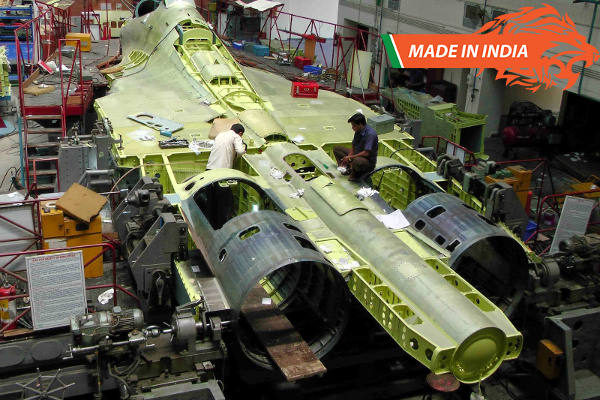
The development is important not merely because another dozen Sukhois are being added to the IAF. It restores active manufacturing capability for the service’s largest heavy-fighter fleet at a time when India is simultaneously attempting to increase fighter production, modernise the existing Su-30MKI fleet and strengthen the domestic aerospace supply chain.
The Ministry of Defence signed the contract with HAL on December 12, 2024, for 12 Su-30MKI aircraft along with associated equipment at an estimated value of ₹13,500 crore, inclusive of taxes and duties. Significantly, the government stated that the aircraft would contain 62.6 per cent indigenous content, reflecting the progressive localisation of components that has taken place over more than two decades of Su-30MKI manufacturing in India. The aircraft will be built at HAL’s Nashik division.
Nashik’s Sukhoi Line Returns to Aircraft Production
HAL’s Nashik complex at Ojhar has played a central role in India’s fighter-aircraft manufacturing history. Established in 1964 for licensed manufacture of the MiG-21FL, the facility subsequently produced different MiG variants, including the MiG-21M, MiG-21bis and MiG-27M, before becoming the principal Indian manufacturing centre for the Su-30MKI. HAL continues to support the Sukhoi fleet through spares, repairs, modifications and overhaul activities at Nashik.
The earlier Su-30MKI manufacturing programme was enormous by Indian aerospace standards. HAL ultimately completed licensed production of 222 Su-30MKIs for the IAF under agreements involving transfer of technology and progressively deeper manufacturing in India. The final aircraft from that production run were completed around 2020-21, after which Nashik increasingly concentrated on overhaul, fleet support and other aerospace programmes.
The latest order therefore represents a genuine reopening of new-build Su-30MKI production rather than simply continuation of maintenance work on existing aircraft.
According to reports in August 2026, HAL is now bringing the manufacturing process back into operation and intends to complete the 12-aircraft programme by 2029.
More Indian Than the Sukhois That Came Before
One of the most important aspects of the revived production run is that these aircraft will emerge from a far more mature Indian industrial ecosystem than existed when the Su-30MKI programme began.
The Su-30MKI itself is unusual among Russian-origin fighters because the Indian version evolved into a multinational and increasingly Indianised platform. Its configuration incorporates Russian airframe and propulsion technologies alongside Indian, French and Israeli avionics and systems, while successive Indian programmes have integrated indigenous weapons and equipment.
HAL officials have previously stated that the Indian Su-30 programme accumulated around 100 modifications, with the integration of the air-launched BrahMos supersonic cruise missile representing one of the most complex modifications undertaken on the aircraft.
The new government’s figure of 62.6 per cent indigenous content for the latest 12 aircraft is consequently significant. It means the renewed production line is not simply assembling aircraft from imported kits. A substantial part of the aircraft’s manufacturing value will pass through HAL and the wider Indian defence-industrial ecosystem.
This industrial base has strategic value beyond the 12 aircraft themselves. Maintaining the ability to manufacture structures, components and systems for the Su-30MKI gives India greater control over the sustainment of a fighter fleet that will remain operational for decades.
The Engine Ecosystem Is Being Sustained Separately
India has also taken a major step to secure the propulsion requirements of the Su-30MKI fleet.
In September 2024, the Ministry of Defence signed a separate contract worth more than ₹26,000 crore with HAL for the manufacture of 240 AL-31FP engines for the Su-30MKI. These engines are being produced at HAL’s Koraput division, with HAL scheduled to supply 30 engines annually and complete the programme over eight years.
The engine programme is particularly important because the Su-30MKI is a twin-engine fighter and maintaining a large fleet over several decades creates substantial requirements for replacement engines and overhaul.
HAL expects indigenous content in the AL-31FP programme to rise to around 63 per cent by the end of the production run, while the government expects an average indigenous content of more than 54 per cent across the engine programme. Indian MSMEs and other public and private-sector manufacturers are also being incorporated into the supply chain.
Taken together, the restarted aircraft line at Nashik and the AL-31FP production programme at Koraput ensure that India retains significant industrial capability around both the airframe and propulsion system of its Sukhoi fleet.
Nashik Will Build Sukhois and Tejas
There is another interesting dimension to the revival.
Nashik is no longer exclusively a manufacturing centre for Russian-origin aircraft. HAL has established a Tejas production line at Nashik, and the first Tejas Mk1A produced at the facility completed its maiden flight in 2025.
This means the complex that once symbolised India’s dependence on licensed Soviet and Russian fighter production is evolving into a facility capable of supporting both the Su-30MKI and India’s indigenous Light Combat Aircraft programme.
For Indian aerospace manufacturing, this is an important transition. The industrial knowledge accumulated while producing MiGs and Sukhois is increasingly being carried into indigenous aircraft manufacturing rather than being allowed to disappear when a foreign-origin production programme ends.
The revived Sukhoi order therefore keeps experienced personnel, specialised tooling and an established supplier network active while Nashik simultaneously expands its role in the Tejas programme.
Twelve Aircraft Are Only Part of a Much Larger Sukhoi Story
The importance of restarting the Su-30MKI line becomes clearer when viewed against the size and expected service life of the existing fleet.
The Su-30MKI remains one of the most strategically important combat aircraft operated by the Indian Air Force, and the Ministry of Defence itself has described the platform as one of the IAF’s most powerful and strategically significant fleets.
India’s challenge is therefore not merely to add aircraft but to ensure that the Sukhoi remains technologically relevant as air warfare moves towards AESA radars, longer-range air-to-air weapons, networked combat, sophisticated electronic warfare and increasingly contested navigation environments.
A substantial modernisation effort is already taking shape around the fleet. In May 2026, the IAF initiated procurement for an anti-jamming and anti-spoofing multi-constellation navigation antenna upgrade for the Su-30MKI, indicating that incremental improvements are proceeding alongside plans for deeper modernisation.
The Su-30MKI’s future in Indian service is therefore likely to involve three parallel tracks: manufacturing a limited number of additional aircraft, sustaining the larger existing fleet through domestically produced engines and spares, and progressively introducing Indian sensors, avionics, electronic warfare systems and weapons.
From Licensed Production to Strategic Industrial Capability
The revival of the Nashik Su-30MKI line also illustrates an important but sometimes overlooked aspect of defence indigenisation.
Licensed production is often criticised because the original aircraft design remains foreign. However, a long-running programme can create manufacturing infrastructure, trained engineers, precision-production capability, suppliers, maintenance expertise and systems-integration knowledge that subsequently becomes part of the domestic industrial base.
India’s Su-30MKI experience followed precisely such a trajectory. The aircraft began as a Russian platform tailored for Indian requirements, but India gradually acquired the ability to manufacture major portions of it, overhaul it domestically, modify its configuration and integrate Indian weapons.
The BrahMos integration is perhaps the clearest example. Converting a heavyweight air-superiority fighter into a platform capable of launching the air-launched BrahMos required substantial structural and systems engineering, demonstrating that India’s role had progressed considerably beyond basic assembly.
The new batch of 12 aircraft, with officially stated indigenous content exceeding 60 per cent, represents the next stage of that progression.
A Small Order With Larger Strategic Value
Twelve fighters will not by themselves transform the numerical strength of the Indian Air Force, but the significance of the programme extends well beyond the number of aircraft involved.
Restarting the production line preserves India’s capacity to manufacture one of the IAF’s most important combat platforms. It supports an established network of domestic suppliers, complements the large AL-31FP engine manufacturing programme and ensures that Nashik retains heavy-fighter manufacturing expertise while simultaneously becoming a production centre for the Tejas.
Most importantly, it keeps the Su-30MKI industrial ecosystem alive at the beginning of what could become the aircraft’s most important Indian transformation yet. As increasingly indigenous sensors, electronic warfare systems, navigation equipment and weapons are integrated into the fleet, the aircraft that entered Indian service as a Russian-designed fighter is steadily becoming a platform sustained, modified and increasingly equipped within India.
The revival of Su-30MKI production at Nashik is therefore not a return to the past. It is an attempt to preserve a proven heavy-fighter capability while India builds the industrial and technological bridge towards a more indigenous combat-aircraft fleet.
References
Ministry of Defence / Press Information Bureau: Contract for procurement of 12 Su-30MKI aircraft from HAL, December 12, 2024.
Ministry of Defence / Press Information Bureau: Contract for 240 AL-31FP engines for the Su-30MKI fleet, September 9, 2024.
Hindustan Aeronautics Limited: Aircraft Manufacturing Division, Nashik.
Economic Times: HAL revives Su-30MKI production at Nashik, August 10, 2026.
You may also like
-
Exercise Tarang Shakti 2026 Concludes in Jodhpur, Showcasing India’s Air Power, Indigenous Defence Technology
-
Indian Navy Vice Chief Inspects Japan’s Mogami-Class Stealth Frigate as India-Japan Shipbuilding Cooperation Expands
-
India and Russia Explore Joint Icebreaker Construction as Maritime Industrial Cooperation Expands
-
Philippine Marine Wargames Reportedly Show BrahMos Can Penetrate Chinese Destroyer Air Defences
-
Safran Signs 18 Agreements with Indian Aerospace Suppliers, Expanding Make in India Manufacturing Partnerships
