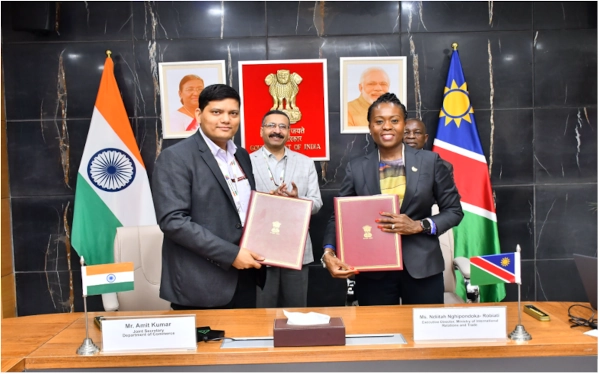
India and Namibia have agreed to deepen their economic partnership across trade, investment, healthcare, critical minerals, digital payments, energy and infrastructure as bilateral merchandise trade reached USD 592.94 million in 2025-26.
The decisions were taken during the Fourth Session of the India-Namibia Joint Trade Committee, held in New Delhi on August 10 and 11, 2026. The Indian delegation was led by Amit Kumar, Joint Secretary in the Department of Commerce, while the Namibian delegation was headed by Ndiitah Nghipondoka-Robiati, Executive Director in Namibia’s Ministry of International Relations and Trade. The agreed minutes of the meeting were signed by the two co-chairs on August 11.
The discussions reflected a broader effort by both countries to move their economic relationship beyond the conventional trade in raw materials and towards greater value addition, manufacturing, services and long-term investment cooperation. Both sides also agreed that future initiatives should be supported by clearly defined timelines and institutional mechanisms so that bilateral discussions translate into projects on the ground.
Bilateral Trade Continues to Expand
Merchandise trade between India and Namibia increased from USD 568.40 million in 2024-25 to USD 592.94 million in 2025-26. India exported goods worth USD 349.09 million to Namibia during the year, while imports stood at USD 243.85 million.
Trade in services has also been expanding, recording growth of 7.34 per cent to reach approximately USD 380 million in calendar year 2024.
Several Indian export sectors have registered particularly strong growth. Engineering exports to Namibia increased by 124.06 per cent to USD 30.24 million, driven substantially by motor vehicles and automotive components. Indian exports of pharmaceuticals and medical devices reached USD 36.50 million, with India emerging as Namibia’s second-largest source of pharmaceutical products, accounting for a 16.4 per cent market share.
New Investment and Services Mechanisms
To provide stronger institutional support for investors, Invest India and the Namibia Investment Promotion and Development Board have been designated as investment focal points under the Joint Trade Committee framework. Each country will nominate officials responsible for facilitating investment-related engagement and addressing issues faced by companies.
The two sides also agreed to establish a dedicated Services Working Group, which is expected to hold its first meeting no later than February 2027 and prepare a work programme for consideration by the Joint Trade Committee.
These arrangements are intended to create more regular interaction between businesses, policymakers and investment agencies while identifying opportunities beyond conventional merchandise trade.
Healthcare and Janaushadhi Cooperation
Healthcare emerged as another important area of cooperation. India and Namibia agreed that the first meeting of the Joint Working Group on Health and Medicine should be convened by December 2026.
Discussions are also progressing on cooperation under India’s Janaushadhi model of affordable medicines, with an agreement involving HLL Lifecare Limited described as being at an advanced stage of finalisation.
Given India’s position as an important supplier of pharmaceuticals to Namibia, such cooperation could expand access to affordable medicines while creating new opportunities for Indian pharmaceutical and healthcare companies in the southern African market.
Critical Minerals Emerge as a Strategic Area
One of the most significant areas identified during the meeting was cooperation in critical minerals, including lithium, graphite, copper, cobalt and rare earth elements.
Rather than limiting cooperation to mineral extraction and exports, India and Namibia discussed collaboration across the entire value chain, including exploration, long-term offtake arrangements, mineral processing and downstream beneficiation.
This approach aligns closely with Namibia’s objective of processing more of its mineral resources domestically, creating local employment and capturing a greater share of the value generated from its natural resources.
For India, closer mineral cooperation with Namibia could contribute to the diversification of supply chains for materials increasingly required by electric vehicles, renewable energy systems, electronics and advanced manufacturing.
Greater Cooperation in Diamonds and Jewellery
India and Namibia also identified new opportunities in the gems and jewellery sector. Namibia has been invited to participate in India’s Special Notified Zones in Surat and Mumbai, which facilitate the display and sourcing of rough diamonds by international mining companies.
Namibian companies were also invited to participate in the India Rough Gemstones Sourcing Show.
India offered cooperation in areas such as diamond cutting, polishing and jewellery design, potentially allowing Namibia to develop greater domestic value addition instead of exporting only unprocessed gemstones.
UPI-Based WayaMe Strengthens Digital Partnership
Digital financial cooperation has emerged as another important pillar of the relationship following the introduction of WayaMe, an instant payment platform in Namibia based on India’s Unified Payments Interface technology.
The system was unveiled in Namibia on June 15, 2026, demonstrating the growing international adoption of India’s digital public infrastructure model.
The two countries are now considering the establishment of a broader FinTech Cooperation Framework between the Reserve Bank of India and the Bank of Namibia, which could facilitate further collaboration in digital payments and financial technology.
Energy, Railways and Infrastructure Offer New Opportunities
India and Namibia also discussed cooperation in major infrastructure and energy sectors, including railways and rolling stock, solar and wind energy, battery storage systems, electricity transmission, green hydrogen, biofuels and desalination.
These sectors offer considerable scope for Indian companies with experience in infrastructure development and renewable energy projects while supporting Namibia’s efforts to expand electricity generation, transport networks and industrial capacity.
Cooperation was additionally explored in agriculture and food security, MSMEs, textiles, tourism and sports, giving the bilateral economic relationship a considerably wider base.
India-SACU Trade Agreement Moves Forward
An important development on the wider regional trade front was the finalisation of the Terms of Reference for negotiations on an India-Southern African Customs Union Preferential Trade Agreement.
The Terms of Reference were scheduled to be signed on August 12, 2026, following which negotiations are expected to begin within one month. The two sides have set an objective of concluding the negotiations within a year.
The Southern African Customs Union brings together Namibia, South Africa, Botswana, Lesotho and Eswatini, meaning a preferential agreement could provide Indian companies with improved access to a wider southern African market while creating additional opportunities for African exporters in India.
India-Namibia Economic Partnership Enters a Broader Phase
The Fourth Joint Trade Committee meeting indicates that India-Namibia economic engagement is gradually evolving from a relatively modest trading relationship into a more diversified partnership covering manufacturing, minerals, healthcare, digital technology, energy, infrastructure and investment.
The emphasis on local value addition in Namibia is particularly significant. Rather than viewing the country simply as a source of minerals and raw materials, the emerging framework seeks to combine Namibia’s natural-resource strengths with India’s capabilities in manufacturing, technology, pharmaceuticals, infrastructure and skills development.
The Fifth Session of the India-Namibia Joint Trade Committee is scheduled to be held in Namibia in 2028, providing the two countries with a formal mechanism to assess progress on the commitments made in New Delhi and expand cooperation further.
Source: PIB: https://www.pib.gov.in/PressReleasePage.aspx?PRID=2297913®=48&lang=1
You may also like
-
India’s Economic Warfare Challenge: Strategic Autonomy, Energy Security and the Rise of a Global Power
-
India-US Trade Deal Stalemate: Why Washington’s Tariff Pressure Has Failed to Secure an Agreement
-
US Double Standards in Foreign Policy: 16 Recent Cases Involving India, Russia, China and Global Trade
-
India’s Arctic Energy Ambitions: Russian Oil, LNG and a New Sea Route to Indian Ports
-
Indian Navy Vice Chief Inspects Japan’s Mogami-Class Stealth Frigate as India-Japan Shipbuilding Cooperation Expands
