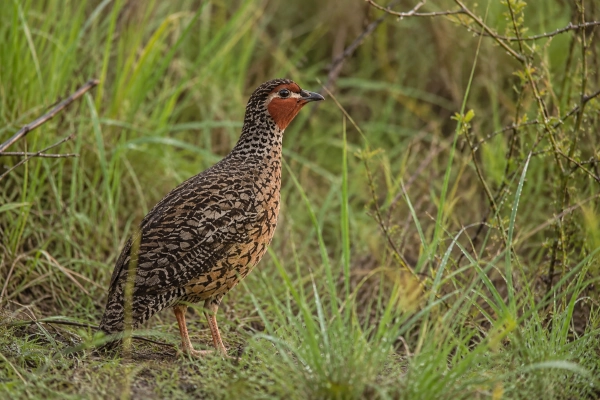
Among the least-known birds of the Indian subcontinent is the Manipur Bush-quail (Perdicula manipurensis), a small ground-dwelling bird associated with the damp grasslands, tall scrub and foothill plains of Northeast India.
Despite carrying the name of Manipur, the species has historically been associated with a wider belt extending through parts of Manipur, Assam and the adjoining northeastern grassland landscape. Its extremely secretive habits, combined with massive losses of its original grassland habitat, have made it one of the most difficult Indian birds to study.
The latest State of India’s Birds assessment lists the Manipur Bush-quail as a High Conservation Priority species, while its current global Red List category is Critically Endangered. It is also protected under Schedule I of India’s Wild Life (Protection) Act, giving it the highest level of statutory protection available to Indian birds.
What makes the species particularly remarkable is how little is still known about it. For decades it virtually disappeared from ornithological records, before an extraordinary sighting in Assam in 2006 suggested that at least some birds had survived in the tall grasslands of the Brahmaputra region.
Scientific Classification
Common name: Manipur Bush-quail
Scientific name: Perdicula manipurensis
Family: Phasianidae
Order: Galliformes
Genus: Perdicula
Principal historical Indian range: Manipur, Assam and adjoining northeastern grassland country
Habitat: Damp tall grassland, scrub and foothill grassland
Conservation status: Critically Endangered
Wild Life (Protection) Act: Schedule I
The Manipur Bush-quail belongs to the same broad family as pheasants, partridges and other quails.
Yet compared with many better-known members of the family, Perdicula manipurensis remains extraordinarily mysterious.
A Tiny Bird Hidden in Tall Grass
The Manipur Bush-quail measures only around 20 centimetres in length and spends most of its life concealed at ground level.
Its plumage is ideally suited to this existence.
The upperparts are generally olive-grey or dark grey with black bars and markings, producing excellent camouflage against dead grass, soil and shaded vegetation.
The male is particularly distinctive when seen well. The forehead, sides of the face, chin and throat have rich rufous or chestnut colouring, while a narrow pale line passes near the eye. The neck and upper breast are greyish with dark spotting, and the lower parts become more buff or rufous.
Females are considerably duller, with the rich reddish facial colouring largely replaced by paler grey-buff tones.
eBird similarly describes the bird as a small, dark-grey quail with a short white eye-stripe, black-scaled upperparts and heavily spotted yellowish-brown underparts.
The difference between the brightly marked male and more subdued female probably helps conceal females particularly effectively when nesting or moving through grass.
More Often Heard—or Flushed—Than Seen
The Manipur Bush-quail is not a bird that normally sits conspicuously on an exposed branch.
It spends its time walking and feeding beneath grass and scrub.
Historically it was reported moving in small groups or coveys, commonly numbering around five to ten individuals. The India Biodiversity Portal records groups of approximately six to eight, while eBird notes historical groups of five to ten birds.
When disturbed, bush-quails tend to remain concealed until danger approaches closely.
They may then explode suddenly from the grass in a rapid, low flight before dropping back into vegetation.
This behaviour creates one of the great problems in studying the species.
A bird can occupy an area of dense grassland without ever providing an observer with a prolonged view.
Even experienced ornithologists may obtain only a few seconds in which to identify it.
Damp Grasslands Rather Than Dense Forest
The Manipur Bush-quail is fundamentally a grassland bird.
Historical descriptions associate it particularly with damp grasslands, tall grass and scrub, extending from lowland plains into foothill areas.
The India Biodiversity Portal describes the species as inhabiting damp grassland from the foothills to approximately 1,000 metres elevation.
This habitat preference is important because Northeast India is often imagined primarily as a region of dense evergreen forest.
Yet its natural ecosystems also include extensive grasslands, floodplains, marshes and savannah-like landscapes.
Assam’s Forest Department notes that grasslands and savannahs form major components of several protected landscapes, including Kaziranga, Orang, Pobitora, Manas and other reserves, with tall grasses in some areas reaching several metres during the monsoon.
It is this tall, structurally complex grassland environment that historically provided suitable cover for specialised birds such as the Manipur Bush-quail.
Manipur Gave the Bird Its Name
The species was scientifically described by the British Indian ornithologist Allan Octavian Hume in 1881.
Its type locality was recorded around the base of the hills in southeastern Manipur, explaining both the scientific name manipurensis and the English name Manipur Bush-quail.
Historical taxonomy recognises two forms.
The nominate Perdicula manipurensis manipurensis was associated primarily with the Manipur Valley.
A second form, Perdicula manipurensis inglisi, was described from Goalpara in Assam and historically occurred in grasslands extending through Assam and adjoining northeastern Bengal.
These historic populations illustrate how the bird once occupied separated pockets of suitable grassland rather than one continuous forest range.
Assam Was Another Important Stronghold
The species’ association with Assam is as important as its connection with Manipur.
Historical records came from the grasslands of the Brahmaputra region and adjoining foothills.
The Assam form, P. m. inglisi, was described from Goalpara in 1909 based on material collected slightly earlier.
Older records indicate that suitable habitat once extended across substantially larger areas of Assam than survive today.
Many of these landscapes were subsequently converted to tea estates, agriculture, settlements or other land uses.
During BirdLife’s reassessment of the species, ornithologist Anwaruddin Choudhury specifically noted that several former collection localities had already lost their original grasslands decades ago.
That disappearance of habitat is probably central to understanding why a bird once known to naturalists became almost impossible to find.
Then the Bird Virtually Vanished
For much of the twentieth century, confirmed records became extraordinarily scarce.
The State of India’s Birds assessment cannot calculate either a meaningful long-term or current population trend because there is simply insufficient modern data.
Historical specimen evidence is similarly sparse.
Modern reviews have questioned some twentieth-century reports and emphasised how few observations can be independently verified.
For decades, it was uncertain whether a viable population survived at all.
Then came one of the most intriguing bird sightings in modern Assam.
The Extraordinary 2006 Manas Sighting
On June 6, 2006, noted ornithologist Anwaruddin Choudhury was travelling through Manas National Park in Assam during the monsoon.
Because access to sections of Manas becomes extremely difficult at that time of year, the visit provided an unusual opportunity to enter tall, heavily overgrown grassland.
During the journey, a quail suddenly flushed from the vegetation.
The bird flew ahead of the vehicle for approximately 15 metres before dropping into the grass.
Choudhury observed it again and identified it as a Manipur Bush-quail.
The observation was reported as the first confirmed sighting of the species for more than 70 years.
The discovery was remarkable because it showed that at least one population had apparently survived unnoticed within Assam’s tall grasslands.
Manas consequently became central to discussions about the species’ continued survival.
But the Mystery Returned
The 2006 sighting did not suddenly produce a series of well-documented populations.
Instead, the Manipur Bush-quail again became extraordinarily difficult to confirm.
A recent conservation initiative describes the Manas observation as the most recent widely acknowledged record, while noting that subsequent reports have generally lacked convincing photographic or other verification.
That creates an unusual conservation problem.
The species is not merely rare.
Scientists do not even have a reliable estimate of precisely where surviving birds remain.
This uncertainty was one of the factors behind the recent move to place the species in the Critically Endangered category.
BirdLife’s 2024 Red List consultation concluded that the probable population was extremely small and recommended listing the species as Critically Endangered under Criterion D, which applies to species with very small populations.
The current State of India’s Birds profile now reflects that Critically Endangered global status.
Why Grassland Loss Is So Dangerous
The Manipur Bush-quail demonstrates one of the biggest problems facing Indian grassland wildlife.
Grasslands have historically been treated far less sympathetically than forests.
Open landscapes are sometimes labelled degraded or wasteland even when they represent ecologically valuable natural ecosystems.
Once converted to plantation, farmland, settlement or infrastructure, the habitat structure required by grassland specialists can disappear completely.
For the Manipur Bush-quail, this means losing the dense mixture of tall grasses, damp ground and scrub cover in which it feeds, hides and presumably breeds.
A landscape can remain green while becoming useless to the bird.
Tea gardens, intensive agriculture and tree plantations may all appear vegetated from a distance but cannot necessarily replace natural grassland.
This distinction is crucial for conservation.
Assam’s Remaining Grasslands May Hold the Key
Modern search efforts therefore concentrate heavily on Assam’s remaining lowland and foothill grasslands.
One current conservation programme involving the Bird Conservation Fund, Aaranyak and the Search for Lost Birds initiative has targeted grasslands and scrub in districts including Kokrajhar, Chirang, Baksa and Udalguri, areas associated with the species’ historic distribution.
The aim is straightforward but scientifically important:
Does the Manipur Bush-quail still survive outside the better-known protected grasslands?
Surveys are particularly valuable because many potentially suitable sites lie outside national parks and wildlife sanctuaries.
A previously unknown population in such a location could fundamentally alter conservation priorities.
It could also require immediate protection if the grassland faced development or conversion.
A Bird That Exposes the Limits of Modern Birdwatching
The Manipur Bush-quail presents an interesting paradox.
India today has far more birdwatchers, cameras, mobile phones, recording equipment and digital databases than at any time in history.
Yet this species remains almost undocumented.
That tells us something important about wildlife detection.
An animal can be extraordinarily difficult to find even in the twenty-first century if it is:
small, ground-dwelling, secretive, locally distributed and restricted to dense vegetation.
Grassland birds pose particular challenges because they can run through vegetation without taking flight.
A bird may therefore remain only metres from observers while being completely invisible.
Little Is Known About Its Breeding Biology
The scarcity of modern observations means that the breeding ecology of the Manipur Bush-quail remains poorly understood.
Older accounts suggest that, like other bush-quails, it nests on or near the ground within dense vegetation.
But there is far less detailed information about its breeding cycle, clutch size, chick survival or territory requirements than exists for common Indian quails.
This lack of knowledge makes conservation more difficult.
Managing grassland requires decisions about:
when to burn,
when to cut,
how intensively livestock should graze,
which patches should remain undisturbed,
and how vegetation should be allowed to regenerate.
Without understanding when the birds breed or which vegetation stages they prefer, poorly timed management could unintentionally destroy nests or remove essential cover.
Grassland Fire Is Both Natural and Dangerous
Tall Indian grasslands frequently experience fire.
Some burning is part of traditional and ecological management because old grass accumulates rapidly, and new growth can follow after burning.
But timing and intensity matter.
A carefully controlled seasonal burn can maintain a mosaic of young and mature grass.
Large uncontrolled fires during breeding periods can destroy nests, chicks and refuge areas.
For a widespread species, such losses may be temporary.
For a bird potentially surviving in only a handful of tiny populations, even one badly timed event could be serious.
The conservation objective should therefore not simply be to prevent all fire or permit unrestricted burning.
It should be to understand the ecological requirements of the grassland and manage it accordingly.
Hunting May Have Added Historical Pressure
Bush-quails are members of the gamebird family and historically were vulnerable to trapping and hunting.
For an abundant species, moderate hunting might not necessarily cause extinction.
But once habitat fragmentation reduces a population to a few isolated groups, additional mortality becomes much more damaging.
The Manipur Bush-quail’s modern Schedule I protection is therefore significant.
The species now receives India’s highest legal protection, reflecting how precarious its status has become.
The greater contemporary threat, however, appears to be the simple disappearance or degradation of its specialised grassland habitat.
Not Just a Manipur Conservation Story
The bird’s name can sometimes create the impression that conservation responsibility belongs primarily to Manipur.
The evidence suggests otherwise.
The species should be viewed as part of the broader grassland heritage of Northeast India, particularly the Assam-Manipur landscape.
The latest State of India’s Birds profile characterises its endemicity as the Assam Plains ecological region rather than treating it merely as a political-state endemic.
This makes cross-state conservation important.
Protecting habitat in Manipur while allowing historically suitable grasslands in Assam to disappear would not be sufficient.
The bird’s survival must be considered at the scale of the ecosystem in which it evolved.
A Flagship for Northeast India’s Forgotten Grasslands
Large charismatic animals usually dominate conservation attention in Assam.
The Brahmaputra grasslands are famous for the greater one-horned rhinoceros, Asian elephant, wild water buffalo and Bengal tiger.
Yet the same landscapes support specialised birds whose entire survival may depend upon maintaining grassland structure.
The Manipur Bush-quail could become a flagship for these less conspicuous species.
Protecting suitable habitat for it would simultaneously benefit many other grassland organisms—birds, reptiles, small mammals, insects and plants that receive far less public attention.
In this sense, conserving one tiny quail can help conserve an entire ecosystem.
A Bird That India Cannot Afford to Lose Unnoticed
The Manipur Bush-quail represents a particularly unsettling form of extinction risk.
Some endangered species remain visible enough for conservationists to count them every year.
This bird is different.
Its population could decline dramatically without anyone witnessing the process.
Its habitat can disappear one grassland patch at a time, and the bird concealed within it may vanish with barely a record.
The species has already demonstrated one extraordinary capacity for survival.
After decades without convincing observations, a Manipur Bush-quail suddenly emerged from the tall grass of Manas National Park in 2006, flew briefly before an ornithologist and disappeared again into the vegetation.
Twenty years later, that fleeting encounter remains enormously important.
It means that the bird survived longer than scientists once feared.
Whether substantial populations still persist today is the question conservationists must now answer.
For India, protecting the Manipur Bush-quail ultimately means recognising something larger: the tall, damp grasslands of Manipur and Assam are not empty spaces waiting to be converted. They are complex natural ecosystems containing species found almost nowhere else.
Hidden somewhere within those grasses may still be one of India’s rarest birds.
Finding it again would be remarkable.
Ensuring that there is still enough grassland left for it to survive would be far more important.
You may also like
-
Chhattisgarh Plans Innovative Tree Surgery to Save Over 500 Damaged Trees in Udanti Sitanadi Tiger Reserve
-
Kerala’s Peechi Wildlife Survey Records 395 Species, Adds 36 New Entries to Biodiversity Checklists
-
Tiger Returns to Maharashtra’s Beed Forests After Nearly 100 Years, Highlights Importance of Wildlife Corridors
-
Himachal Pradesh Achieves Major Success in Rare Cheer Pheasant Conservation
-
Blackbucks to Return to Chhattisgarh’s Gomarda Wildlife Sanctuary After Five Decades
