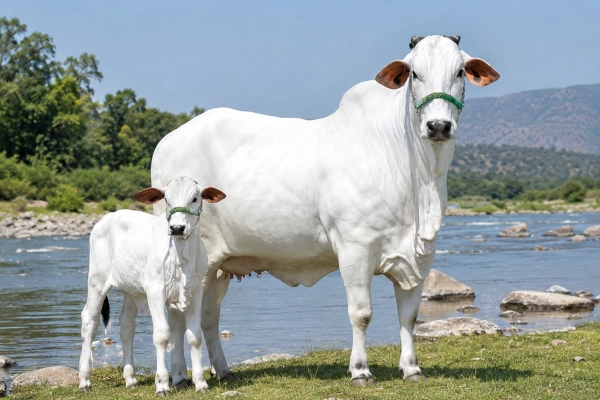
Among India’s indigenous cattle, the Tharparkar stands out for an unusual combination of milk production, physical endurance and adaptation to some of the harshest climatic conditions encountered by livestock.
Closely associated with the Thar Desert and the arid districts of western Rajasthan, Tharparkar cattle have been shaped by generations of survival under intense summer heat, limited rainfall, seasonal fodder shortages and long periods of dry weather. Their ability to continue producing milk under such conditions has made the breed an important genetic resource for Indian dairying, particularly as heat stress and water scarcity become increasingly important challenges.
There is also an interesting historical dimension to the breed’s name. Tharparkar takes its name from Tharparkar district in Sindh, now in Pakistan, which formed part of undivided India, while its recognised breeding tract in present-day India includes Barmer, Jaisalmer and Jodhpur in Rajasthan and Kutch in Gujarat.
A Cattle Breed Forged by the Thar Desert
The Thar is an unforgiving environment for livestock.
Summer temperatures can become extreme, vegetation is highly seasonal and farmers frequently have to manage cattle on relatively limited fodder and water resources. Animals that could not tolerate these conditions were naturally less likely to survive and reproduce successfully.
Over generations, this environmental pressure combined with farmer selection produced cattle exceptionally suited to the hot and dry landscape.
Research on indigenous cattle maintained in Rajasthan’s Thar region identifies Tharparkar, Rathi and Sahiwal among important cattle populations capable of functioning under harsh desert climatic conditions.
A separate study of Tharparkar cattle maintained in the arid region of Rajasthan found that first-lactation performance remained comparatively stable across environmental periods and seasons. The researchers suggested that this reflected the breed’s adaptation to Rajasthan’s arid environment.
This ability to remain productive in difficult conditions is one of the Tharparkar’s defining characteristics.
The Distinctive White-Grey Cattle of Western India
Tharparkar cattle are predominantly white or light grey, giving herds an unmistakable appearance against the ochre and sandy landscape of western Rajasthan.
The Department of Animal Husbandry and Dairying describes the breed as having a white or light-grey body, with the face and extremities tending to be darker. Bulls can develop considerably darker colouring around the neck, hump, forequarters and hindquarters.
The forehead is characteristically convex, while the horns are set relatively widely apart before growing upward and outward and finally turning inward towards their blunt tips.
The animals are generally medium-sized and compact rather than extremely massive.
Their physical appearance reflects the functional nature of the breed. These are cattle developed to travel, graze and survive in a landscape where animals historically could not depend upon permanently lush pastures or intensive stall feeding.
A Genuine Dual-Purpose Indigenous Breed
Tharparkar is classified as a milk-and-draught breed, although the dairy ability of its cows has become its most important characteristic in modern livestock production.
Traditionally, this dual purpose was highly valuable.
The cow provided milk for the farming household and local market, while males could be used for agricultural work and transport.
In the pre-mechanised rural economy, this combination greatly increased the usefulness of an indigenous cattle breed.
A farmer did not merely maintain a dairy animal. The same breeding population could supply milk, draught power, manure and replacement animals for the agricultural system.
That economic environment explains why many of India’s great indigenous breeds developed as multifunctional livestock rather than highly specialised dairy animals.
How Much Milk Does a Tharparkar Cow Produce?
The National Dairy Development Board records an average lactation yield of around 1,749 kg for Tharparkar cattle, with a reported range of approximately 913 to 2,147 kg per lactation.
Actual production varies substantially according to genetics, nutrition, management and the production system.
Research on Tharparkar cattle maintained at the Livestock Research Station at Beechwal in Bikaner found an average 305-day first-lactation milk yield of about 2,003.5 kg among the animals studied.
These figures should not be directly interpreted as the breed’s maximum potential. Superior individuals selected scientifically and maintained under good feeding and health management can perform considerably better than population averages.
The important characteristic of the Tharparkar is not simply its absolute milk yield.
It is its ability to combine useful dairy production with adaptation to a hot, arid environment.
Built to Handle Heat
Heat tolerance is becoming one of the most important characteristics in modern cattle breeding.
High environmental temperatures place considerable physiological stress on dairy animals. Cattle respond by increasing respiration, altering blood flow and changing their feeding and water-consumption behaviour. Severe heat stress can ultimately reduce milk production, reproductive efficiency and overall health.
Indigenous Bos indicus breeds have important advantages under such conditions.
An ICAR-linked study comparing Tharparkar calves with Karan Fries cattle under thermal stress found that the crossbred animals exhibited greater changes in several physiological and hormonal indicators. The researchers concluded that Tharparkar animals demonstrated greater thermotolerance under the experimental conditions.
Another study comparing indigenous zebu cattle, including Tharparkar, with Karan Fries animals found physiological differences consistent with better adaptation of indigenous zebu cattle during heat stress.
This characteristic gives Tharparkar genetics potential importance far beyond Rajasthan.
Surviving When Fodder Is Scarce
The desert does not provide a uniform supply of green fodder throughout the year.
Consequently, successful livestock production in western Rajasthan has historically depended upon animals capable of coping with highly variable feed availability.
NDDB notes more generally that India’s indigenous cattle have evolved under local agro-climatic conditions and can survive and produce using relatively marginal feed and fodder resources compared with many specialised exotic breeds.
This does not mean Tharparkar cattle can produce large quantities of milk without adequate nutrition.
Better feeding still produces better results.
ICAR’s Central Arid Zone Research Institute, for instance, reported that feeding trials involving fodder beet produced an 8–10% improvement in milk yield in Tharparkar cattle.
The lesson is important: environmental hardiness protects the animal under difficult conditions, while good nutrition allows its genetic potential to be expressed more fully.
The Bullock’s Traditional Role
Before tractors became common across Rajasthan, Tharparkar males had an important second function.
The breed’s bullocks were used for ploughing and other agricultural work, making Tharparkar a classic example of India’s dual-purpose cattle system. Agricultural breed descriptions have traditionally recognised Tharparkar bullocks as suitable working animals in addition to the milk-producing value of the cows.
Mechanisation dramatically reduced this role.
Tractors replaced bullocks for much of the heavy field work, while trucks and tractors replaced cattle carts for transport.
As with Hariana and several other dual-purpose Indian cattle breeds, this changed the economics of maintaining male animals.
The breed’s future consequently rests increasingly upon dairy production, genetic improvement and the value of its environmental adaptation.
Scientific Conservation of Tharparkar Genetics
India now maintains Tharparkar as an officially recognised indigenous cattle breed, with Rajasthan identified by ICAR-NBAGR as its principal Indian home tract.
Its genetic material is also being preserved systematically.
Tharparkar is among the cattle breeds whose semen has been cryopreserved in the National Livestock Gene Bank, providing a long-term genetic safeguard against erosion of valuable indigenous germplasm.
ICAR-NBAGR has additionally cryopreserved somatic cells from Tharparkar cattle as part of its programme to conserve India’s livestock genetic resources.
This represents a modern form of conservation very different from simply maintaining a few animals in cattle farms.
Semen, cells and well-documented breeding populations collectively allow valuable genetics to remain available for future breeding and research.
Improving the Breed Without Losing Its Identity
Scientific breeding programmes are also attempting to increase productivity within indigenous populations.
Under the National Dairy Plan, Tharparkar was one of the indigenous breeds selected for pedigree-selection programmes aimed at producing high-genetic-merit bulls.
ICAR’s Central Arid Zone Research Institute at Jodhpur has likewise maintained a substantial Tharparkar research and demonstration herd and supported farmers engaged in breed improvement and conservation in Rajasthan.
More advanced reproductive technologies are now entering the picture as well.
ICAR-IVRI has been working on ovum pick-up, in-vitro fertilisation and embryo-transfer technologies involving indigenous breeds including Tharparkar, potentially allowing valuable genetics from superior females to be multiplied much more rapidly than through conventional reproduction alone.
The objective is not to turn Tharparkar into an exotic high-input breed.
It is to identify the best animals within the breed and increase productivity while retaining the qualities that make Tharparkar distinctive.
A Breed Increasingly Relevant to Climate-Resilient Dairying
The characteristics that developed in the desert may become increasingly valuable elsewhere.
Dairy production around the world faces growing challenges from heat stress. Animals bred primarily for high production in temperate climates can require considerable cooling, high-quality feed and carefully controlled management when maintained in tropical environments.
Tharparkar represents a different biological strategy.
Its value lies in balancing reasonable milk production with heat tolerance and adaptation to demanding environments.
That combination makes indigenous genetics relevant to discussions about climate-resilient livestock farming.
The Tharparkar’s genetic contribution can already be seen in the Karan Fries, a dairy cross developed using Tharparkar and Holstein Friesian ancestry. Research comparing the cross with indigenous animals also illustrates the complex relationship between greater exotic inheritance, milk production and heat tolerance.
A Living Heritage of the Indian Desert
Tharparkar cattle ultimately represent more than milk statistics.
They are the biological product of a landscape.
For generations, farmers maintained these white and silver-grey cattle across a region of blazing summers, scarce rainfall and fluctuating forage availability. Animals that survived, reproduced and remained productive passed their characteristics to succeeding generations.
The result is a breed particularly suited to the ecology of India’s western drylands.
Modern breeding science now offers the opportunity to improve milk production without discarding this inheritance.
For Rajasthan, the Tharparkar remains part of the livestock heritage of the desert. For India as a whole, it represents something increasingly valuable: an indigenous dairy genetic resource capable of remaining productive where heat, dryness and limited resources make cattle farming particularly demanding.
In an era when livestock agriculture must simultaneously pursue productivity and climate resilience, the qualities developed in the Thar over generations may prove more relevant than ever.
References:
- National Dairy Development Board (NDDB) – Tharparkar Cattle Breed Profile
https://www.nddb.coop/farmer/animal-breeding/breeds/cattle/tharparkar - National Bureau of Animal Genetic Resources (ICAR-NBAGR) – Indigenous Cattle Breeds of India
https://nbagr.res.in/cattle-breed - Department of Animal Husbandry and Dairying, Government of India – Tharparkar Cattle Breed
https://dahd.gov.in/hi/pashupedia-cattle-breed - Tamil Nadu Agricultural University – Indigenous Cattle Breeds: Tharparkar
https://agritech.tnau.ac.in/animal_husbandry/animhus_cattle%20_breed_indigenous.html - Indian Council of Agricultural Research – Indian Journal of Dairy Science: Studies on Tharparkar Cattle Performance in Arid Rajasthan
https://epubs.icar.org.in/index.php/IJDS/article/view/121556 - Indian Council of Agricultural Research – Research on Thermal Tolerance of Tharparkar Cattle
https://epubs.icar.org.in/index.php/IJDS/article/view/55675 - Indian Council of Agricultural Research – Comparative Heat-Stress Adaptation of Indigenous Zebu and Crossbred Cattle
https://epubs.icar.org.in/index.php/IJDS/article/view/58951 - ICAR – Central Arid Zone Research Institute: Tharparkar Cattle and Fodder Management
https://icar.gov.in/hi/node/5626 - National Dairy Development Board – High Genetic Merit Bull Production and Pedigree Selection Programmes
https://www.nddb.coop/ndpi/focus/merit - ICAR-NBAGR – National Livestock Gene Bank
https://nbagr.res.in/gene-bank - ICAR-NBAGR – Conservation of Somatic Cells of Indigenous Livestock Breeds
https://nbagr.res.in/node/106 - ICAR – Central Arid Zone Research Institute: Tharparkar Breed Conservation and Improvement
https://www.icar.gov.in/hi/node/20074 - ICAR-IVRI – Advanced Reproductive Technologies for Indigenous Cattle Breeds
https://icar.gov.in/en/leap-forward-indigenous-breeding-icar-ivris-breakthrough-producing-sahiwal-calves-through-advanced
You may also like
-
Satpura Tiger Reserve’s Barasingha Population Crosses 300 as Madhya Pradesh Plans New Wildlife Corridors
-
Karnataka’s Tiger Population Could Cross 700 as New Census Builds on Official Count of 563
-
Project Cheetah Expands as Veerangana Durgavati Tiger Reserve Becomes Madhya Pradesh’s Third Cheetah Habitat
-
Kashmir Markhor Population Rises to 227 as Kazinag Conservation Efforts Show Results
-
ICAR-CIFRI Pushes Conservation of Indigenous Himalayan Fish for Biodiversity and Livelihood Security
