Money has meaning because of personal differences.Art has meaning because of personal commonality.
The fundamental restructuring of society has begun. Historically, “Human Resources”—the unique capacity of an organization to employ and compensate individuals—relied strictly on human intellectual, muscular, and physical skills. Today, Artificial Intelligence has emerged as our collective swarm intelligence, and advanced robotic systems are poised to outpace human performance and productivity. Because of this, the very value of exchange and currency must be reconsidered from its foundational roots.
Currency is the breath of society—a medium through which human needs, labor, resources, and aspirations circulate. Yet, the true purpose of any urban settlement is not merely economic exchange; it is raw human survival. The primary function of a city must be to ensure that the fundamental conditions for human existence are universally accessible.
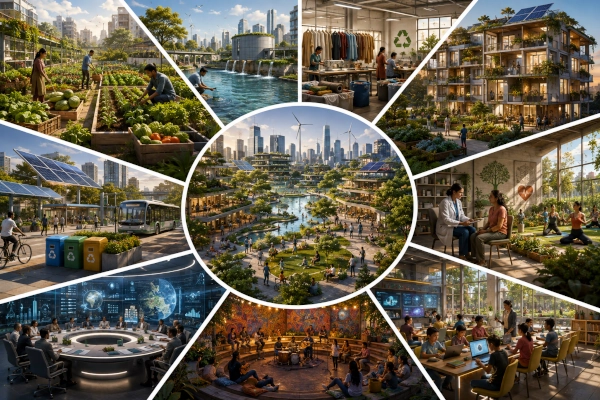
Periods of profound technological and economic disruption have historically produced displacement, inequality, social fragmentation and, in their darkest manifestations, violent exclusion. The challenge before us is to ensure that the transition created by AI and automation follows a different path — one in which urban design absorbs disruption rather than allowing large populations to become economically superfluous. This time, through intentional urban design, we can do it differently. We must shift our attention to where people actually live. Urban design must be reimagined around the foundational layers of human survival, development, and continuity.
The Six Pillars of Societal Continuity
1. Food
Every settlement must possess resilient systems for localized food production, storage, distribution, and access. This opens doors for cultivating and utilizing nutrition for every urban dweller.
Core Inquiry: How can we produce nutrient-appropriate, natural food accessible to every urban citizen?
2. Water
Clean, reliable water forms the absolute basis of public health, economic productivity, and ecological sustainability.
Core Inquiry: How can we engineer urban design so that every natural water source within a city is inherently drinkable?*
3. Clothing
Protection from environmental conditions and access to basic material needs preserves human dignity and physical well-being.
Core Inquiry: What emerging materials can be upcycled into functional clothing through localized urban manufacturing?
4. Shelter
Housing is not merely a physical structure, but a stable platform from which individuals safely participate in society.
Core Inquiry: How can we design flexible, assisted-living architecture that simultaneously accommodates humans, diverse lifeforms, and emerging indoor food supply systems?
5. Health
The first four pillars collectively dictate physical and mental health.
Historically, the suffix -th was used in Old English to form abstract nouns of action, state, or condition from verbs and adjectives. When you attach it to heal (from the Proto-Germanic hailjan, meaning “to make whole”), you get heal-th as in healed. Literally, health is the state or condition of being healed or made whole. Health represents both a personal choice and a mutual responsibility. Every cell division offers an opportunity to heal or break down; therefore, preventive health infrastructure must be embedded within the fabric of communities rather than isolated from them.
Core Inquiry: How can we design flexible, assisted-living architecture that simultaneously accommodates humans, diverse lifeforms, and emerging indoor food supply systems?
6. Education
Knowledge sharing enables problem-solving, innovation, adaptation, and the seamless transfer of wisdom across generations. Every major cultural shift opens a doorway: we either climb toward the fruits of emerging knowledge, or descend into animalistic survival traits.
Core Inquiry: How can we design educational ecosystems that teach us to coexist and survive by actively solving one another’s problems?
7. The Seventh Pillar: Art and Entertainment
Once survival is reasonably secured, humanity naturally turns toward expression. Art, culture, music, storytelling, ritual, architecture, and recreation emerge as the shared language of collective identity. They create meaning beyond utility and transform mere settlements into true civilizations.
While money emerges from the differences in value assigned to diverse skills, resources, and desires, art emerges from commonality —shared emotions, experiences, symbols, and aspirations. A mature society maximizes economic utility and cultural expression.
8. The Eighth Pillar: Governance and Coordination
Completing this framework is the regulatory and administrative layer. Food, water, shelter, health, education, and art all require systems to manage cooperation, resolve conflicts, protect rights, and ensure long-term stewardship. Governance is the connective tissue that ensures the smooth functioning of the previous seven systems.
Conclusion: The Indian City Was Never Merely an Economic Machine
The idea that a settlement exists only to maximise commercial output would have been unfamiliar to much of classical Indian political thought. A functioning janapada depended upon fertile land, dependable water, productive occupations, trade routes, security, learning and social institutions. Agriculture and water management were matters of statecraft because food security was inseparable from political stability. Markets mattered, but markets existed inside a larger civilisational system.
The Indian conception of prosperity was therefore broader than accumulation alone. Artha represented material capability, but it operated alongside dharma, social order and responsibility, while knowledge, health, family, culture and the continuity of community gave material prosperity its purpose. A city that became wealthy while destroying its water, degrading its food systems, isolating its elderly, making families insecure and reducing education to employability would consequently be economically active but civilisationally incomplete.
The coming age of artificial intelligence makes this older distinction unexpectedly relevant. If machines increasingly perform the productive tasks around which modern urban life has been organised, the question confronting cities will no longer be simply how to create more employment. It will be what human civilisation is ultimately organised to preserve once survival is no longer inseparable from human labour.
The sustainable city of the future cannot be designed as a machine for consumption. Historically, the most enduring cities balanced these eight dimensions rather than focusing solely on economic growth.
The purpose of urban design is not merely to house populations; it is to cultivate civilization. We must design living ecosystems where:
* Essential needs are locally resilient,
* Knowledge flows freely,
* Health is integrated into daily life,
* Resources circulate efficiently,
* Culture flourishes naturally, and
* Human beings coexist with dignity.
