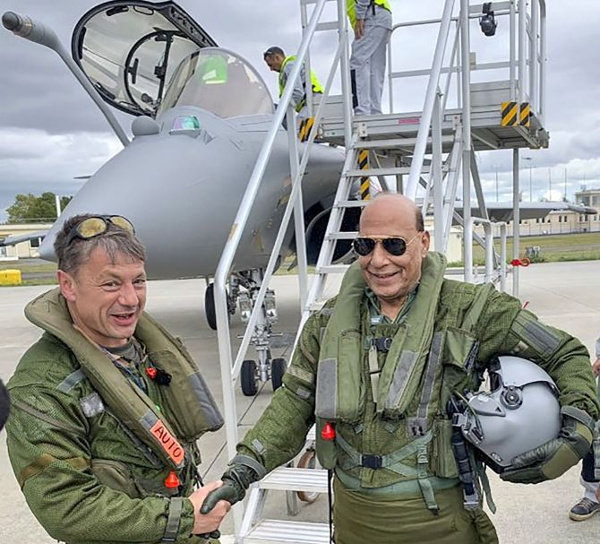
India’s proposed acquisition of 114 additional Rafale fighters is beginning to look like far more than another large aircraft purchase. If the programme proceeds along the industrial model now being negotiated with France, India could emerge as the second major global manufacturing base for the Rafale outside France, supported by complementary aerospace hubs in Nagpur and Hyderabad.
The distinction between the two locations is important.
Hyderabad already has a formally announced and confirmed Rafale fuselage-production programme involving Dassault Aviation and Tata Advanced Systems Limited (TASL). Nagpur, meanwhile, has an established Dassault industrial base through Dassault Reliance Aerospace Limited (DRAL) and has been reported as a potential location for the Indian Rafale Final Assembly Line, although the final industrial arrangement for the 114-aircraft programme has not yet been contractually fixed.
Together, however, the two centres reveal the scale of the manufacturing ecosystem Dassault is constructing in India.
Hyderabad: Complete Rafale Fuselages to Be Built in India
The most concrete part of the programme is already underway in Hyderabad.
On June 5, 2025, Dassault Aviation and Tata Advanced Systems signed four Production Transfer Agreements covering the manufacture of Rafale fuselage structures in India.
Dassault described it as the first time Rafale fuselages would be manufactured outside France.
Tata Advanced Systems is establishing a dedicated facility in Hyderabad that will manufacture virtually the entire structural body of the fighter.
The work packages include:
- lateral shells for the rear fuselage;
- the complete rear fuselage section;
- the central fuselage;
- and the front fuselage section.
The first sections are scheduled to emerge during FY2028, with the Hyderabad facility designed eventually to produce up to two complete Rafale fuselages every month.
That translates into potential structural production capacity for approximately 24 aircraft annually.
And these components are not intended solely for Indian Rafales.
Dassault explicitly said the programme would support India as well as other international Rafale customers, integrating Hyderabad into its global production network.
That is a significant distinction from conventional defence offsets.
India would effectively become a second source for one of the most important structural elements of every Rafale.
Nagpur: Dassault’s Existing Indian Industrial Base
About 425 kilometres away in Nagpur, another Dassault aerospace ecosystem has already been developing for years.
Dassault Reliance Aerospace Limited, located at the MIHAN aerospace complex, began production activities in 2020.
Dassault subsequently increased its holding in DRAL to 51%, giving the French aircraft manufacturer majority control of the venture.
Nagpur’s currently confirmed production programme is centred primarily on the Falcon family of business aircraft, not Rafale final assembly.
That distinction matters because some reports have incorrectly described the current Nagpur facility as an operational Rafale production line.
Dassault’s own latest material says Nagpur is being expanded into the company’s first Falcon Centre of Excellence outside France, producing forward fuselages for the Falcon 2000, Falcon 8X and Falcon 6X.
The infrastructure and workforce being created there, however, make Nagpur an obvious candidate for much more.
And that is where the proposed 114-Rafale programme enters the picture.
Nagpur Has Been Proposed as a Rafale Final Assembly Hub
In January 2026, defence reporting indicated that the proposed manufacturing plan for India’s 114 fighters envisaged a Rafale Final Assembly Line at the DRAL complex in Nagpur.
The proposed line was reportedly being planned for a capacity approaching 24 fighters annually and could ultimately support export orders as well as Indian requirements.
If implemented, this would represent an enormous technological leap.
Producing fuselage sections is advanced aerospace manufacturing.
But final assembly of a combat aircraft involves an entirely different level of industrial integration.
The facility would potentially have to bring together:
- fuselage structures;
- wings and control surfaces;
- landing gear;
- Safran M88 engines;
- hydraulic systems;
- electrical systems;
- flight-control systems;
- radar;
- electronic warfare equipment;
- avionics;
- cockpit systems;
- weapons interfaces;
- software;
- ground testing;
- and eventually flight acceptance.
A genuine Rafale Final Assembly Line would therefore turn India from a component supplier into a country capable of delivering complete Rafale fighters.
But the Nagpur FAL Is Not Yet a Signed Fact
There is an important development that has emerged during 2026.
By May, reporting on India’s final RFP said several locations were still being evaluated for the final assembly operation, including Nagpur, while Hyderabad was also being discussed because of its rapidly expanding aerospace infrastructure.
And the picture has shifted again with France’s latest proposal.
According to reporting published on August 7, 2026, Dassault has proposed partnering with the Tata Group for the Rafale Final Assembly Line in India as part of France’s formal response to India’s requirement for 114 aircraft.
The French proposal was reportedly received by India on July 29 and is now under evaluation.
That means it would be premature to state that India has definitively approved two complete Rafale assembly lines—one at Nagpur and another at Hyderabad.
It has not.
What is clearly emerging instead is a two-node Rafale industrial ecosystem, with Hyderabad already confirmed for fuselage manufacturing and the final assembly architecture still being negotiated.
Hyderabad Is Already a Rafale Production Line
This does not diminish Hyderabad’s importance.
In aerospace terminology, a production line does not necessarily mean a Final Assembly Line.
Hyderabad will manufacture complete major structural sections of Rafales.
That means the city will literally produce the central body around which the aircraft is constructed.
The front fuselage houses key portions of the cockpit and aircraft systems.
The central section must support enormous structural loads from the wings, engines and manoeuvring forces.
The rear fuselage integrates with the aircraft’s propulsion and empennage structures.
Manufacturing these sections requires extremely tight tolerances.
Errors measured in fractions of millimetres can become unacceptable when an aircraft is expected to fly faster than Mach 1.8 and withstand repeated high-g manoeuvres over thousands of flight hours.
This is high-end fighter-aircraft manufacturing.
Why Dassault Needs India
Dassault itself has a compelling reason to establish additional manufacturing capacity.
The Rafale has undergone one of the most dramatic export successes of any European fighter aircraft.
Dassault’s backlog stood at 220 Rafales at the end of 2025, including 175 export aircraft and 45 for France.
Orders have come from customers including Egypt, Qatar, India, Greece, Croatia, the United Arab Emirates, Indonesia and Serbia.
India has already acquired 36 Rafales for the Indian Air Force.
Another 26 Rafale Marine aircraft have been contracted for the Indian Navy.
Dassault therefore describes India as having already ordered 62 Rafales.
If the proposed additional 114-aircraft acquisition is completed, India’s overall Rafale commitment would rise to 176 aircraft.
At that scale, establishing a major Indian manufacturing base becomes economically much easier to justify.
The 114-Rafale Deal Changes Everything
France has now formally submitted its technical and commercial proposal for the 114-aircraft programme.
The estimated programme value is around ₹3.25 lakh crore, making it potentially one of the largest defence acquisitions in Indian history.
Large-scale local manufacturing is a central element of the offer.
The proposed aircraft are also expected to incorporate progressively increasing Indian content.
Recent reporting indicates that India is seeking at least 40% indigenous content during initial domestic production, eventually moving towards approximately 60% in later production batches.
This is substantially different from India’s original 36-aircraft Rafale purchase.
Those aircraft were manufactured in France.
The new programme could create an Indian industrial system capable of manufacturing substantial portions of the aircraft itself.
A Distributed Rafale Factory
The future Rafale manufacturing system should therefore not be imagined simply as one giant factory.
Modern aircraft production rarely works that way.
Instead, it resembles a geographically distributed industrial network.
Hyderabad could manufacture the fuselage.
Other Indian companies could manufacture structural components, electronics, mechanical systems and precision parts.
Safran-related work could cover propulsion and other systems.
Thales-related partnerships could progressively move avionics and electronics activity into India.
MBDA-related partnerships could expand missile and weapons manufacturing.
All these components would ultimately converge at the Final Assembly Line.
France’s latest industrial proposal reportedly envisages precisely such a structure.
Dassault would work with Tata, while other major French suppliers would establish relationships with Indian companies including Larsen & Toubro, Mahindra and HAL.
HAL Could Enter the Rafale Ecosystem Through Safran
Another particularly interesting element concerns Hindustan Aeronautics Limited.
France’s latest proposal reportedly envisages Safran working with HAL.
Safran produces the Rafale’s M88 turbofan engine.
The exact industrial scope of the proposed relationship has not yet been publicly disclosed, so it should not automatically be interpreted as complete Indian manufacture of the M88.
But bringing HAL into the Rafale supply chain could have benefits extending beyond the aircraft itself.
India and France are simultaneously exploring deeper cooperation in fighter-engine technology, an area directly relevant to India’s future Advanced Medium Combat Aircraft programme.
The Rafale acquisition could consequently become part of a much larger Indo-French aerospace relationship.
Hyderabad Gives India Something Even Before the 114-Jet Contract
One of the strongest aspects of the Hyderabad programme is that it is not entirely dependent upon India’s 114-aircraft contract.
Dassault and Tata agreed to create the fuselage facility as part of Dassault’s wider global supply-chain strategy.
Dassault CEO Éric Trappier described the arrangement as a dual production source for Rafale structures.
In other words, France will no longer necessarily remain the sole source of every Rafale fuselage.
India becomes the alternative.
That is strategically important for Dassault because global aerospace supply chains have repeatedly suffered disruption from shortages of materials, skilled workers and subcontractor bottlenecks.
An Indian production source provides redundancy.
For India, it creates something even more valuable—continuous manufacturing experience.
Indian engineers do not acquire expertise simply by assembling a limited number of aircraft under licence.
Expertise accumulates when factories repeatedly manufacture aerospace structures to international standards for global customers year after year.
That is the kind of ecosystem Hyderabad could create.
Nagpur Could Become the Place Where Those Structures Become Fighters
If Nagpur ultimately receives the Final Assembly Line, the relationship between the two cities could become particularly interesting.
A future Rafale could begin its structural life in Hyderabad.
Its major fuselage sections could then move through the Indian production network.
Components from other Indian aerospace suppliers could be incorporated.
The aircraft could finally reach Nagpur for integration, testing and delivery.
In that model:
Hyderabad builds the body.
Nagpur builds the aircraft.
That would represent one of the most sophisticated private-sector aerospace manufacturing chains ever established in India.
But the final location of the FAL still awaits confirmation under the current negotiations.
Dassault Is Already Preparing India for a Bigger Role
Dassault’s July 2026 statements provide another important clue.
Recent reporting on CEO Éric Trappier’s comments says Dassault is examining an Indian industrial scheme for the 114 Rafales extending “as far as aircraft flight.”
That wording is significant.
It suggests the proposed Indian manufacturing operation could encompass not only structures and assembly but potentially ground testing and flight testing of completed aircraft before delivery.
India would therefore no longer merely manufacture parts that are sent to France.
Completed Rafales could eventually emerge from an Indian production system.
India Could Become Dassault’s Second Global Manufacturing Pillar
That possibility is probably the most important aspect of the entire programme.
The 114 Rafales will eventually be delivered.
But factories can survive for decades.
Skills remain.
Supply chains expand.
Engineers trained on one programme move to the next.
Precision-machining companies learn aerospace standards.
Composite manufacturers improve.
Electronics companies qualify for military aviation.
Small suppliers become international suppliers.
This is how an aerospace industrial base develops.
Dassault itself increasingly describes India as part of its broader manufacturing strategy rather than merely as an export customer.
The company says its Indian network has expanded to more than 30 suppliers, with increasingly complicated manufacturing work being transferred into the country.
The Rafale Could Help Build the Aircraft That Eventually Replaces It
There is another long-term consequence.
India is developing Tejas Mk1A, Tejas Mk2, AMCA and eventually TEDBF.
A sophisticated Rafale manufacturing programme need not compete with those projects.
It can strengthen them.
Engineers trained to manufacture fighter fuselages can eventually work on Indian fighters.
Companies producing Rafale hydraulic components can bid for AMCA components.
Precision machining capability does not disappear when a Rafale contract ends.
Quality-control expertise transfers between programmes.
Advanced tooling can be reused.
Supply-chain managers learn how to maintain fighter-production cadence.
India’s real return from Rafale manufacturing could therefore extend far beyond the aircraft itself.
From Buying Rafales to Building a Rafale Ecosystem
India’s first Rafale acquisition was fundamentally an operational procurement.
Thirty-six fighters arrived from France and transformed several aspects of the Indian Air Force’s combat capability.
The proposed 114-aircraft programme could be very different.
It could become an industrial procurement as much as a military one.
Hyderabad is already being established as the first Rafale fuselage-production centre outside France.
Nagpur has become Dassault’s principal existing manufacturing footprint in India and has been reported as a potential Rafale Final Assembly Line location.
The newest French proposal appears to give Tata an even larger role in final assembly, meaning the precise geographic architecture remains under negotiation.
Therefore, it would be inaccurate today to say that two complete Rafale Final Assembly Lines have been approved at Nagpur and Hyderabad.
What India is actually building may ultimately be more important:
a distributed Rafale manufacturing ecosystem spanning multiple Indian aerospace hubs, capable of building structures, integrating systems, assembling aircraft and potentially supplying the worldwide Rafale fleet.
If the 114-fighter agreement is concluded with the level of localisation currently being discussed, the transformation will be profound.
For decades, Rafales were aircraft that India bought from France.
The next generation may contain fuselages made in Hyderabad, Indian-built components from across the country and—depending on the final industrial decision—fighters assembled and flown from an Indian production facility.
That would mark the point at which India stops being merely one of Dassault’s largest Rafale customers and begins becoming one of the pillars on which the global Rafale production programme itself depends.
Sources
Dassault Aviation confirmed the Tata-Hyderabad fuselage programme and its two-fuselage-per-month target. Dassault’s latest corporate material confirms Nagpur’s existing Falcon role and the expansion of its Indian industrial network. Earlier reporting placed the proposed Rafale Final Assembly Line at Nagpur, while later reporting shows the exact FAL arrangement remained under negotiation. France has now submitted its formal proposal for the 114-aircraft acquisition and large-scale Indian manufacturing.
You may also like
-
India’s Economic Warfare Challenge: Strategic Autonomy, Energy Security and the Rise of a Global Power
-
India-US Trade Deal Stalemate: Why Washington’s Tariff Pressure Has Failed to Secure an Agreement
-
US Double Standards in Foreign Policy: 16 Recent Cases Involving India, Russia, China and Global Trade
-
India’s Arctic Energy Ambitions: Russian Oil, LNG and a New Sea Route to Indian Ports
-
Indian Navy Vice Chief Inspects Japan’s Mogami-Class Stealth Frigate as India-Japan Shipbuilding Cooperation Expands
