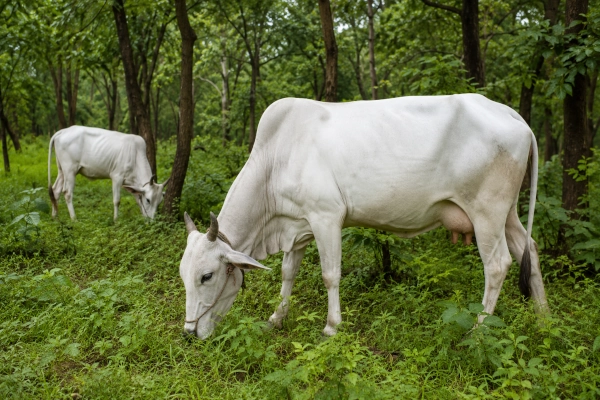
Among the great indigenous cattle breeds of northern India, the Hariana occupies a distinctive position as a genuinely dual-purpose breed—one in which the cow has traditionally been valued for milk while the bullock earned its reputation through hard agricultural and transport work.
The breed developed across the plains of Haryana, western Uttar Pradesh and adjoining Rajasthan, an area characterised historically by intensive cultivation, hot summers, seasonal scarcity of fodder and the need for animals capable of performing several functions within a farming household. ICAR’s National Bureau of Animal Genetic Resources officially records Haryana, Uttar Pradesh and Rajasthan as the home tract of Hariana cattle.
Rather than specialising exclusively in dairy production or draught power, the Hariana evolved around the requirements of the traditional north Indian farm. A family could obtain milk from its cows while raising strong males capable of ploughing fields, pulling carts and transporting agricultural produce.
That versatility made the breed an integral part of the rural economy long before tractors and mechanised transport transformed Indian agriculture.
The Heartland of the Hariana Breed
The principal breeding region of Hariana cattle lies in Haryana, particularly around Hisar, Rohtak, Sonipat, Gurugram, Jind and Jhajjar. NDDB identifies these districts as the breed’s core native tract.
From this centre, Hariana cattle historically spread into neighbouring regions of Rajasthan and western Uttar Pradesh.
This wider distribution was natural. The agricultural landscapes on either side of modern state boundaries share many common characteristics—hot summers, relatively dry conditions, extensive cereal cultivation and a long tradition of bullock-powered agriculture.
The result was a cattle population selected generation after generation not merely for appearance, but for usefulness under the farming conditions of the north Indian plains.
A Graceful White and Grey Indian Breed
Hariana cattle have a characteristic appearance that makes a good specimen relatively easy to recognise.
The predominant body colour is white or light grey. Adult bulls tend to develop darker grey pigmentation, particularly around the forequarters and hindquarters. The horns are generally small. Government breed descriptions also identify the Hariana’s characteristic coffin-shaped skull.
The overall build is proportionate and functional rather than excessively heavy.
Like other indigenous Bos indicus cattle, the Hariana possesses the characteristic hump and other physical features associated with Indian zebu cattle.
A well-bred animal gives an impression of alertness and balance—qualities particularly important in the males historically selected for field and road work.
The breed’s predominantly pale colour is also visually striking. A traditional pair of white or silver-grey Hariana bullocks pulling a wooden plough or bullock cart was once a familiar sight across large areas of northern India.
The Hariana Cow: Milk for the Farming Household
Hariana is officially classified as a milk-and-draught, or dual-purpose, breed rather than as a specialised high-yielding dairy breed.
According to NDDB breed data, Hariana cows have an average lactation yield of about 997 kg, with recorded yields ranging from approximately 693 kg to 1,745 kg per lactation.
Individual animals selected for superior genetics and provided with good feeding and management can perform considerably better. NDDB has documented, for example, a Hariana cow under a pedigree-selection programme in Haryana reaching a reported peak daily yield of around 12 litres during its third lactation.
Such examples illustrate an important point about indigenous cattle: the average of a breed does not necessarily represent the potential of its best genetic lines.
Systematic selection of superior cows and breeding them with high-genetic-merit bulls can gradually improve productivity while retaining the characteristics that make the breed suitable for its native environment.
The Bullock Was the Hariana’s Great Strength
If the cow supplied milk, historically it was the Hariana bullock that gave the breed much of its agricultural reputation.
Government breed descriptions specifically characterise Hariana bullocks as good draught animals, while agricultural references describe them as powerful working cattle.
Before widespread mechanisation, such animals represented agricultural power.
Bullocks were required to pull the plough through cultivated soil, operate traditional agricultural equipment, haul harvested crops, carry grain to markets and draw carts between villages.
A good pair had to combine strength with endurance and the ability to work for extended periods under the heat of northern India.
This explains why the breed cannot be evaluated simply by comparing the milk production of Hariana cows with modern specialised dairy animals. The Hariana emerged from an agricultural system in which the value of the male calf was substantial rather than incidental.
The farmer obtained milk from one generation while producing the draught power needed to cultivate the next crop.
A Cattle Breed Shaped by the North Indian Farm
The Hariana represents a type of livestock breeding closely connected to India’s traditional agricultural economy.
The animal had to perform within a system where crop cultivation and livestock keeping complemented each other.
Cattle consumed crop residues and locally available fodder. They supplied milk to households. Bullocks provided traction. Dung returned nutrients to fields and served numerous domestic agricultural purposes.
Consequently, a dual-purpose breed could contribute to several parts of the farm economy simultaneously.
This ecological relationship also explains why indigenous cattle genetics remain valuable even after mechanisation has reduced the demand for bullock power.
NDDB notes more generally that indigenous cattle have been shaped by local agro-climatic conditions and possess characteristics useful for functioning under India’s tropical environment and variable feed resources.
Mechanisation Changed the Economics of Hariana Cattle
The tractor fundamentally changed the role of breeds such as the Hariana.
For generations, the male calf of a strong draught breed had clear economic value. It could mature into a working bullock that performed agricultural labour for years.
As tractors, mechanised tillers and motor vehicles replaced animal traction, that economic role declined rapidly.
The change created a challenge for virtually every traditional dual-purpose Indian breed.
Where farmers once selected cattle simultaneously for milk and work, modern commercial dairying increasingly rewards milk production above almost everything else.
This creates pressure to replace or crossbreed indigenous populations with animals selected primarily for higher dairy output.
The long-term danger is the erosion of valuable native genetic resources that took centuries of farmer selection to develop.
Scientific Selection Offers a New Future
Rather than treating the Hariana as a relic of bullock-powered agriculture, India’s livestock breeding programmes have increasingly concentrated on genetic improvement within the breed itself.
Under the National Dairy Plan, the Haryana Livestock Development Board implemented a dedicated pedigree-selection programme for Hariana cattle. The programme involved milk recording, identification of superior females and the production of high-genetic-merit bulls for breeding.
The Hariana programme ultimately made 43 high-genetic-merit bulls available, demonstrating the scale at which systematic breed improvement was being attempted.
Hariana has also been included among the indigenous breeds supported under the Rashtriya Gokul Mission, which focuses on conservation, genetic improvement and enhanced productivity of India’s native bovine resources.
This approach is important because conservation does not have to mean maintaining animals unchanged in small protected herds.
A stronger conservation strategy can make an indigenous breed economically attractive to farmers, selecting its best genetic lines for improved milk production while maintaining its identity and adaptation.
Preserving the Pure Hariana Gene Pool
One concern confronting the breed has been indiscriminate crossbreeding.
NDDB documented how farmers participating in Hariana pedigree-selection areas had earlier faced difficulty obtaining semen from pure Hariana bulls, creating pressure to inseminate their cows with other breeds. The subsequent breeding programme sought to reverse this by providing semen from selected high-genetic-merit Hariana bulls.
This illustrates why conservation requires more than simply keeping a few animals in government farms.
Farmers must have access to reliable purebred semen, performance records, artificial-insemination services and economically attractive breeding stock.
The breed must continue reproducing within working rural herds if its genetic population is to remain viable over the long term.
Government farms also maintain pure Hariana populations for genetic improvement and conservation. The State Cattle Breeding Farm at Saraikela, for example, maintains Hariana cattle with the stated objective of preserving indigenous germplasm and producing improved breeding bulls.
Hariana in the Era of Indigenous Breed Revival
The renewed Indian focus on indigenous cattle gives the Hariana an opportunity to acquire a different economic role from the one it occupied a century ago.
Its future is unlikely to depend primarily upon returning bullocks to large-scale plough agriculture.
Instead, its importance can increasingly rest on selective dairy improvement, purebred breeding programmes, climate suitability and preservation of native genetic diversity.
Modern genomic selection, artificial insemination, embryo technologies and systematic milk recording make it possible to identify superior animals much more accurately than was possible under traditional breeding systems.
The objective need not be to transform Hariana into another breed altogether.
It can instead be to produce a better Hariana.
That means preserving the breed’s defining characteristics while steadily increasing the productivity of successive generations.
A Living Heritage of India’s Agricultural Civilisation
Hariana cattle are ultimately more than another entry in India’s catalogue of indigenous breeds.
They represent the agricultural history of the upper Indo-Gangetic and north-western plains, where livestock and cultivation evolved together over generations.
The white Hariana cow supplied the household with milk. Her male offspring could become the powerful bullock that ploughed the family’s land, transported its harvest and helped sustain the next agricultural season.
Few modern livestock systems ask a single breed to perform such different roles.
That is precisely what makes the Hariana significant.
It is a breed created not for a single industrial purpose, but for the complete economy of the traditional Indian farm.
Mechanisation may have reduced the importance of its bullocks, but it has not diminished the value of the genetic resource itself. With scientific selection, better dairy management and continued conservation, the Hariana can remain a productive part of modern Indian agriculture while preserving the characteristics developed across Haryana, Uttar Pradesh and Rajasthan over generations.
In that sense, the Hariana is both a cattle breed of India’s agricultural past and a genetic resource for its farming future.
References:
- National Bureau of Animal Genetic Resources (NBAGR) – Hariana Cattle Breed Profile
https://nbagr.res.in/cattle-breed - National Dairy Development Board (NDDB) – Hariana Breed Information
https://www.nddb.coop/hi/node/1316 - National Dairy Development Board (NDDB) – Indigenous Cattle Breeds and Genetic Improvement
https://www.nddb.coop/services/animalbreeding/geneticimprovement/breeds - National Dairy Development Board (NDDB) – Indigenous Breed Development under Hariana Pedigree Selection Project
https://www.nddb.coop/farmer/animal-breeding/stories/indigenous-breed-development-under-hariana-ps-project - National Dairy Development Board (NDDB) – Hariana Pedigree Selection Programme
https://www.nddb.coop/node/1067 - Department of Animal Husbandry, Government of Jharkhand – Indigenous Cattle Breeds / Hariana
https://animalhusbandry.jharkhand.gov.in/cattle-breeds/ - Department of Animal Husbandry, Government of Jharkhand – State Cattle Breeding Farm, Saraikela
https://animalhusbandry.jharkhand.gov.in/govt-cattle-farm-saraikela/ - Press Information Bureau, Government of India – Rashtriya Gokul Mission and Indigenous Breed Development
https://www.pib.gov.in/PressReleasePage.aspx?PRID=2241795
You may also like
-
Satpura Tiger Reserve’s Barasingha Population Crosses 300 as Madhya Pradesh Plans New Wildlife Corridors
-
Karnataka’s Tiger Population Could Cross 700 as New Census Builds on Official Count of 563
-
Project Cheetah Expands as Veerangana Durgavati Tiger Reserve Becomes Madhya Pradesh’s Third Cheetah Habitat
-
Kashmir Markhor Population Rises to 227 as Kazinag Conservation Efforts Show Results
-
ICAR-CIFRI Pushes Conservation of Indigenous Himalayan Fish for Biodiversity and Livelihood Security
