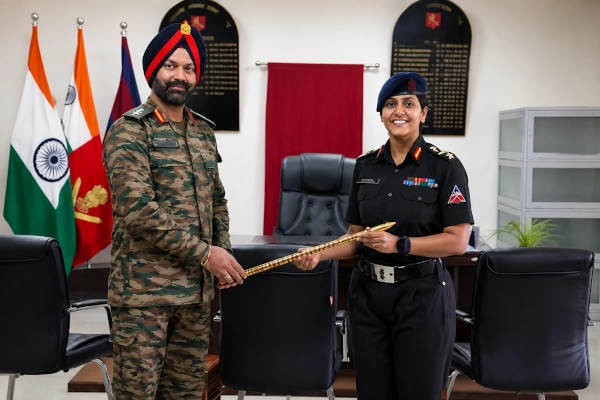
Colonel Sphurti Kulkarni has become the first woman officer to take command of 45 Task Force under Project Chetak of the Border Roads Organisation, marking an important milestone in the growing participation of women officers in operational and leadership appointments within India’s strategic infrastructure establishment.
She formally assumed command of the formation on July 30, 2026, taking responsibility for a task force involved in the construction, maintenance and strengthening of strategically important road infrastructure along India’s western frontier.
The 45 Task Force performs a critical role in maintaining road connectivity required for the movement of military personnel, equipment, logistics and supplies in sensitive border areas. Such formations also ensure that vital routes remain operational in demanding terrain and climatic conditions, where infrastructure reliability can directly influence military mobility and operational readiness.
As commanding officer, Colonel Kulkarni will be responsible for overseeing engineering projects, road construction and maintenance operations, manpower deployment, logistics and coordination with military as well as civil authorities. Her role will also involve ensuring that strategically important infrastructure projects are completed within operational timelines and that existing road networks remain serviceable throughout the year.
The significance of the appointment extends beyond the command itself. Border infrastructure formations frequently operate in remote and difficult locations where officers and personnel must deal with extreme weather, logistical constraints, difficult terrain and demanding construction conditions. Commanding such a formation therefore requires a combination of engineering expertise, leadership ability, administrative experience and operational awareness.
Project Chetak is one of the Border Roads Organisation’s major infrastructure projects supporting connectivity in western India. Its work contributes to the development and maintenance of roads that provide access to strategically important areas and forward locations.
The strategic importance of such roads has increased considerably as modern military operations demand the rapid movement of troops, artillery, armoured vehicles, ammunition, fuel and other essential supplies. High-quality border roads can significantly reduce mobilisation time while giving the armed forces greater flexibility in responding to operational requirements.
BRO infrastructure also serves a wider developmental purpose. Roads constructed and maintained in remote border regions frequently provide civilian populations with improved access to healthcare facilities, educational institutions, markets and administrative centres. Infrastructure originally developed to meet strategic requirements can therefore become an important economic and social lifeline for isolated communities.
Colonel Kulkarni’s appointment reflects the steadily expanding role of women officers within the Border Roads Organisation. Women are increasingly taking responsibility for field formations, complex engineering assignments and infrastructure projects in some of the country’s most challenging regions.
Such appointments demonstrate a broader transition from women officers being represented primarily in supporting roles towards assuming direct responsibility for demanding field commands. In the BRO, this can mean leading large teams of engineers, supervisors, construction workers and support personnel deployed across multiple project locations.
The appointment also highlights the organisation’s increasing emphasis on professional capability and experience in determining leadership responsibilities. Command of a task force brings accountability not only for construction targets but also for personnel management, equipment availability, safety, logistics and the operational readiness of critical infrastructure.
For the 45 Task Force, the immediate mission remains unchanged: maintaining and enhancing strategic mobility along India’s western frontier. Under Colonel Kulkarni’s leadership, the formation will continue working on the construction, improvement and upkeep of roads necessary for both military requirements and regional connectivity.
The importance of the BRO has grown as India accelerates the development of roads, bridges, tunnels and other infrastructure in frontier regions. Better connectivity allows troops and equipment to reach forward areas more rapidly while simultaneously reducing the isolation of border communities.
Colonel Sphurti Kulkarni’s elevation is therefore significant both institutionally and operationally. It places a woman officer at the head of a strategically important field formation while reinforcing the widening opportunities available to women officers in demanding command positions.
Her assumption of command of the 45 Task Force under Project Chetak represents another step in the evolution of leadership within the Border Roads Organisation and underscores the increasing contribution of women officers to India’s strategic connectivity, infrastructure development and national security.
The milestone also reflects the spirit embodied in the BRO motto, “Shramena Sarvam Sadhyam” — everything is achievable through hard work.
You may also like
-
Indian Navy Vice Chief Inspects Japan’s Mogami-Class Stealth Frigate as India-Japan Shipbuilding Cooperation Expands
-
Philippine Marine Wargames Reportedly Show BrahMos Can Penetrate Chinese Destroyer Air Defences
-
Safran Signs 18 Agreements with Indian Aerospace Suppliers, Expanding Make in India Manufacturing Partnerships
-
Indian Army’s Vajra Corps Certifies First Batch of Drone Operators, Strengthens Battlefield Surveillance
-
India to Seek 35% Increase in Defence Modernisation Budget for FY 2027–28
